
Business communication solutions: what they are and how to choose one
What business communication solutions really are, the features worth paying for, and how to pick a European Union hosted, GDPR ready partner.

Most companies never set out to buy "business communication solutions". They set out to stop a small change from turning into a support ticket. Add a user, forward a number, open a second office, wire the phones into Microsoft Teams, and a five minute job becomes a two week project.
That's the real starting point, and it quietly changes what you should be shopping for. The visible features still matter: auto attendants, call queues, a softphone, a mobile app, a link to your customer records. But they're no longer what decides a good system. What decides it now is where your data lives, how you stay compliant with the General Data Protection Regulation, how ready you are for voice AI, and how much you can run yourself without phoning a supplier. A communication system stopped being "just the phones" a while ago. It's infrastructure that touches your business data, your recordings, and your logs.
This guide is written for the person doing that evaluation. What these solutions actually are, which features earn their place, what you get beyond the handset, how to weigh a partner, and how to move across without a painful cutover.
What business communication solutions actually are
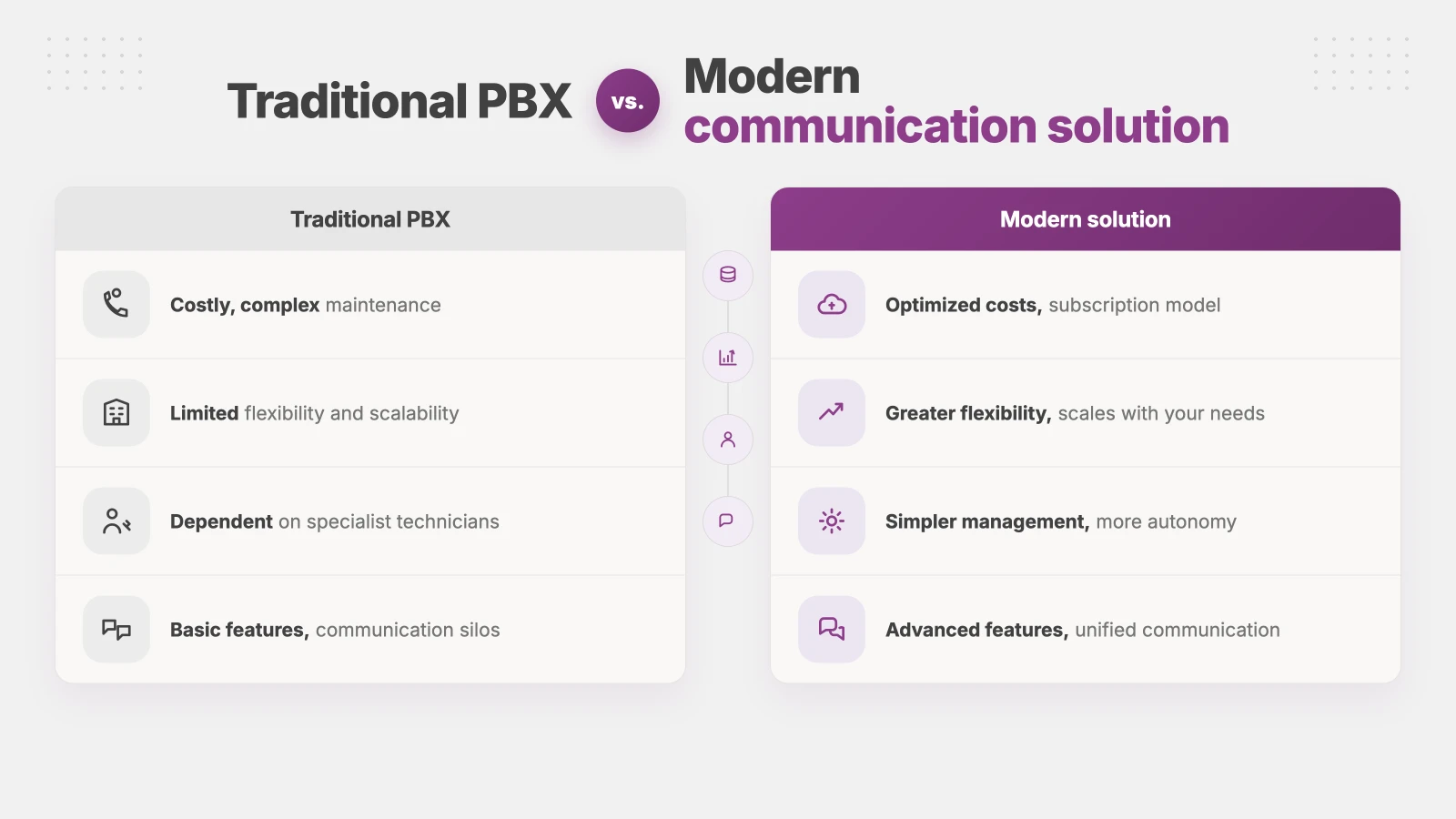
A modern business communication solution replaces the logic of a hardware phone switch with hosted software. With a traditional on-premise PBX you're tied to physical kit: cards, gateways, a mix of handsets, and a chain of technical work behind every change. That's fine while the organisation sits still. The moment you have to absorb remote work, pull several sites together, or connect the phones to your business tools, it starts to creak.
Two terms come up constantly here, so it's worth being plain. Cloud PBX is your phone system delivered as a hosted service instead of a box in a cupboard. Unified communications as a service (UCaaS) is the wider bundle: calling plus messaging, video, and presence, all run the same way. Most of the "business communication solutions" you'll compare are one or the other, and often both.
From phone switch to software
The shift isn't only technical. It changes how your IT people spend their week. Instead of nursing local hardware, they manage users, routing rules, call groups, opening hours, queues, and access rights from one screen.
Telephony becomes one app among many. It talks to Microsoft Teams, to a customer relationship management tool, to your enterprise resource planning system, to web apps and phones in people's pockets. That connection is the line between real modernisation and simply renting someone else's cupboard for the same old switch.
An infrastructure you can actually read
Routing a call is the easy part. The value now is in making your communications legible, in reading them like data. An IT director doesn't just want to hear the phones ring. They want to see which queues are drowning, spot the pressure hours, change how calls are greeted, and hand real day to day control to the teams who own those calls. A well built platform turns communications into something you can measure and adjust.
A few signs you're looking at a current platform and not a repainted old one:
Central administration for users, extensions, and call flows, in one place
Multi device access across web, desktop, and mobile, on the same number
Real integration with your other systems, not a silo that pretends to talk to them
Live control through dashboards and call history, not a monthly export
Headroom to add a site or reorganise without a rebuild
The features that matter
The useful features aren't the ones that fill a comparison grid. They're the ones that lower risk, cut daily friction, and let the phones sit properly inside the rest of your systems.
Securing the traffic without making life harder
On an internet protocol network, security starts by separating the signalling from the audio. In plain terms, the control traffic that sets a call up travels one way and the voice itself travels another, and each gets its own protection. Session initiation protocol over transport layer security guards the signalling. Secure real time protocol, or a browser using WebRTC, guards the audio. That split is what keeps a call from being casually intercepted.

For a business leader it reduces to one idea. A call shouldn't only connect. It should travel cleanly, on protected channels, in an architecture someone can actually explain to you.
| Building block | What it protects | What that buys you |
|---|---|---|
| Session initiation protocol over transport layer security | The signalling (call setup) | The control traffic isn't exposed in the open |
| Secure real time protocol | The audio | The conversation itself is much harder to intercept |
| WebRTC | Calling from a browser | No hard dependence on a physical desk phone |
WebRTC and real mobility
The point of WebRTC isn't that it looks modern. It's flexibility. Someone can take a call in a browser tab with nothing heavy installed on their machine. For teams spread across locations, for a pop-up desk, for an integrator who has to deploy fast, that's a concrete win, not a slide.
Where it earns its keep: a person keeps the same extension whether they're at their desk, on a laptop, or on their phone. A new site opens without reconfiguring local telephony first. And when the internet at one desk dies, the call can move to web or mobile instead of dropping. The trap is treating the browser client as a way to copy every habit of the old switch, or stacking yet another tool on top instead of centralising the management. And none of it saves you from doing the boring work on network quality and access policy.
Interfaces and business integrations
A communication solution earns its place when it talks to the rest of your stack. Native links to Microsoft Teams or Odoo pay off the day you switch them on. Beyond those, application programming interfaces and computer telephony integration handle the time sinks: popping the right customer record on an inbound call, click to call, logging calls automatically, syncing presence, kicking off a workflow.
The catch is always the same. An advertised integration is only worth something if the documentation is usable, the permissions are clear, and the logs let you diagnose an incident yourself instead of opening a ticket every single time.
If your IT team still has to open a ticket for every routine change, whatever you bought hasn't modernised anything. It's just moved the same friction to a new address.
What you get beyond telephony
For a small or mid sized business, the gain isn't a longer feature list. It's a shorter gap between "we need this" and "it's live". Opening a site, moving numbers around, absorbing a seasonal peak, splitting call flows between subsidiaries. In a well designed setup those are configuration and admin rules, not a van full of engineers. The benefit shows up exactly when the business is changing fast, which is precisely when the old switch used to make you wait.
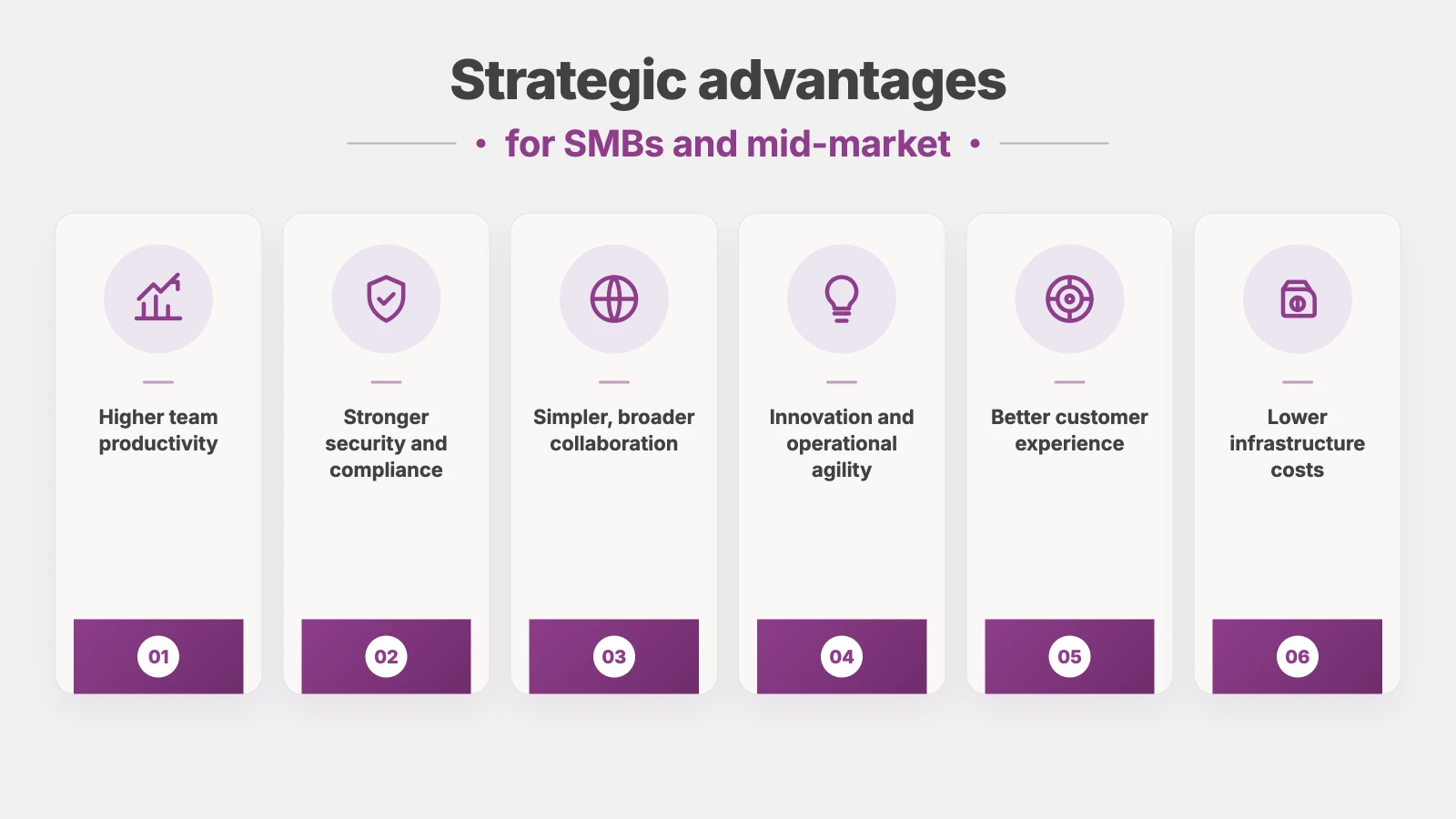
The change people feel most, though, is control. A good business communication solution lets your own team handle the routine: creating a call queue, changing a schedule, adjusting rights, opening an account, applying a recording policy. If every small change still routes back to a supplier, the cloud model hasn't kept its promise. That autonomy doesn't push the integrator out. It moves them up to where they're worth paying for: architecture, security, interconnection, supervision, and migration. A centrally administered European cloud PBX fits a reseller's logic neatly, with hosting inside the European Union and a setup an IT team can read.
Sovereignty as a selection criterion
The bigger subject sits underneath all of this, and it's not audio quality or the length of the feature list. An IT director has to know where the signalling data, the recordings, the logs, and the metadata actually live. Who can reach them, under what right, and with what trail left behind.
For a lot of small and mid sized companies this turns decisive the moment there are sensitive conversations, sector rules, or voice AI in the picture. The General Data Protection Regulation today. The European Union's Artificial Intelligence Act tomorrow. Choosing a communication solution is a data governance decision, not just a piece of user tooling.
A credible architecture has to do three things. Host and process the data inside a clear European framework. Give the company and its integrator genuine visibility into the settings and the logs. And leave room for transcription, assistance, and voice analysis to arrive later without opening a legal blind spot.
How to choose the right partner
A good choice isn't won on a smooth sales demo. It's won on whether the supplier keeps you autonomous, documents their interfaces, and stays readable when your needs change. A short set of questions does most of the filtering:
Where is the data hosted? The provider should name where calls, recordings, and metadata live, without hedging.
Who administers what? Admin rights should be granular and legible, not all-or-nothing.
Are the interfaces documented? An integrator needs usable documentation, not a promise of openness.
Is support direct or handed off? You need to know who picks up a complex incident, and how fast.
Can you leave? Getting your data and your numbers back out should be on the table before you sign, not after.
What an integrator should test before signing
A serious platform gets tested on real cases, not one inbound call and two extensions. Set up users, queues, schedules, and rights yourself and see how fast it goes. Connect it to Teams, a customer relationship tool, or an internal app and see whether the integration is real. Check that activity and event logs actually tell you what happened. Push the support path with a hard question. And confirm you can recover your useful data and your numbers if you walk away. A credible partner welcomes that scrutiny. One that keeps steering you back to the sales story and dodges the operational questions is telling you something.
Use cases by sector
Needs shift from one line of work to the next, and an effective solution adapts less through its feature list than through the quality of its configuration, its integrations, and its compliance framework.
In healthcare, the problem was never "having a line". It's getting the right call to the right team at the right moment without breaking continuity of care: on-call, reception, admissions, families, internal coordination. A rigid system becomes friction fast. Time based routing separates reception, on-call, and emergency cover. Per service queues cut out constant manual transfers. And operational traceability shows where things saturate. Here, hosting and security are first order criteria, and the rules on recordings, logs, and admin access have to be settled up front.

A hotel doesn't work its switchboard like a services firm. It's juggling reception, bookings, outside callers, sometimes several properties, and demand that swings with the season. What it needs is smoothness: telephony wired to the existing property management system, queues built by call type, and a welcome that stays coherent as the team rotates through day, evening, and weekend. Value comes from the quality of the design, not from premium extras. An overloaded voice menu or a vague transfer does more damage than a simpler system that's run properly.
In a council or a local public service, the stake is receiving the public. Most calls are simple requests, but they arrive in tight windows, and poor routing bounces the caller from desk to desk. A well planned architecture gives clear queues by department, plain voice menus without a needless tree, continuity through internal reorganisation, and a framework that's easier to defend on sovereignty grounds. The sensitive point in the public sector is governance: who writes the rules, who approves access, who signs off a change. Without that discipline, even a good platform ends up reproducing the old mess.
Preparing the migration and judging the return
On the day of the switchover, the phone system forgives nothing. If a main number doesn't port in time, if the auto attendant sends calls to the wrong groups, or if reception hasn't understood the new setup, the failure is instantly visible to customers, suppliers, and your own management. Treat the move like a critical operations project, framed technically, administratively, and around compliance.
The starting point isn't the platform. It's the reality you already run. Most companies have quietly accumulated implicit telephony rules: forwards set up years ago, direct numbers still live for services that no longer exist, shared handsets, different hours per site, half finished Teams or CRM integrations. Migrate on top of an incomplete inventory and the cloud doesn't simplify anything. It relocates the mess. A sensible order of work:
Map what exists. Numbers, direct dial ranges, groups, forwards, queues, schedules, special handsets, and the critical inbound and outbound flows.
Clean up the scenarios. A migration is the right moment to kill historical exceptions, contradictory rules, and routings no one can justify any more.
Start number portability early. Contracts, carrier records, line holders, service addresses, and target dates all want checking from day one. This is where schedules usually slip.
Test the real usage. Reception, overflow, supervision, mobility, outbound calls, softphone, answering on a mobile, record pop, and recording where it's permitted.
Train users and administrators separately. Users need a handful of simple gestures. IT and integrators need real control over rights, queues, access policy, and logs.
Plan the cutover and the way back. Set the go live window, the escalation contacts, the post migration tests, and the exact conditions for rolling back.
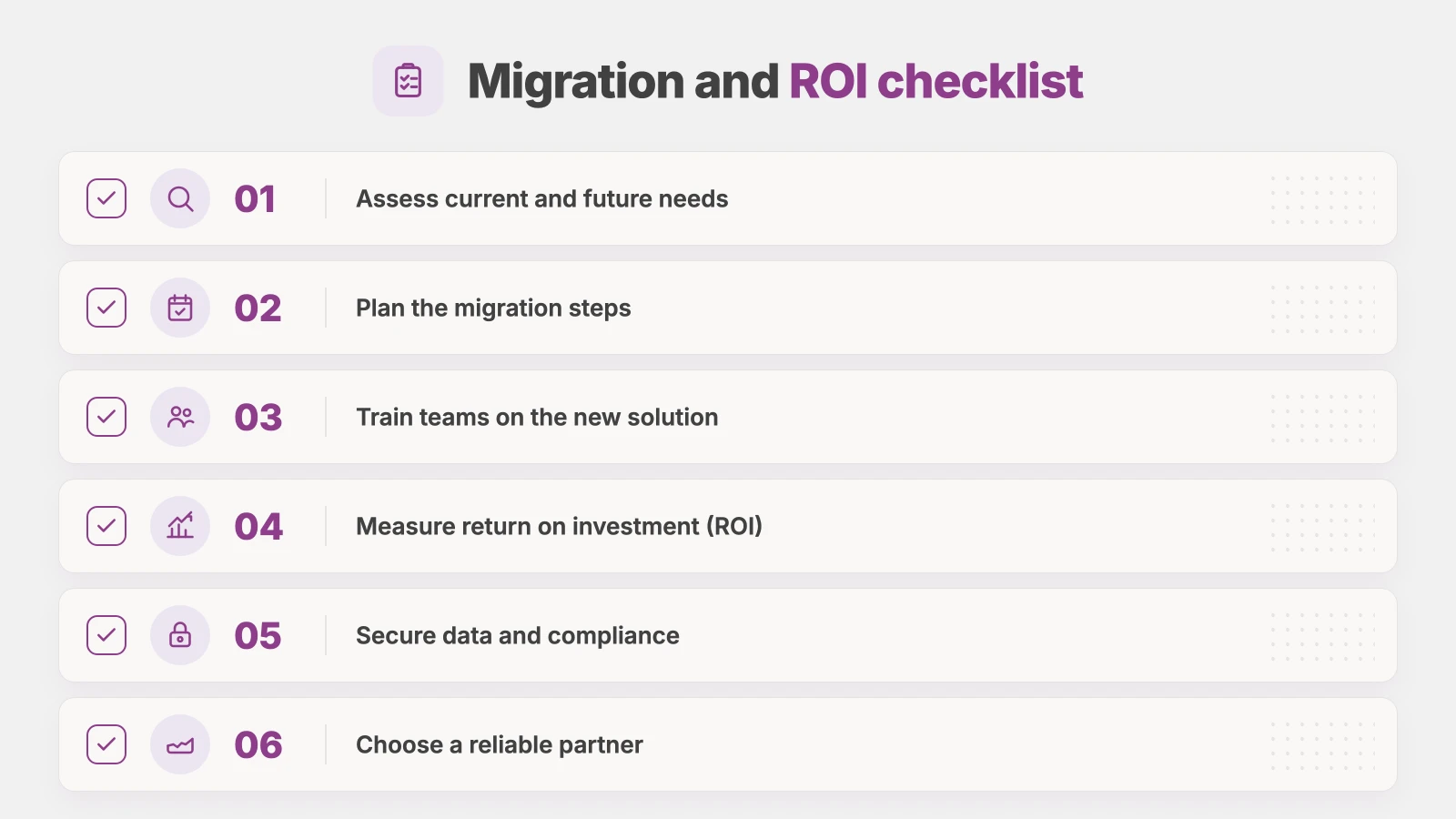
That acceptance test has to run concrete scenarios, not a technical tick sheet. A call to reception. A transfer to a second site. Overflow at peak hour. The internet dropping at one desk. Someone leaving and a replacement arriving. Those are the moments that actually break.
Judging the return without stopping at the licence price
The return on a business communication solution is settled in operations, not on the monthly invoice. Four blocks usually matter more than the sticker.
First, the costs you remove: maintaining the old PBX, lines that no longer fit, call-outs for changes you could have made yourself, time spent untangling badly documented routing. Second, the IT time you get back: central, web based administration cuts low value work and speeds up the routine changes. Third, and this one gets underrated, the business teams: clean routing, mobile tools that are set up properly, and real system integration mean fewer lost calls, less double entry, and fewer delays. Fourth, and decisive for many IT directors: compliance, sovereignty, and how dependent you are on the vendor. European Union hosting, a clear logging policy, permission management, recording governance, and readiness for whatever AI obligations land on transcription and assistance features. On that last point, a solution with fewer features but better governance can be worth more than a broad platform you can't control.
Integrators do the same sum. An offer that looks profitable on paper loses its shine fast if every change needs vendor support, if admin roles are boxed in, or if the data you need for an audit stays opaque. Operational autonomy weighs as much as voice quality. A well prepared migration improves continuity of service, cuts the administrative load, and strengthens compliance, and that combination is what justifies the spend.
Voxbi is a cloud PBX built for European companies and the partners who deploy for them: hosted in the European Union, administered like software rather than maintained like hardware, and designed so IT teams and integrators keep real control of their data. If you're weighing a business communication solution against the points in this guide, from delegated administration to system integration and data governance, it's a straightforward place to start. Talk to the team or a certified Voxbi partner at hello@voxbi.com.