
The month-end spreadsheet
Hours get typed in from memory and emails, then fixed by hand before payroll. Nobody quite trusts the total.
Tempus is the time and attendance module of Voxbi. When someone sets their status to working, in a meeting or at lunch, Voxbi routes their calls and Tempus logs the time. It also handles leave, shifts and overtime.
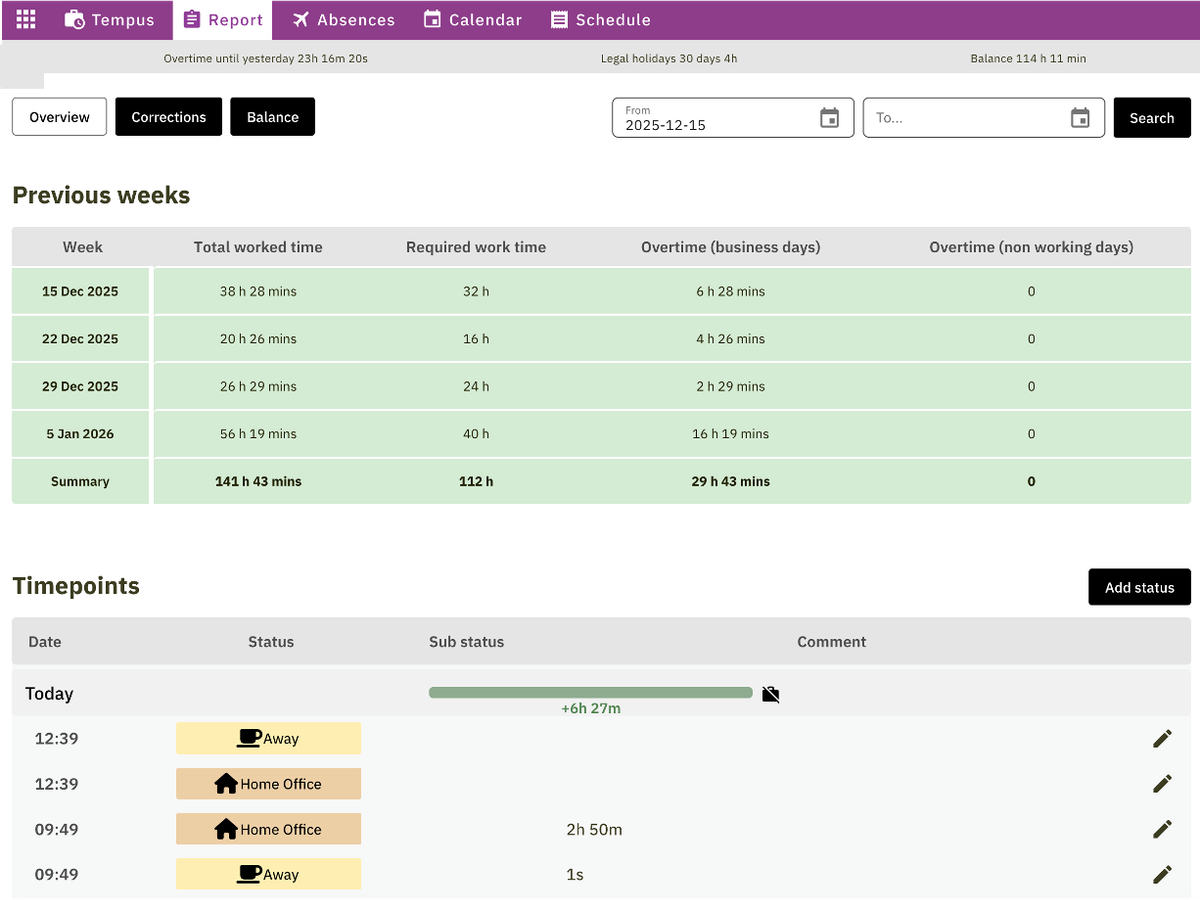
Hours get typed in from memory and emails, then fixed by hand before payroll. Nobody quite trusts the total.
The time clock says someone left an hour ago. The phone system still shows them as available, so calls ring at an empty desk.
Staff who live in France, Belgium or Germany can only work so many days outside Luxembourg before their tax changes. Without a record, you're guessing.
In the Voxbi app on a computer or phone, or through their calendar while they are in a meeting.
Each status has its own call rules. Calls ring as normal, go to voicemail with a greeting that fits, or move to a colleague or a mobile.
The same status counts as paid work, a lunch break or an absence. By the end of the day the entries add up to the hours on the report.
They approve leave and corrections, see worked hours against the target, and download the report for payroll or an inspection.
HR usually ends up chasing the hours: timesheets that arrive late, holiday requests buried in email, overtime added up by hand before payroll. With Tempus the people doing the work fill in the record as they go.
Hours build up from the statuses people set during the day. When the month ends, the report is already there.
Leave, home office days and corrections go to the right approver, and each answer stays on the record.
The start, end and length of every working day, plus overtime, in a report you can export the same day.
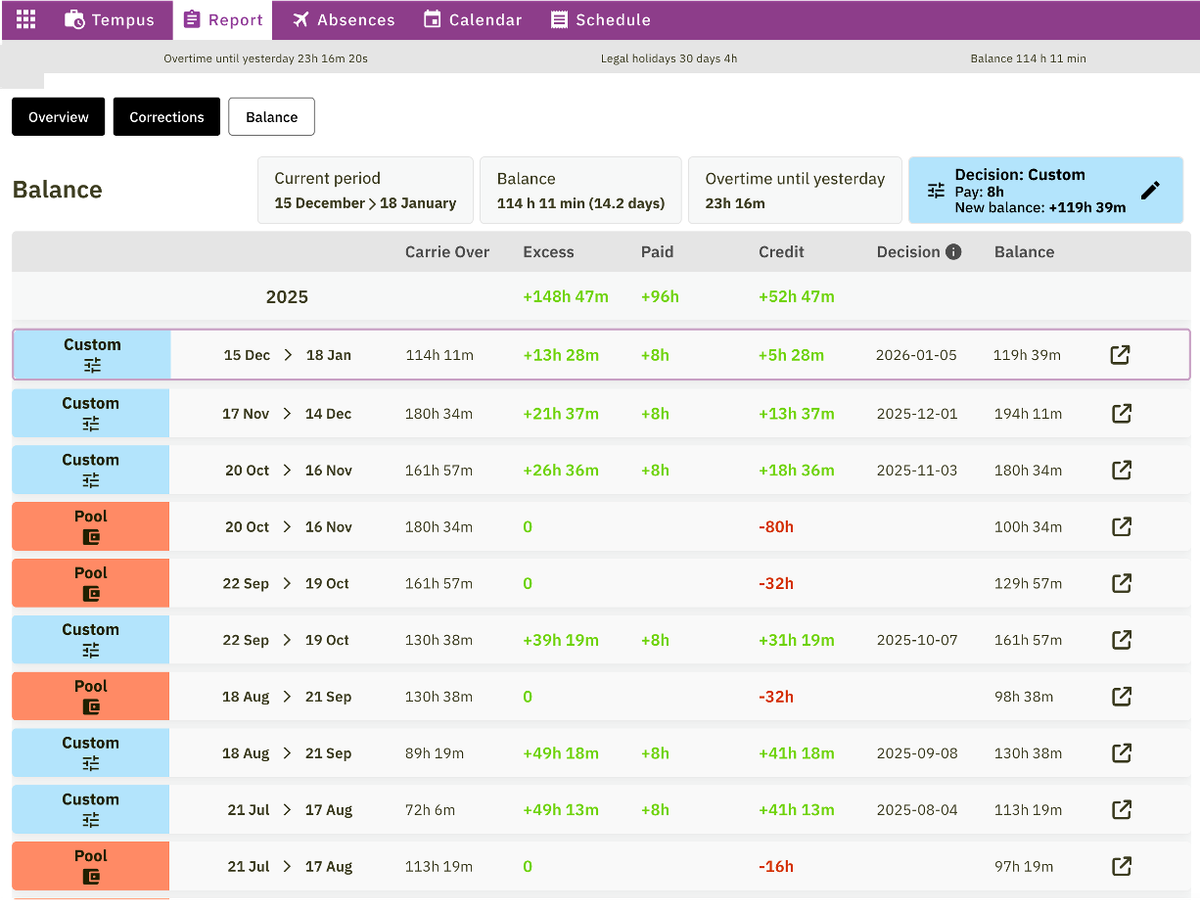
Staff see their own balance, and every pay-out or credit decision is written down, so the numbers hold no surprises.
The report puts worked hours next to required hours, keeps overtime on working days apart from overtime on days off, and lists every status change with its time.
Staff ask for a holiday or a home office day and it goes to the right approvers, up to three levels. Everyone can see their balance and where each request stands.
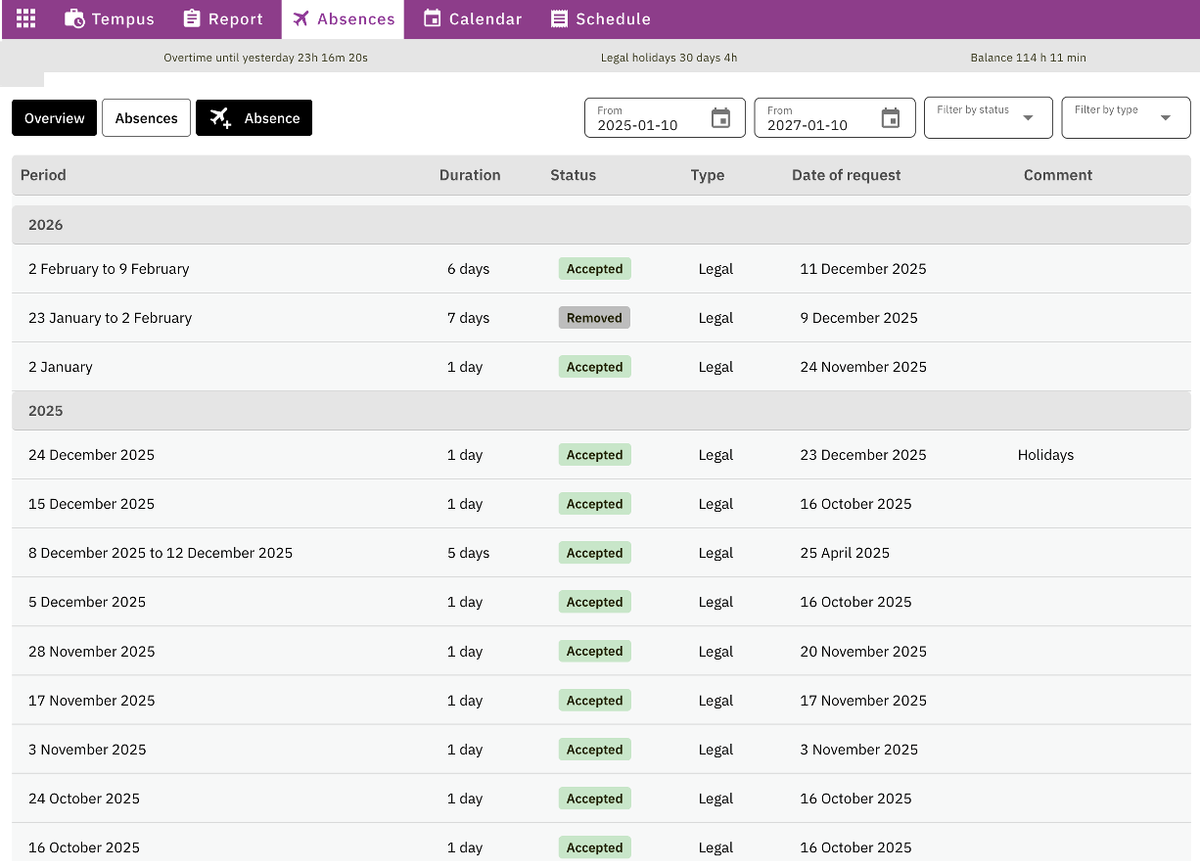
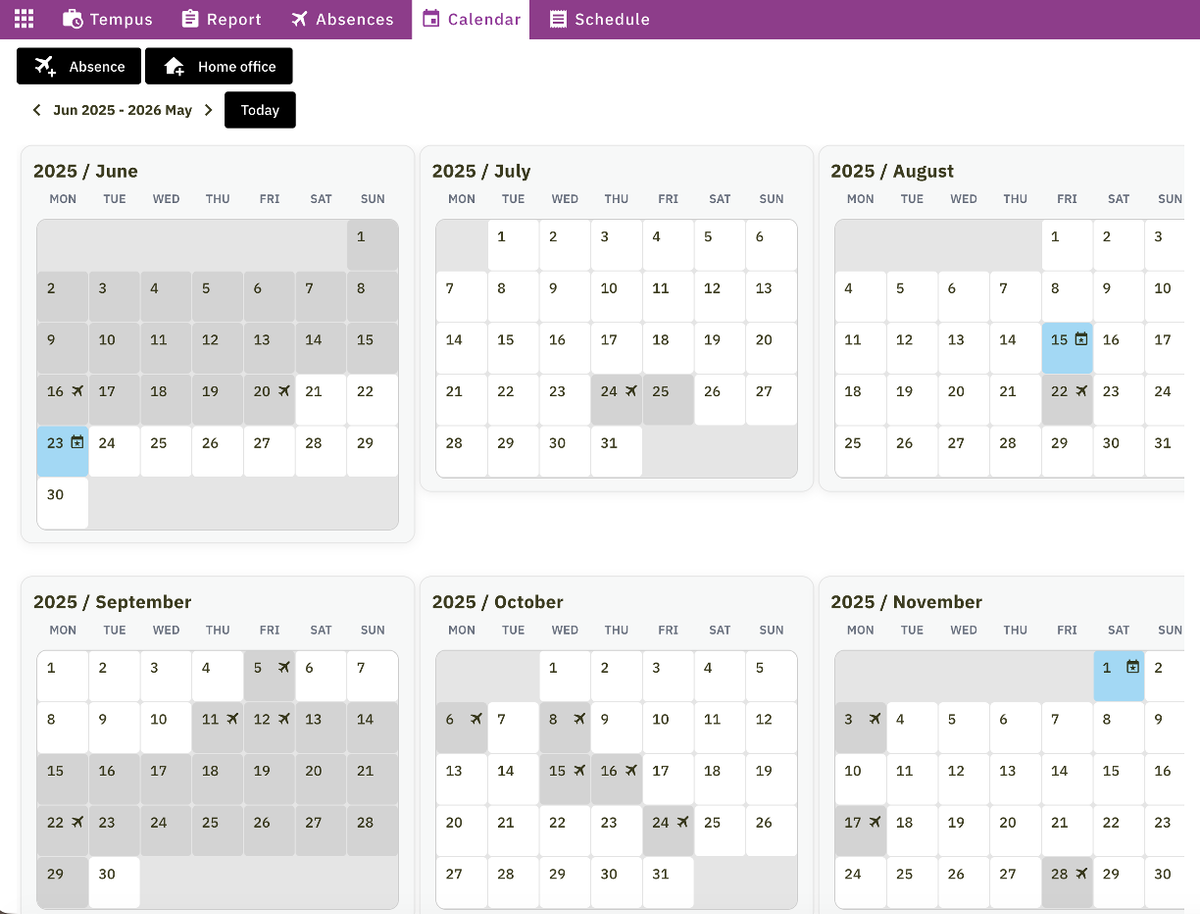
The calendar shows every absence and home office day across twelve months. A new request starts right there.
At the end of each period you choose what happens to the extra hours: pay them out, add them to the balance, or split them. Each decision stays on the record.
Since a 2019 ruling by the EU Court of Justice, employers have to record how long each person works every day. In Luxembourg the labour code asks for the start, end and length of every working day, and the labour inspectorate (ITM) can ask to see that record. Belgium, Germany, France and the Netherlands each have their own version.
Tempus keeps the record without a second system. The hours come from the statuses people already set for their calls, and every report can be exported. The fines, the rules for cross-border staff and the roles the law leaves out are in the questions below.
Working hours, absences and locations are personal data, and sick leave is more sensitive still. Tempus is part of Voxbi, built and hosted in the European Union by a Luxembourg telecom operator.
Security groups decide who can see and approve what, so a manager works only with the teams assigned to them.
Country tracking is optional, and staff clock in with a status, a badge or a PIN. Tempus never uses fingerprints.
Start and end the day from the Voxbi app on desktop or mobile, or on the web. Breaks, overtime and flexible hours are counted too.
Worked hours against required hours, week by week, with overtime split out. Download a report for payroll or for an inspection.
Managers build weekly or monthly schedules and assign shifts by availability, role or site. A published shift shows up in the employee's calendar.
Holidays, sick leave and home office days, each with its own balance and approvers. Luxembourg public holidays can be filled in for you.
Forgot to clock out? Staff ask to add, change or remove an entry and give the reason. A manager accepts or refuses it.
The app can note where each status change happened, so you can count the days someone worked outside Luxembourg. It's optional.
A meeting in Outlook sets the matching status, so calls and hours follow the calendar.
Approved absences and published shifts are written to Google Calendar, and a meeting there sets the status.
When the shift ends or the holiday starts, work calls stop reaching that person. Luxembourg employers must have a policy for this.
For staff with no desk computer and no company phone, such as on a shop floor or in a warehouse. They clock in with an RFID card or a PIN. We supply the tablet through our local partner.
If you run payroll in salary.lu, Tempus sends it the worked time, overtime included, so nobody types the hours in again.
Tempus is included in the Voxbi Managed Business and Enterprise plans. The custom status changer it builds on is included from Professional up. If you're on Voxbi One and want time tracking, ask us.
No. People clock in through their status in the Voxbi app, on a computer or a phone. A badge tablet is an optional extra for staff who have neither.
In most of the European Union, yes. In May 2019 the EU Court of Justice ruled that employers must measure each worker's daily working time with a system that is objective, reliable and accessible (case C-55/18). Each country applies it through its own law, and not all of them have passed one yet. None of these rules tells you which system to use. The questions below cover Luxembourg, Belgium, Germany, France and the Netherlands.
Article L.211-29 asks employers to record the start, end and length of every working day, plus overtime and hours worked on Sundays, public holidays and at night. The ITM can ask to see that register, and a breach of the working-time rules costs between 251 and 15,000 euros. Some roles fall outside these rules, such as senior executives, so check your own case with your adviser. This is a summary, not legal advice.
Belgium has no general duty to record working time yet. Today it applies only in specific cases, such as part-time staff who work outside their set schedule and staff on flexible hours. The government announced in November 2025 that recording will become mandatory for all employers from 1 January 2027, but as of October 2026 the law has not been voted.
Since a Federal Labour Court ruling of 13 September 2022, German employers have to record their staff's working time. The Working Hours Act already asked for a record of every hour worked beyond eight a day, kept for at least two years. Neither rule says the system has to be electronic. A draft law that would require electronic recording was published in June 2026 and has not been passed.
When staff in a team do not all work the same posted schedule, the French labour code asks the employer to record each person's hours every day, by any means: either the start and end of each working period or the number of hours worked, plus a weekly total. For staff on one collective schedule, the posted schedule does that job.
The Working Hours Act asks every employer to keep a sound record of working and rest times that the Labour Inspectorate can check. The record has to show when people worked, including start and end times, and you keep it for at least 52 weeks.
Tempus records the start, end and length of each working day, plus overtime and absences, and you can export the report when the ITM asks for it. The register is still your responsibility as the employer.
Someone who lives in France, Belgium or Germany keeps paying tax only in Luxembourg as long as they work no more than 34 days a year outside it. Past that limit the normal tax treaty rules apply to every day worked abroad, not only the extra ones. For social security, an EU agreement in force since July 2023 lets them stay in the Luxembourg system while telework is under half their working time. Tempus can record the country of each status change to help you count.
Location is personal data under GDPR, so use it only for a clear purpose, such as counting the days cross-border staff work outside Luxembourg, and tell your team before you switch it on. It's optional, and you decide whether it goes into the reports.
Tempus is hosted in the European Union as part of Voxbi. Security groups set who can see and approve each team's hours and absences, location is only recorded if you switch country tracking on, and no biometric data is used. As the employer you stay responsible for the data: tell staff what you record and why, and decide how long you keep it.
Yes. They ask for a correction from the report and say why, and a manager accepts or refuses it.
Download the report of worked time, overtime included, and import it into your payroll software. If you use salary.lu, there is an optional connection for it.
Where Tempus fits in the platform, next to presence, call flows and the Odoo integration.
How a meeting in Microsoft 365 sets the status, and how that status decides where calls go.
Set business hours, public holidays and company closures once, and calls follow them.
How an away or holiday status stops office calls from reaching a personal mobile.
We'll show you Tempus, from clocking in to the monthly report, and tell you which Voxbi Managed plan fits your team.