
Aircall alternatives: 10 European cloud phone systems compared
Ten Aircall alternatives compared on hosting location, administration, integrations and price model, with how Aircall's own pricing plans are structured.

Most shortlists of Aircall alternatives are built on price per user, the length of the integration list and the number of countries covered. That's enough for a twelve-person sales team. It leaves gaps for a company replacing an on-premises PBX, for a clinic, for a local authority, and for an integrator who administers several sites from one console. This comparison is written for the IT managers and integrators who own that decision.
A choice that holds up puts several things on the same level: telephony features, where calls and recordings are hosted, GDPR guarantees, the deployment model, day-to-day administration, links to Microsoft Teams, Odoo, a REST API and TAPI computer telephony integration, number portability, the price model, and local support. Artificial intelligence deserves a separate line of analysis. It helps with transcription, summaries and quality review, and it remains a supporting feature rather than the category a cloud PBX is bought in.
Voxbi belongs on the list when data sovereignty, direct administration and Microsoft Teams or Odoo connections come first. The ten platforms below are ranked by how much control they hand to the buyer, how they're architected, and which organisations they suit.
Aircall alternatives: how to define the category
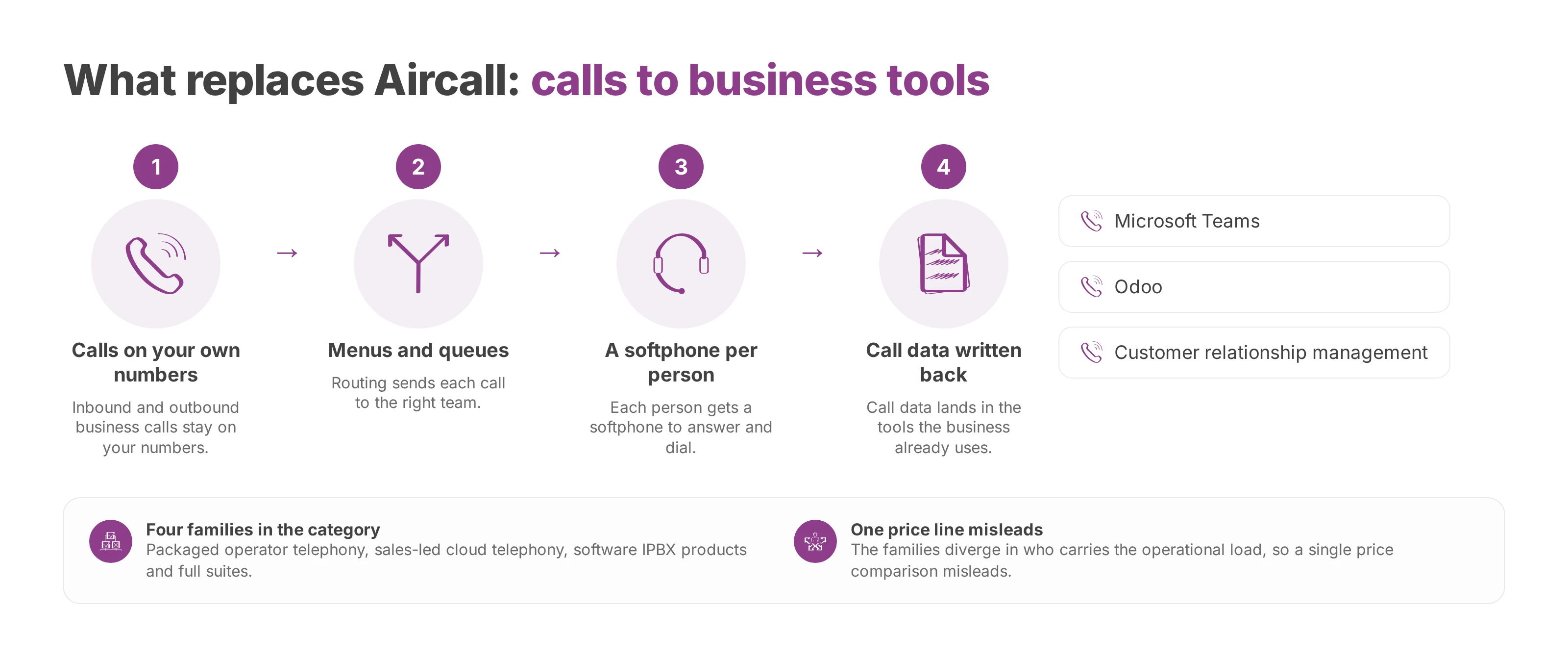
An Aircall alternative is any platform that can take over Aircall's actual job: carrying inbound and outbound business calls on your own numbers, routing them through menus and queues, giving each person a softphone, and writing call data into the tools the business already uses. Anything that does less isn't a replacement, and plenty of products that do far more get sold as one.
Four families sit inside the category. Packaged operator telephony replaces a fixed-line switchboard with a managed service and published packs. Sales-led cloud telephony builds around customer relationship management integrations and call metrics. Software IPBX products hand the hosting decision back to you. Full suites combine unified communications as a service (UCaaS) with contact centre as a service (CCaaS) under one contract. The families overlap in features and diverge sharply in who carries the operational load, so comparing them on a single price line produces a misleading table.
Aircall pricing plans and what Aircall costs
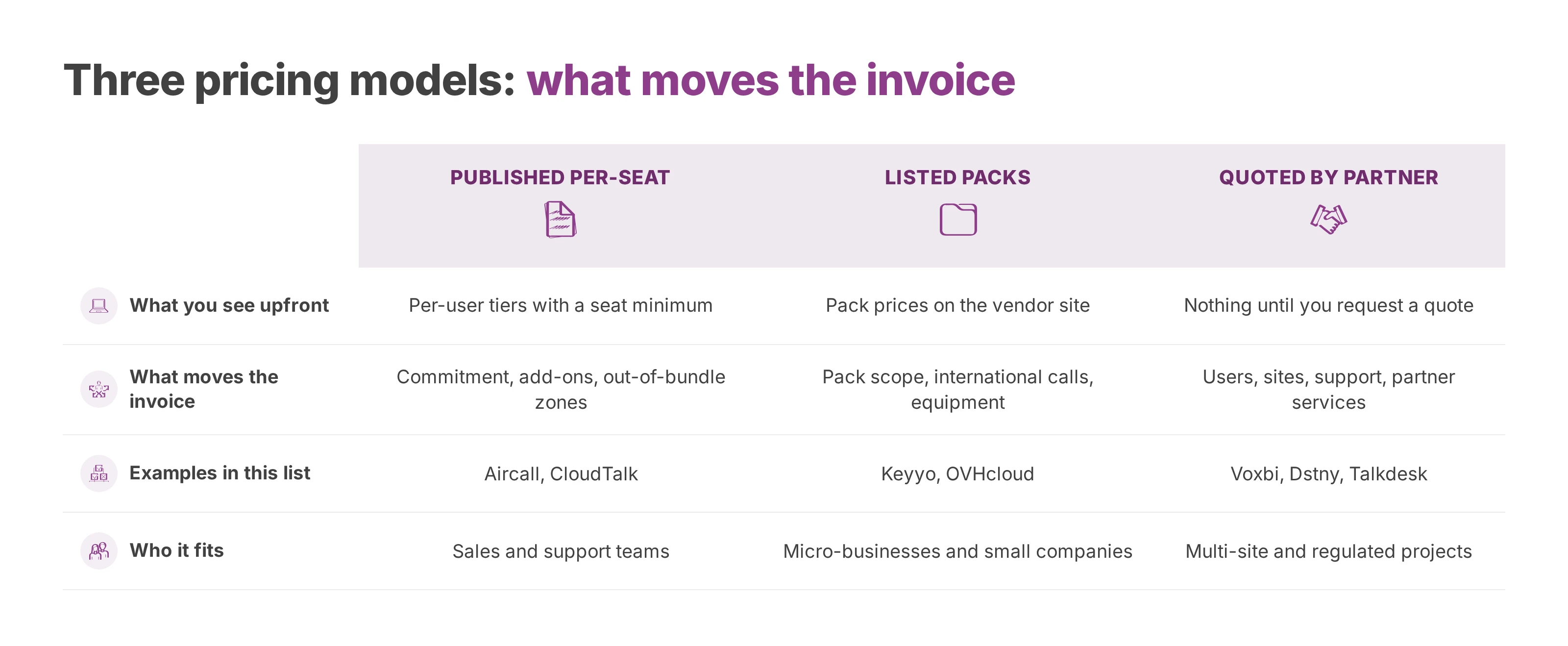
Aircall publishes per-user, per-month pricing in tiers on its own website, with a minimum number of seats, a lower rate for an annual commitment, and a quote-based tier for larger configurations. As of August 2026 those published figures are the ones to work from, and reading them at the source matters more than usual: prices and tier contents move, and an undated number copied into a comparison article can't be defended six months later.
The per-seat figure is only part of what Aircall costs. Numbers, international destinations, minutes beyond the included allowance, artificial intelligence features sold as add-ons, and the seat minimum all move the invoice. Contract length moves it again. Build the same seat count, the same call profile and the same integration list across every vendor you're weighing, then compare the totals. The framework for choosing a cloud phone system separates what's included from what's optional, which is where most quotes stop being comparable.
1. Voxbi
Voxbi is a cloud PBX hosted in the European Union. It's aimed at organisations that are retiring an on-premises PBX and want to keep configuring the system themselves. From Voxbi Cockpit, the web administration interface, administrators define users, extensions, interactive voice response menus, queues, call scenarios and closing hours. An IT team running several sites can change a routing rule or a queue without raising a ticket with the provider every time.
Data sovereignty is the main axis of evaluation. Voxbi hosts in European data centres, offers GDPR guarantees, and encrypts with HTTPS, SIP TLS and WebRTC. Readiness for the European Union AI Act still has to be verified against your own use cases, the data being processed and the responsibilities written into the contract. On its own it isn't proof of compliance for a given project.
Administration built for integrators
Voxbi ships native integrations with Microsoft Teams and Odoo, plus click-to-call, contact synchronisation, a REST API and TAPI computer telephony integration. Those interfaces let an integrator wire telephony into a customer relationship management tool or a line-of-business application, with more reach than a fixed catalogue of connectors. Bring your own carrier and support for standard SIP handsets also make a staged migration workable when a company wants to keep part of its existing installation.
Real-time dashboards, historical analysis and call recording cover supervision. AI transcription and summaries feed coaching, reporting and search across past conversations. Using them requires a written policy on recordings, metadata, access rights and retention periods.
The commercial model runs through certified integrators and resellers. Voxbi doesn't publish a per-user price, so a buyer requests a quote and agrees portability, deployment and support with the partner. That structure fits multi-site projects, mid-market groups, regulated sectors and European integrators better than an immediate self-service subscription.
Strengths: European hosting, browser-based administration, Teams and Odoo integrations, REST API and TAPI computer telephony integration, multi-site deployment, partner support, analytics and AI features.
Limits: no public price list, and dependence on the partner for advanced customisation and on-site support.
2. Ringover
Ringover is a French cloud telephony platform that combines PBX features, supervision and call-centre usage. It targets small and mid-sized companies that want telephony live quickly for sales, support or hybrid working. The positioning is more packaged than a self-hosted software IPBX.
Data is stated as hosted in France, with no transfer outside the European Union or the European Economic Area. For a buyer in France that narrows the residency question, though the contract, the sub-processors and the integration flows still need reading. Ringover also promotes integrations with customer relationship management and helpdesk tools, an API, webhooks, interactive voice response, queues and live coaching.
A sales-led option with modules to weigh
Ringover transcribes and summarises calls and voicemails, and sells prospecting modules alongside the core plans. The trade-off is economic, because some AI tools and sales-cadence features arrive as paid add-ons. The real price follows the commitment, the seat count and the modules you keep. French hosting is a favourable signal, and it doesn't replace an analysis of the processing activities, the sub-processors and the retention rules.
A sales team gets to production faster here than with an IPBX that needs an integrator. An IT department that wants fine control of the architecture, a TAPI integration or a bring-your-own-carrier strategy should confirm what's technically possible before shortlisting Ringover.
3. CloudTalk
CloudTalk targets sales and support teams that want cloud telephony organised around customer relationship management integrations. Its web, desktop and mobile apps cover routing, queues, recording, analytics and supervision. Transcription, sentiment analysis and call notes sit in the AI layer, usually priced as distinct options inside the chosen scope.
Its European infrastructure relies partly on Amazon Web Services in the European Union, listed among the declared sub-processors. CloudTalk publishes GDPR documentation, a data processing policy and a sub-processor list. That transparency helps an IT team document the service. Hosting with a cloud sub-processor doesn't by itself mean every flow in your organisation stays inside one jurisdiction.
A fair fit for customer relationship management teams
Some plans include unlimited domestic calling in the European Union and several associated countries, with geographic bundles on top. Read "unlimited" together with the fair-use policy and any zone restrictions. Calls outside the bundle and the advanced AI features both move the total.
CloudTalk works for a commercial team that measures its calls, already runs a supported customer relationship management tool, and doesn't need control of the underlying infrastructure. It fits less naturally where a local authority or a healthcare provider requires a documented sovereignty architecture, precisely configured retention, or local integration support.
4. 3CX
3CX is a software IPBX. You can self-host it, run it on public cloud infrastructure, or have 3CX host it, and that deployment choice changes where responsibility sits. Running the environment yourself gives you control over location and configuration, along with the updates, security, monitoring and service continuity.
The platform includes interactive voice response, queues, recording, web and mobile softphones, and connections to Microsoft 365, Teams, Google Workspace and several customer relationship management tools. Its ecosystem of SIP trunk providers and integrators makes multi-site architectures straightforward to assemble.
Flexibility against operational load
Licensing is generally calculated on simultaneous calls rather than user count. That favours an organisation with many users and a controlled volume of concurrent conversations. It also demands a serious estimate of peak activity, queue depth and failover capacity.
3CX suits IT integrators, companies with in-house skills, and projects that need precise control of hosting. It suits a small company less well when the goal is to activate a number, import users and let the provider own the whole technical layer. Pricing and options vary by edition and hosting mode, so a comparison with any other business communication solution has to include partner, infrastructure and maintenance costs alongside the licence.
5. Dstny
Dstny positions itself as a pan-European unified communications and contact centre operator with a substantial presence in France. Its portfolio covers telephony, customer relationship management integrations, analytics, Microsoft Teams calling and business mobility options. It addresses companies that prefer to hand scoping and deployment to an operator or a partner network.
That approach suits a business that doesn't want to turn its IT department into a telecoms team. The partner takes on portability, routing rules, the Teams interconnection and user onboarding. In exchange there's less self-service than with a product designed around fully direct administration.
A broad portfolio that's hard to trim
Dstny converges fixed, mobile and collaboration usage. A mid-market group harmonising several entities benefits from that breadth, while the same UCaaS and mobility catalogue complicates the decision for a small organisation that only wants a PBX replacement.
An online estimator helps model an offer and set some parameters. Contracting still runs mainly on quotes, which makes scope definition before signature essential: numbers, users, sites, support, integrations and the partner's responsibilities all belong in writing. Dstny is a proximity-and-support choice. Where daily administrator autonomy ranks first, check how far the internal team can change call scenarios without external intervention.
6. Keyyo
Keyyo takes a simpler, more packaged approach. This French business-to-business operator, a subsidiary of Bouygues Telecom Entreprises, sells IP telephony offers aimed mainly at micro-businesses and small companies. The packs bundle a softphone, supervision tools and options tied to Teams or to handsets.
The service fits a company replacing traditional fixed-line telephony with a managed offer, without designing a complex contact centre architecture. The Callpad tools work from a computer or a mobile, while real-time supervision and recording answer a team leader's everyday needs.
Clear packaging for small organisations
Public pricing is a concrete advantage here. Keyyo lists its pack prices on its own site, which gives a small organisation an initial reference point before any sales conversation. The exact scope depends on the pack, on international calling, on equipment and on the options subscribed, and the figure on the page is the one to quote rather than a number from a comparison table.
Keyyo is less convincing for a project that needs a rich CCaaS suite, many business integrations or highly granular control of call journeys. The positioning stays professional fixed telephony rather than a platform for orchestrating multi-site contact centre operations. For a local small business that simplicity is a feature. An integrator industrialising heterogeneous deployments should verify the extension and API limits first.
7. OVHcloud VoIP telephony
OVHcloud VoIP telephony targets companies that want a legible voice over internet protocol offer from a French cloud infrastructure provider. SIP lines, the Softcall softphone, number portability, time-based schedules and line grouping cover what a classic switchboard does.
The platform adds interactive voice response and a Contact Center Solution option for organising call queues. That's enough for a small company distributing calls across several agents. It doesn't necessarily replace a specialist CCaaS suite for advanced quality management, workforce management or omnichannel journeys.
A rational choice for standard telephony
Pricing is presented transparently, and some offers include unlimited calls to fixed lines in France or Belgium under stated conditions. Portability and fast activation lower the barrier to replacing an existing installation. The absence of a commitment period on certain offers makes a limited pilot easy, provided you validate call quality and support during it.
OVHcloud promotes French hosting and GDPR compliance. For a sensitive sector, the buyer still has to separate the hosting location from the administration flows, the recordings, the metadata and any connected third-party tools. This alternative suits an organisation that values published prices and French infrastructure, and answers less naturally where deeply integrated customer relationship management or contact centre requirements go beyond telephony and basic routing.
8. RingCentral
RingCentral is a global UCaaS and CCaaS platform. The catalogue brings together telephony, video meetings, webinars, contact centre, analytics, recordings and AI features. RingCentral has a presence in France, localised contracts, billing in euros and editions adapted to the European market.
The appeal is the breadth of the ecosystem. A mid-market group consolidates several communication needs into one supplier relationship instead of assembling a PBX, a meetings product and a contact centre platform. Teams with a mature collaboration environment also get depth in the administration features.
Power that adds complexity
Price construction is the counterweight. Service tiers, discounts, options and contact centre modules make comparison hard without a detailed scenario. Contact centre offers are frequently quoted rather than listed, and add-ons widen the contractual perimeter quickly.
RingCentral fits a company that wants a very broad communications suite and has the resources to govern that platform. For a small company that wants a cloud switchboard, the feature depth generates more selection work than operational value. European residency needs examining product by product and data type by data type, because the rules can differ between telephony, video, contact centre, recordings and AI services. A local presence doesn't establish that every processing activity stays inside the European Union.
9. Talkdesk
Talkdesk is primarily a CCaaS platform for contact centres. It provides routing, analytics, quality management, workforce management, integrations and AI features. Its architecture can include data regionalisation in Europe as well as private deployment options, which matter in multi-site or regulated environments.
That depth suits a customer service operation that measures queue performance, formalises quality checks and orchestrates several channels. It also interests a sensitive sector that has to document data export, deletion and retention under GDPR and the applicable European requirements.
Reserve it for complex operations
Talkdesk is rarely the simplest way to replace a handful of desk phones. Implementation needs functional scoping, data governance and usually an integrator. Pricing is mainly quoted, so several usage scenarios have to be modelled before offers can be compared.
Residency and private deployment options strengthen control, and they don't remove the customer's own obligations. You still define roles, permissions, retention periods and the rules that apply to transcripts.
Sizing rule: a contact centre can justify Talkdesk. A small company that only wants a cloud PBX ends up paying for and administering an oversized platform.
The line between telephony and a contact centre is drawn in more detail in this guide to contact centre outsourcing. Talkdesk becomes relevant once customer relationship processes matter more than the switchboard replacement itself.
10. Wildix
Wildix is a European vendor of unified communications and WebRTC PBX systems, distributed mainly through a partner network. Its browser-native architecture lets people call from a web, mobile or desktop app. Supervision and CDR-View reporting give visibility into team activity, while the marketplace connects Salesforce, HubSpot, Zoho and Microsoft 365.
Plans can be differentiated by role, with options for international calling. Voicebots, chatbots, transcription and summaries form a complementary layer. As with every platform using artificial intelligence, verify the data processing, the retention rules and the available controls before using it in a regulated sector.
A channel-first architecture
The distribution model is what sets Wildix apart. An integrator designs a deployment for a retail chain, a hotel group or a set of facilities, then owns support and future changes. That works for organisations that prefer a close relationship with one party who can connect telephony, network, handsets and business processes.
The trade-off lands on the final price. Public pricing is partial, and the quote depends on plans, add-ons, headsets, equipment and partner services. Compare total cost of ownership rather than the software licence alone. Wildix is a strong option for supported WebRTC and multi-site projects, while a small team that wants an immediate self-service subscription with a known figure should look at a more standardised offer.
Aircall competitors compared: the ten alternatives side by side
| Solution | Key features | Experience and quality | Who it fits | What makes it distinct | Pricing and deployment |
|---|---|---|---|---|---|
| Voxbi | Cloud PBX hosted in the European Union, Voxbi Cockpit web administration, WebRTC and SIP TLS, Teams and Odoo integrations, REST API and TAPI, recording and AI | Direct administration from the browser, real-time dashboards, GDPR guarantees; European Union AI Act readiness to verify per use case | Small and mid-sized companies, healthcare, public sector, integrators, multi-site | Data residency in the European Union with native Teams and Odoo links | Quoted through certified integrators and resellers |
| Ringover | PBX and call centre, French hosting, interactive voice response, queues, AI modules as add-ons, 60+ integrations | Fast onboarding, real-time supervision; AI is a paid option | Small and mid-sized companies, sales and support teams | Hosting in France with ready-made packs | Plans plus add-ons; price varies with commitment |
| CloudTalk | Web, desktop and mobile apps, recording, analytics, AI add-ons, European calling bundles | Strong feature-to-price ratio for sales and support; "unlimited" subject to fair use | Sales and support teams in smaller businesses | Deep customer relationship management integrations and published GDPR documentation | Public plans; paid options for AI and out-of-bundle zones |
| 3CX | Software IPBX, self-hosted or cloud, interactive voice response, softphones, Microsoft 365 and CRM integrations | Full control when self-hosted; needs an integrator to maintain | Technical companies, high call volumes | Data control through self-hosting, priced by simultaneous channels | Annual licence by simultaneous calls; options vary by hosting |
| Dstny | Pan-European UCaaS, Teams calling, analytics, CRM integrations | Support through a local partner network, packaged offers | Small and mid-sized companies wanting European proximity | Pan-European footprint with local partner support | Mainly quoted; online estimator available |
| Keyyo | Pro packs, softphone, supervision, Teams compatibility | Simple deployment, packaged interface | Micro-businesses and small companies wanting a turnkey service | Bouygues Telecom subsidiary with published pack pricing and local support | Clear packs listed on the vendor's site |
| OVHcloud VoIP telephony | SIP lines, Softcall, interactive voice response, portability, time-based schedules | Transparent prices, fast activation, no commitment on some offers | Small companies wanting an economical, simple service | French hosting with straightforward billing | Public prices, immediate activation |
| RingCentral | Unified communications, contact centre and video, analytics, European edition, messaging | Mature ecosystem, very broad functional coverage | Mid-sized and large companies needing full UCaaS and CCaaS | Global suite with a localised European edition | Complex model; tiers and add-ons; contact centre often quoted |
| Talkdesk | Advanced CCaaS, AI, quality and workforce management, European data regionalisation, private deployments | Very complete for contact centres, needs an integrator | Contact centres, regulated sectors | Advanced contact centre capability with data sovereignty options | Mainly quoted, tailored deployments |
| Wildix | Native WebRTC, web, mobile and desktop apps, marketplace, voicebots | Channel-first, partners for multi-site, CDR supervision | Small and mid-sized companies, hospitality, retail, integrators | WebRTC architecture with a partner ecosystem | Modular plans; final pricing through partners |
The right choice follows the level of control you want
The French market now offers several routes, and they answer different needs. Market sizing diverges by method while describing the same rapid growth in cloud telecoms services. One estimate values the French telecom cloud market at $1,090.5 million in 2025, projecting $2,715.2 million in 2030 at a 20.0% compound annual growth rate, while another puts it at $1,272.2 million in 2025 and $6,773.1 million in 2033, at a 23.5% rate between 2026 and 2033. Read both as orders of magnitude produced by different methods rather than as one measurement (telecom cloud market outlook, Grand View Research).
Regulation is a second reason to look past the price line. The SREN law of 21 May 2024 gave ARCEP new powers over cloud interoperability, portability and the openness of interfaces, and it caps switching fees at the costs the provider actually bears (ARCEP annual report). Migrating a PBX or a cloud telephony service therefore has to account for reversibility, numbers, data and interfaces, not only the initial configuration.
An operational decision matrix
Keyyo or OVHcloud suit packaged, legible telephony that deploys quickly.
Ringover or CloudTalk serve sales and support teams that prioritise customer relationship management integrations, queues and analytics.
3CX is the pick for self-hosting, SIP trunk flexibility and projects driven by an IT team or an integrator.
Dstny or Wildix fit where partner support, mobility and multi-site rollouts weigh heavily.
RingCentral or Talkdesk target extended UCaaS and CCaaS environments, with more functional depth and a harder selection and governance job.
Voxbi becomes particularly relevant when a company wants a European cloud PBX, data hosted in the European Union, direct administration, and Teams, Odoo, REST API or TAPI computer telephony integration usage with an integrator alongside.
France still has room to adopt. One sector report citing Eurostat puts French company use of cloud services at 27% in 2023, against a European level above 52% in 2025 (Channelnews on business communications in France). Those are two different reference years, so the gap indicates a direction rather than a like-for-like measurement. Either way, replacing an on-premises PBX is rarely just a technical migration. It usually redraws telephony administration, IT responsibilities and data flows at the same time.
Checks to run before you sign
Every vendor on this list should answer these in writing:
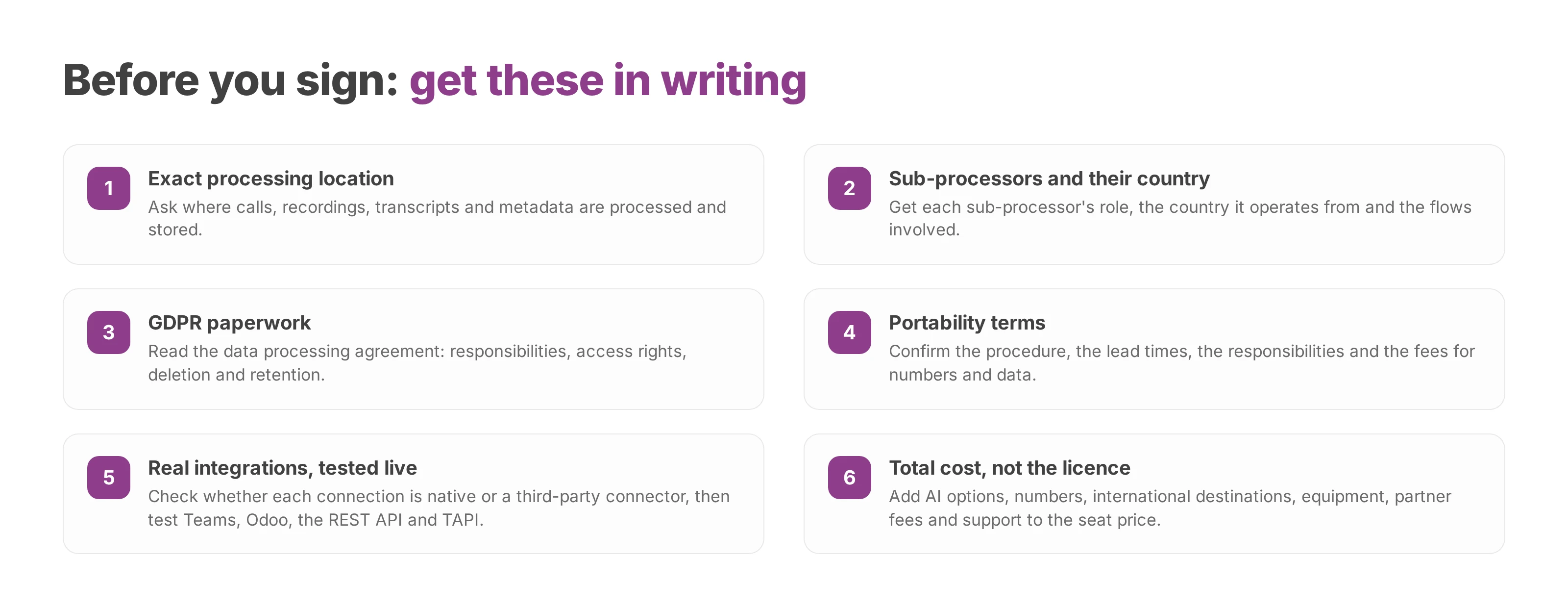
Exact location: where calls, recordings, transcripts and metadata are processed and stored.
Sub-processors: their role, the country they operate from, and the flows involved.
GDPR: the data processing agreement, the responsibilities, access rights, deletion and retention.
Regulated sectors: in France, personal health data has to be hosted by a provider with HDS certification, on top of GDPR (French cloud compliance overview, Baker McKenzie).
Public sector sovereignty: the European Commission's level 1 for public cloud requires processing and storage on infrastructure located in the Union (Cloud and AI Development Act policy page).
Portability: the procedure, the lead times, the responsibilities and the fees for numbers and data.
Real integrations: whether each connection is native or a third-party connector, then a live check of Teams, Odoo, the REST API, TAPI computer telephony integration and your customer relationship management tool.
Total cost: AI add-ons, numbers, international destinations, equipment, partner fees and support.
Service levels and deployment: availability commitments, support, training and who owns the cutover.
The cheapest line on a price sheet often isn't the cheapest system to run. An architecture you can control, reverse and connect to your business tools reduces the risk of the next migration, and that risk is largest for a mid-market group or a network of sites.
Voxbi provides a European cloud PBX with administration from Voxbi Cockpit, hosting in the European Union, and integrations with Microsoft Teams, Odoo, a REST API and TAPI computer telephony integration. To scope an Aircall alternative for a small company, a mid-market group or a multi-site rollout, write to hello@voxbi.com and ask for a session with a certified partner.