An 80-person company reaches the end of the maintenance contract on its on-premise PBX. A cloud PBX migration lands on the roadmap, and nobody in the building has used a softphone, cloud call routing or Teams Phone before. On paper the project is technical. In the building it touches inbound calls, transfers, queues, the reception desk, mobile working and the trust people place in the phone. This guide is for the IT manager, integrator or reseller who owns that project.
The migration changes daily habits and the felt reliability of the phone, well beyond the equipment swap. Teams who tie continuity to the box in the comms cupboard will read every hiccup as evidence against the new system. A technology comparison frames the buying decision, and winning people over takes its own separate work.
The IFOP survey on how organisations support people through change reports that 74% of employees cite a change of methods and processes, 69% new equipment and 66% a cultural change. A phone migration sits squarely inside that reality.
What a cloud PBX migration is
A cloud PBX migration moves your telephone system from hardware on site to a platform your provider hosts and runs. Users, extensions, call flows, queues and opening hours all live in a web interface, and the desk handset becomes one endpoint among several. The technology side starts from a plain description of what a cloud PBX does.
Three weak signals should reach the project lead before kick-off. The first is attachment to the existing hardware. While users equate telephony with a physical desk phone, they'll read the softphone as a downgrade, even when the new system covers more scenarios than the old one.
The second signal is privacy. People worry about call recording, remote listening and loose control of their data. The third is unfamiliarity with cloud service commitments. A team that doesn't know the provider's responsibilities, the escalation path or how incidents get handled will read every anomaly as proof that the cloud can't be trusted.
Reception qualifies calls. Sales transfers fast to the right person. Support runs queues and keeps sight of abandoned calls. The technical configuration earns its keep when those practices survive the move and then improve without disrupting the teams.
Situations vary widely inside one company. The same IFOP survey found that 69% of employees had been through a structural reorganisation, while 50% saw a headcount reduction and 41% a headcount increase. So one phone project can feel like new freedom to a salesperson and like extra load to someone on the reception desk.
Field rule: a successful migration starts by naming what each team has to keep doing without friction, long before anyone configures a SIP trunk.
The recommended cycle has three movements. You diagnose the ground, you equip the people it touches, then you steer and close the gaps. French practitioner literature formalised that sequence as a diagnosis, support and performance method. Over a 90-day trajectory it gives you a concrete frame, from the first audit through to the point where the new system is simply how work happens.
Diagnose the ground before the kick-off meeting
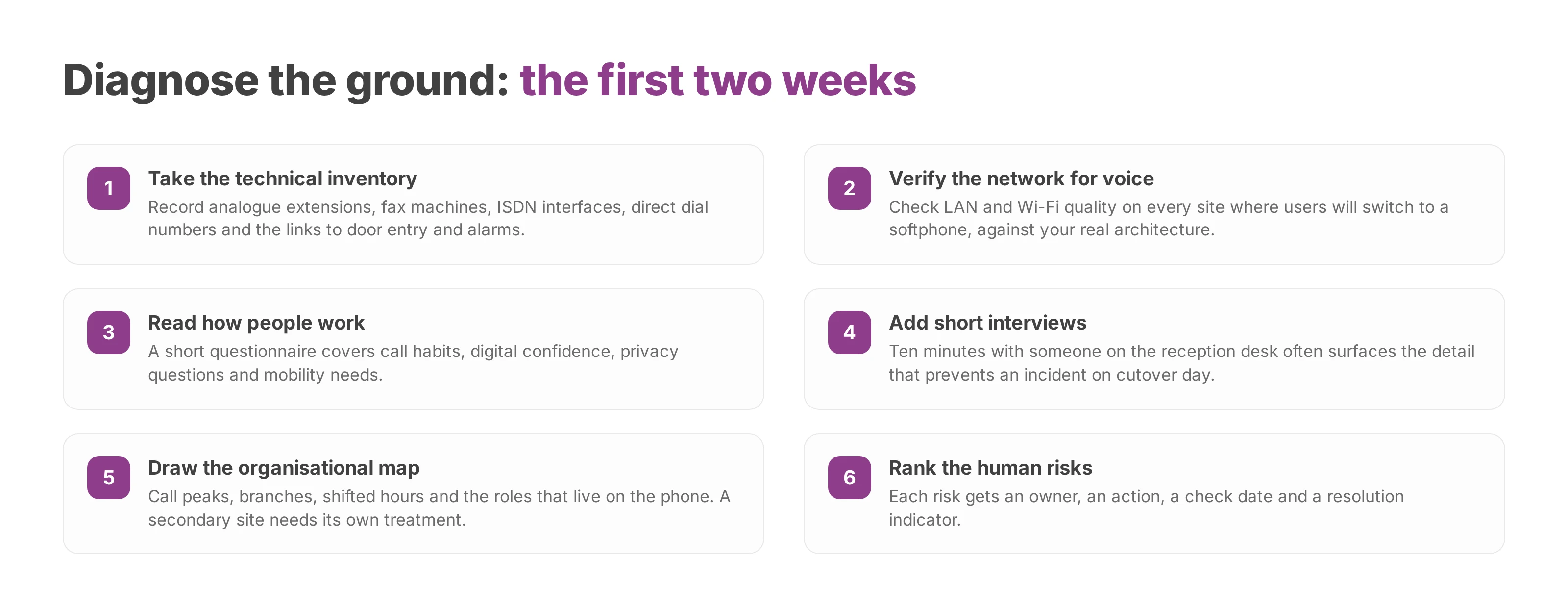
The diagnosis runs in the first two weeks, and the project lead runs three analyses in parallel. A short document that surfaces the blockers beats a thick one that files them.
The technical inventory
The inventory goes well past the list of phones. It records analogue extensions, fax machines, ISDN interfaces, direct dial numbers, music-on-hold equipment and the dependencies with door entry, alarms and the reception desk. Direct dial deserves attention early, because the routing rules behind a DDI number usually carry business logic nobody's written down.
LAN and Wi-Fi quality needs verifying for voice over IP, especially on the sites where you'll ask users to switch to a softphone. The standard checks on call quality over IP belong against your real architecture. Network flows and security rules get prepared with the infrastructure team rather than copied from a generic procedure.
Reading how people actually work
A short questionnaire gives you the first reading. Ask about:
Call habits: who transfers, who supervises, who takes queued calls?
Digital confidence: who already works with Microsoft Teams, business software or a mobile app?
Privacy questions: what comes up about recording, listening in and GDPR?
Attachment to the desk phone: who treats the handset as essential?
Mobility needs: which roles work across sites or on the road?
Cross the answers with short interviews. A questionnaire shows you a trend. Ten minutes with someone on the reception desk often surfaces the one detail that prevents an incident on cutover day.
The organisational map
The map takes in call peaks, branches, shifted hours and the roles that live on the phone. Support, logistics and sales can't share a single adoption path. A secondary site with a different network or more local autonomy needs its own treatment rather than a copy of head office.
The deliverable is a map of human risks ranked by criticality. Each risk gets an owner, an action, a check date and a resolution indicator. That discipline heads off the classic telecoms failure, where objections surface after the supplier is chosen and there's little left to change.
Map the stakeholders and set up governance
Governance gives each actor a precise role. The executive team needs the cost of doing nothing, the dependencies and the decisions expected of them. The telecoms administrator needs call flows, supervision, admin rights and continuity of service. Same project, two very different stories.
Four circles carry it. Sponsors, the executive team and finance, arbitrate budget, risk and priority. Project leads, IT and the support manager, turn the decision into architecture, procedures and assistance. Champions, power users identified site by site, test the scenarios and give the move local credibility. End users adopt the new habits in their real work.
One message per group
The sponsor gets a financial and operational executive summary. Project leads need a technical demonstration covering call flows, supervision, administration rights and continuity of service. Champions work on concrete use cases. Reception tests a transfer into a queue. A salesperson checks click-to-call and mobile working. The support manager checks supervision and recovery after an incident. End users get plain FAQs, screenshots and a readable calendar.
The weekly ritual that stops things stalling
A short weekly committee brings together the sponsor, IT, support and whoever leads adoption. It handles decisions due, new objections and late actions. Problems shouldn't wait for the monthly steering committee to become visible.
A communication plan fits on one page:
Hybrid and multi-site teams need in-person and remote forums, collaborative tools, FAQs and a written trail. A French public-sector memo on supporting change confirms how much those arrangements matter once people are spread across locations.
Build training around user profiles
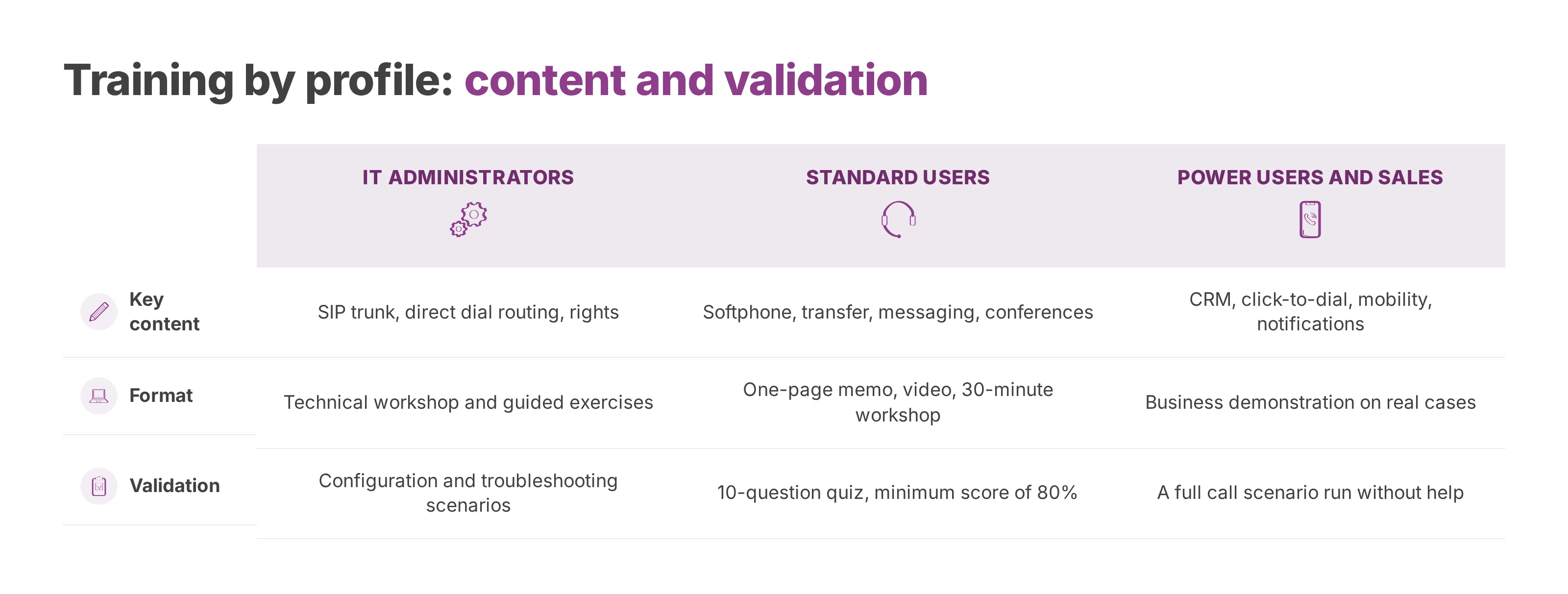
One training session for everyone overloads standard users with administrator settings and leaves the IT team without troubleshooting practice. The programme should follow real responsibilities, in short formats, with something observable at the end.
Three levels, three objectives
IT administrators work on SIP trunk configuration, direct dial routing, rights, supervision and quality of service. The mechanics of a SIP trunk are worth a session on their own. Standard users learn the softphone, transfers, unified messaging and conferences. Power users and field sales add CRM integration, click-to-dial and mobile use.
The material stays available after the session. A one-page memo answers the urgent question. A three-minute video reminds someone of one specific gesture. A weekly question-and-answer slot absorbs the difficulties that only appear in real use. The glossary defines extension, trunk and queue, because plenty of users have never needed those words.
A calendar that rehearses real use
At D-30 the teams get the theory and the ground rules. At D-15 they run exercises on inbound calls, transfers and fallback scenarios. At D-7 the dress rehearsal checks roles, equipment, announcements and escalation procedures.
Administrator training stays separate from user training. That split keeps sessions from drifting into generalities, and it gives IT time to practise the sensitive operations.
The reusable participant record holds the profile, the site, the critical uses, the starting level, the modules taken, the errors observed and the final validation. The adoption lead keeps those records in the project register, then hands them to support so the recurring requests are already known.
Deploy in waves with written go/no-go criteria
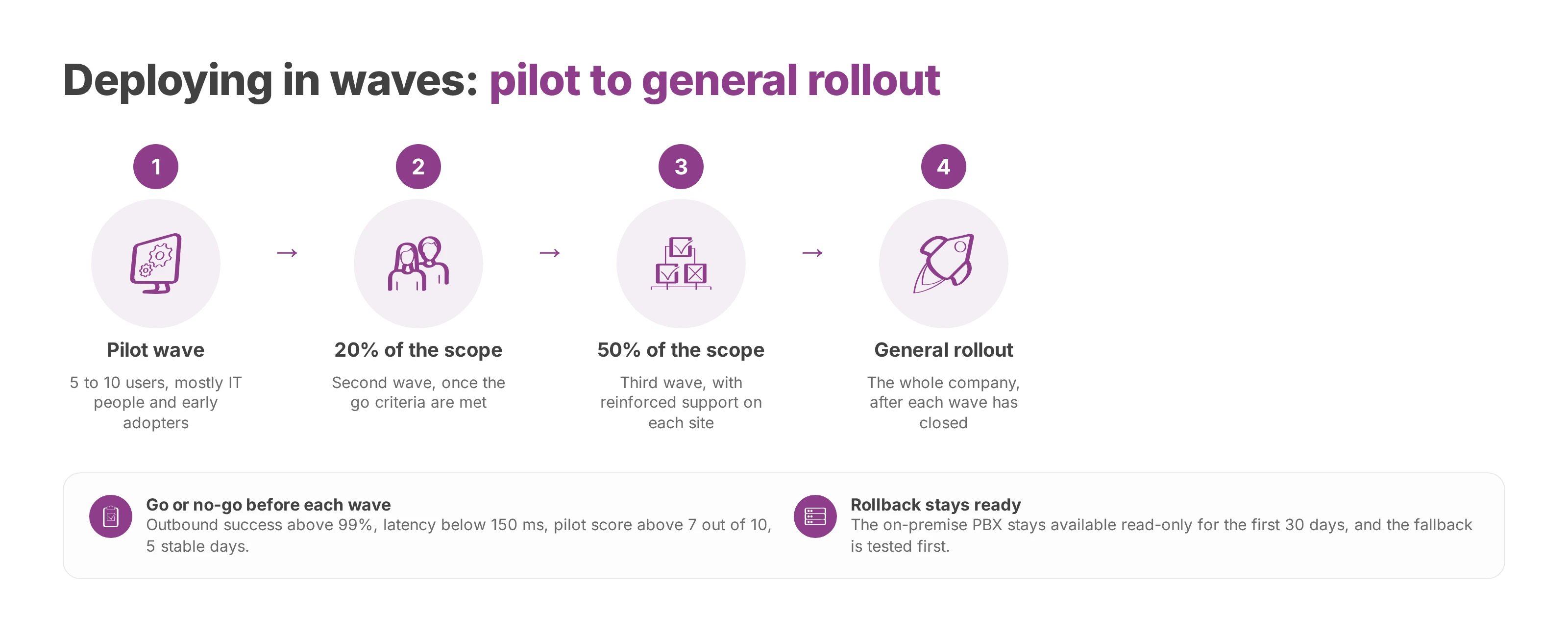
A single big-bang cutover turns one fixable problem into a company-wide rejection. An incident on queues, direct dial numbers or the Wi-Fi hits everybody at the same moment. Waves keep that contained, and each wave carries an explicit right to suspend the next one.
A controlled ramp-up
The first wave takes 5 to 10 pilot users, mostly IT people and early adopters. It validates telephony, the business journeys and the quality of support. The second wave covers 20% of the scope, the next 50%, then comes general rollout.
Every step rests on go/no-go criteria written in advance:
Outbound calls: success rate above 99%.
Call quality: latency below 150 ms.
Pilot satisfaction: score above 7 out of 10.
Stability: no blocking incident for 5 working days.
Those thresholds sit alongside the committee's judgement. What they mainly prevent is a wave getting waved through because the calendar has slipped. Each decision goes into a signed handover note listing the reservations, the actions and the owner.
Prepare the rollback
The fallback plan gets tested before the first wave runs. For the first 30 days the on-premise PBX stays available read-only, so the information needed for operations and comparison is still in reach. The rollback names who decides, within what time, and by what procedure calls get rerouted.
The cutover happens outside working hours, with a named team for telephony, network, support and communication. A daily check-in runs through the first week. It looks at incidents, tickets, missed calls and usability problems, and it records the irritations instead of smoothing them over.
Reinforced support follows each wave. Champions become the first port of call on their own site, while IT keeps control of configuration changes. That separation stops users from changing their own settings at random to fix a local problem.
A wave is finished at the point where the teams can work, ask for help and report a fault through the route you set up.
Measure adoption and run an improvement loop
A cloud PBX migration succeeds when the company measures adoption. The dashboard combines usage indicators with qualitative feedback, and every signal connects to a concrete action.
Three indicators worth tracking
The first is the active usage rate, measured by weekly softphone logins. It separates created accounts from real use. A persistent drop on one site triggers a conversation with the local manager or champion.
The second is the internal net promoter score, taken quarterly. It carries more meaning read next to the other two. A low score can point to a mobility problem, a badly configured notification or missing training rather than a general fault in the service.
The third is the number of tickets per user per month, broken down by theme: transfers, inbound calls, mobile, headsets, presence, administration. A single global figure hides the irritations that need a targeted fix.
Turning signals into decisions
The dashboard shared with management shows the trend, the scope affected, the probable cause and the action underway. A spike in transfer tickets produces an extra how-to sheet and a short reminder. A falling mobile score sends you back to the notification settings and the training path.
Retrospectives at D+30, D+90 and D+180 give the improvement its structure. Each one examines recurring incidents, unresolved requests and the practices that have genuinely taken hold. Decisions go into a continuous improvement register with a review date and an owner.
Cigref structured change support into seven phases, from context analysis to final evaluation, in its 2003 report on change support practices. The lesson holds for a cloud PBX: the feedback loop belongs in the design from day one.
Make European sovereignty and GDPR part of the case
Data sovereignty belongs in the selection matrix at the same level as call journeys, quality of service, reversibility and support. Putting it there early gives the project a straight answer the first time somebody asks where the recordings live.
Three criteria are non-negotiable for a European company:
Data hosted in the European Union, with a clearly documented location.
Backup location, including recovery environments and technical logs.
Certifications and compliance scope, notably ISO 27001 and health-data hosting where the context requires it.
Sovereignty rests on more than the server's location. The French SecNumCloud 3.2 framework, published in March 2022, comprises 37 requirements covering security architecture, operational procedures, personnel, the supply chain and governance. It also imposes exclusive submission to European law, as the principles behind sovereign cloud set out.
Helping teams understand the protection
The data protection officer joins the project committee before signature. They check the controller and processor roles, retention periods, administrator access, any transfers, and how GDPR requests get handled. A contractual reversibility clause spells out data return, formats, exit assistance and deletion after the migration.
The message to the teams stays precise. This wording works as a starting point, provided you verify it with the provider first: "Your conversations are hosted in France, encrypted end to end, and nobody outside the EU has access." It holds only when the contracts, the architecture and the controls actually match it. Sovereignty is demonstrated with verifiable evidence.
The European cloud sovereignty framework distinguishes eight objectives, spanning the strategic, legal, data and AI, operational, supply chain, technological, security and sustainability dimensions, per the Commission's cloud sovereignty procurement announcement. Compliance with the EU AI Act deserves a specific analysis of its own, based on the functions used, the data processed and the contractual responsibilities.
In France this level of scrutiny fits a cloud adoption rate that still sits below the European average. In 2023, 22.9% of French companies used cloud solutions against 38.9% across the European Union, with French small and medium businesses at 21.79%, according to France's Digital Decade country report. Whoever integrates the system carries the translation work, turning sovereignty into architecture decisions, contract clauses and messages people can understand.
Diagnosis, support and steering then become a way of running the service rather than a project phase. An annual review of subprocessors, a GDPR review after deployment and a reversibility check keep the trust intact once the system is in production.
Voxbi is a cloud PBX built for European companies. Users, extensions, call flows, queues and opening hours are configured from Voxbi Cockpit, and the platform is hosted in European Union data centres. To scope your own migration, write to hello@voxbi.com with your call volumes, your sites and the date your maintenance contract ends.