There's a point where the phones stop being a background hum and start being the constraint on everything else. The team is already at its ceiling, the on-site PBX takes more maintenance every quarter, and each new slot of opening hours drags a scheduling, cost and supervision headache behind it. So the reflex kicks in: look at contact center outsourcing. The call sounds easy, but it puts your service quality, your data security, your compliance and your telecom architecture on the line all at once.
For an IT director, an integrator or a business owner, the useful questions come after the yes-or-no: what to outsource, where, with how much control, and on what technical foundation. Get the framing wrong and you degrade the customer experience while opening blind spots on recordings, metadata, CRM access and traceability. Get it right and you absorb the load, steady the service, and keep your hands on the flows that actually matter.
So this goes well beyond cutting costs. It touches sovereignty, day-to-day operations, and whether you can plug an external provider into an existing setup without breaking security or operational visibility. It helps to place the decision inside the reality of a modern customer contact center, where telephony, CRM and reporting all run as one production system.
A B2B services company can run fine on a small internal team as long as volumes stay predictable. Then a new market lands, more customers arrive, seasonal peaks hit, cases take longer to resolve, and the switchboard becomes a friction point. Calls pile up, wait times rise, supervisors improvise stopgaps, and management starts weighing the cost of reinforcing the team against the cost of an outside partner. This is a well-established market, not a fringe experiment: the French contact center sector reached 3.56 billion euros in 2023, up 18.6% between 2019 and 2021 (analysis of the French contact center market).
Outsourcing answers that pressure well. It lets you absorb variable volumes faster, add capacity without opening a full HR project, and stop resting the entire service on aging infrastructure. Handing the work over relocates the problems rather than removing them. Loss of control, access to internal tools, the quality of what customers hear, how recordings are managed, where the data lives: all of it becomes a governance question the moment you sign. That trade is the one most companies discover late, when the brand starts sounding like someone else's on the phone and nobody owns the field knowledge the internal team used to carry.
For a European company there's an extra layer. The decision has to sit comfortably with GDPR, with telecom security constraints, and with a technical ecosystem where the cloud PBX, the APIs, the CRM and the dashboards all have to keep working as one coherent whole.
What companies really hand off
In well-run projects, a company doesn't outsource everything to the same depth. It might:
Outsource overflow only for call peaks, while keeping sensitive cases in-house.
Hand off one specific channel such as reception, appointment booking or first-line support.
Split front-office from core business handling, so an external provider never touches operations that are too critical.
That granularity matters. It's what keeps negotiation, complex complaints and the most sensitive data inside your own walls.
Onshore, nearshore, offshore
Three models shape the market. Onshore uses a provider in your own country. Nearshore leans on a neighbouring or nearby country. Offshore moves the activity to a more distant geography. The terms are familiar, and they're often misused. The choice drives far more than cost: language, working hours, service culture, management, and above all how easily you can enforce European security and sovereignty requirements.
Comparing onshore, nearshore and offshore
The outsourcing debate often circles one cliché: that outsourcing means shipping your customer relationship abroad. The data tells a different story. Domestic delivery still dominates the French market, at 46% of total outsourcing revenue, a share that keeps growing and confirms the strategic weight of a service run locally (SP2C data on contact centers).
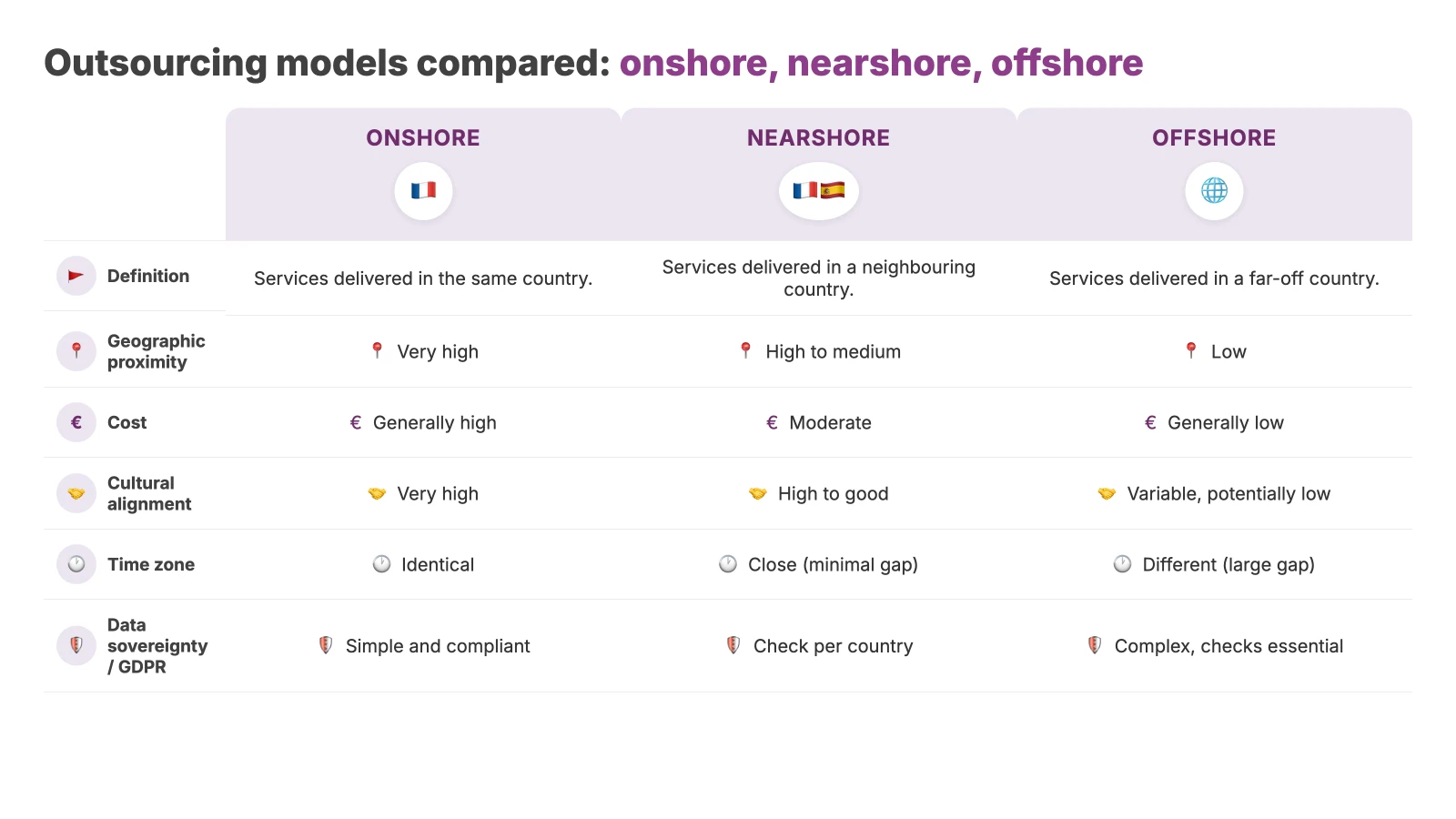
Three models, three operating logics
Onshore suits companies that want to limit cultural gaps, cut supervision friction and keep a simple read on their regulatory obligations. It's often the best option for high-perceived-value services, sensitive customer journeys and regulated sectors.
Nearshore works when you're after a compromise. The geographic proximity stays reasonable, hours are usually compatible, and some nearshore teams operate in French very well. But quality leans heavily on the site, the management and the contractual frame applied to the data.
Offshore can answer volume plays or wider coverage. The further the distance, though, the more you have to compensate with training, quality control, technical integration and security governance. That's where the advertised savings can evaporate under operational rework, quality incidents or compliance constraints.
The right model depends less on call volume than on your tolerance for risk. Premium customer service usually stays most coherent onshore. Standardised support with well-established scripts can hold up nearshore. Heavily industrialised campaigns can go offshore, provided you accept tighter steering. And in regulated sectors, the trade-off has to start from the data and the jurisdiction, not the price tag.
Keeping data sovereign and staying GDPR-compliant
For a European company, confidentiality is only part of the story. The heart of the matter is the operational and legal sovereignty of your voice data, recordings, call metadata and the associated CRM information.
One requirement comes up again and again: hosting and processing should happen inside the EU, out of reach of extraterritorial laws like the US Cloud Act. GDPR does allow transfers outside the EU under strict legal conditions, notably via Standard Contractual Clauses, but those only count if a serious audit of the provider backs them up (analysis of sovereignty, GDPR and the Cloud Act). For a European company, the line that matters is between declared compliance and real control.
"GDPR-compliant" doesn't say much on its own
Plenty of providers just display "GDPR-compliant" and leave it there. The phrase tells you almost nothing about the actual architecture.
You need to check the provider's jurisdiction, the subcontracting chain, where production, backup and export data physically sit, and the conditions for administrator access. If conversations, technical logs or CRM exports travel outside the EU, the risk doesn't disappear because a contract clause exists.
The right question isn't "are you GDPR-compliant?" It's "where does the data live, who can reach it, under which jurisdiction, and with which subcontractors?"
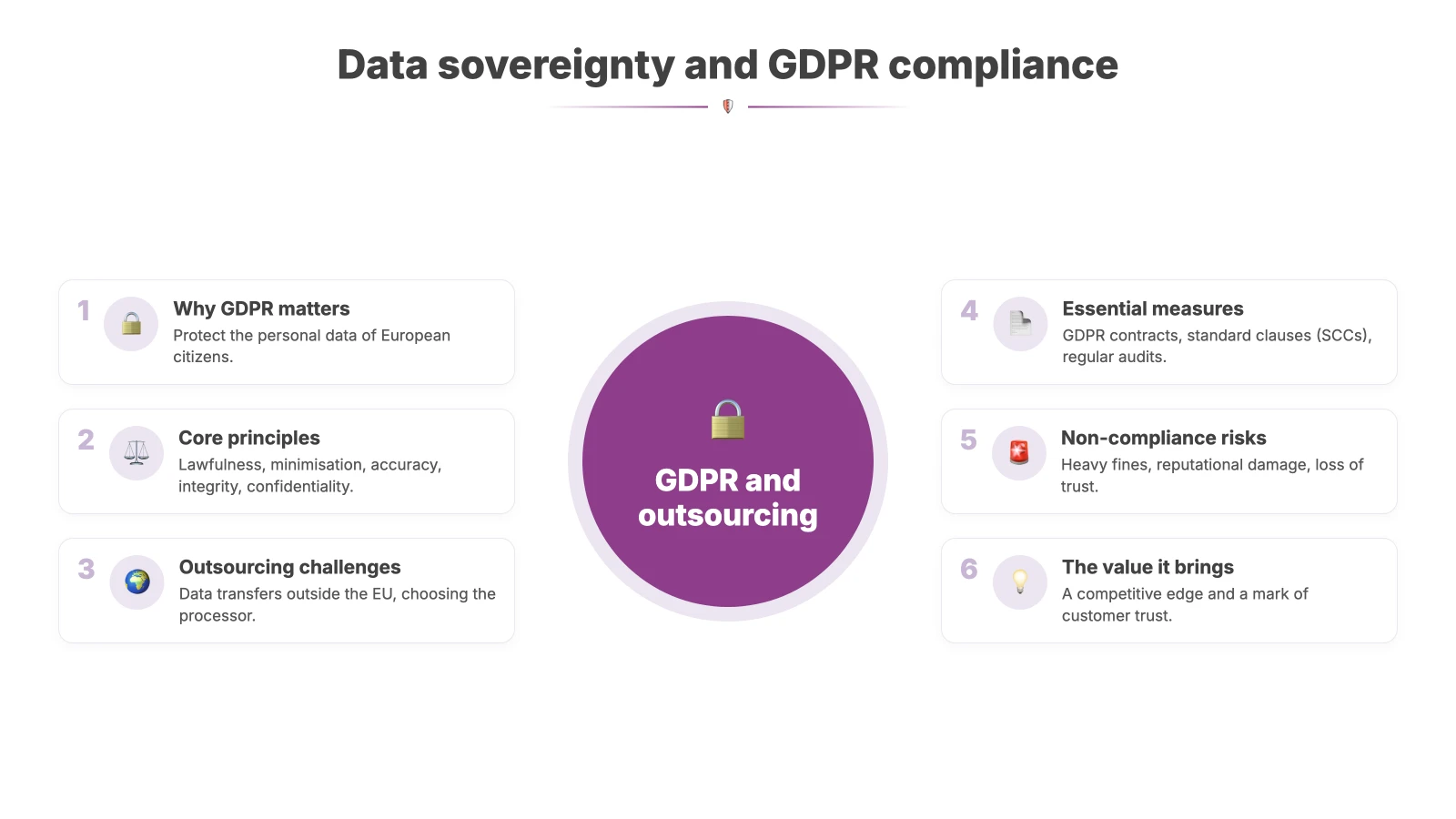
Something else gets underestimated: primary responsibility stays with you, the client company. When an incident hits, the cloud subcontractor has to notify you fast. GDPR sets the alert deadline at 72 hours at the latest, and high-stakes processing tied to call data and metadata can call for a Data Protection Impact Assessment (reminder of GDPR duties on the cloud-subcontracting side).
Turn that into concrete questions to validate before you sign, not commercial promises:
Where processing happens. Ask where calls, recordings, logs and backups are stored.
The real subcontracting chain. Demand the list of providers involved in hosting, analytics and support.
Encryption and traceability. Check how data is protected in transit and at rest.
Exports and data-subject rights. Make sure a standard-format export stays possible when you have to answer an access request.
Regulated sectors. For healthcare, check for a health-data hosting certification (in France, the HDS certification) on top of ISO 27001, and the SecNumCloud qualification where the context demands it (practical markers for hosting sensitive data).
One method point matters too. Supervision dashboards shouldn't expose more than they need to. Identifiers, free-text comments and sensitive metadata should be filtered at the source inside the reporting tools, so telecom supervision doesn't quietly become a new exposure risk. For an IT director, a mature provider shows it in how precisely they answer on architecture, jurisdiction and the technical chain, not in the marketing line.
Getting the technical integration right
Bolt an outside provider onto the existing setup in a hurry and the whole thing turns fragile. Connecting them to a call queue is the easy part. The real work is guaranteeing that telephony, CRM, routing, agent identity, history and reporting all stay coherent.
The cloud PBX stays the central piece
In a modern setup, the cloud PBX is what keeps your hands on numbering, queues, routing scenarios and operational visibility, even when some of the agents are external. That foundation is what stops the provider from turning into a black box.
In practice, decide what you keep under direct control. Numbers, opening rules, forwards, announcements, ring groups and routing priorities shouldn't depend on someone manually changing a setting at a third party. The more of that your company or its integrator can steer, the easier reversibility becomes.
Integration quality also plays out in the business applications. When an external agent picks up a call, they need enough context to help and nothing beyond that. That's where CRM integrations earn their place: they link telephony and customer records without multiplying double entry or leaving permanent access lying around.
Healthy integration rests on a few building blocks any IT team already knows:
REST APIs and webhooks to sync statuses, push call events and feed internal tools.
Computer-telephony integration (CTI) to surface the customer record at the right moment and log the interaction.
A shared knowledge base so the provider doesn't answer differently by channel or team.
Fine-grained permissions to limit what an external agent can view, edit or export.
On security, one requirement isn't up for negotiation. Call-data storage has to stay in the EU, and voice flows have to be encrypted over SIP TLS and WebRTC, so that connecting to the CRM never opens a gap while data is in transit (technical security requirements for outsourced contact centers).
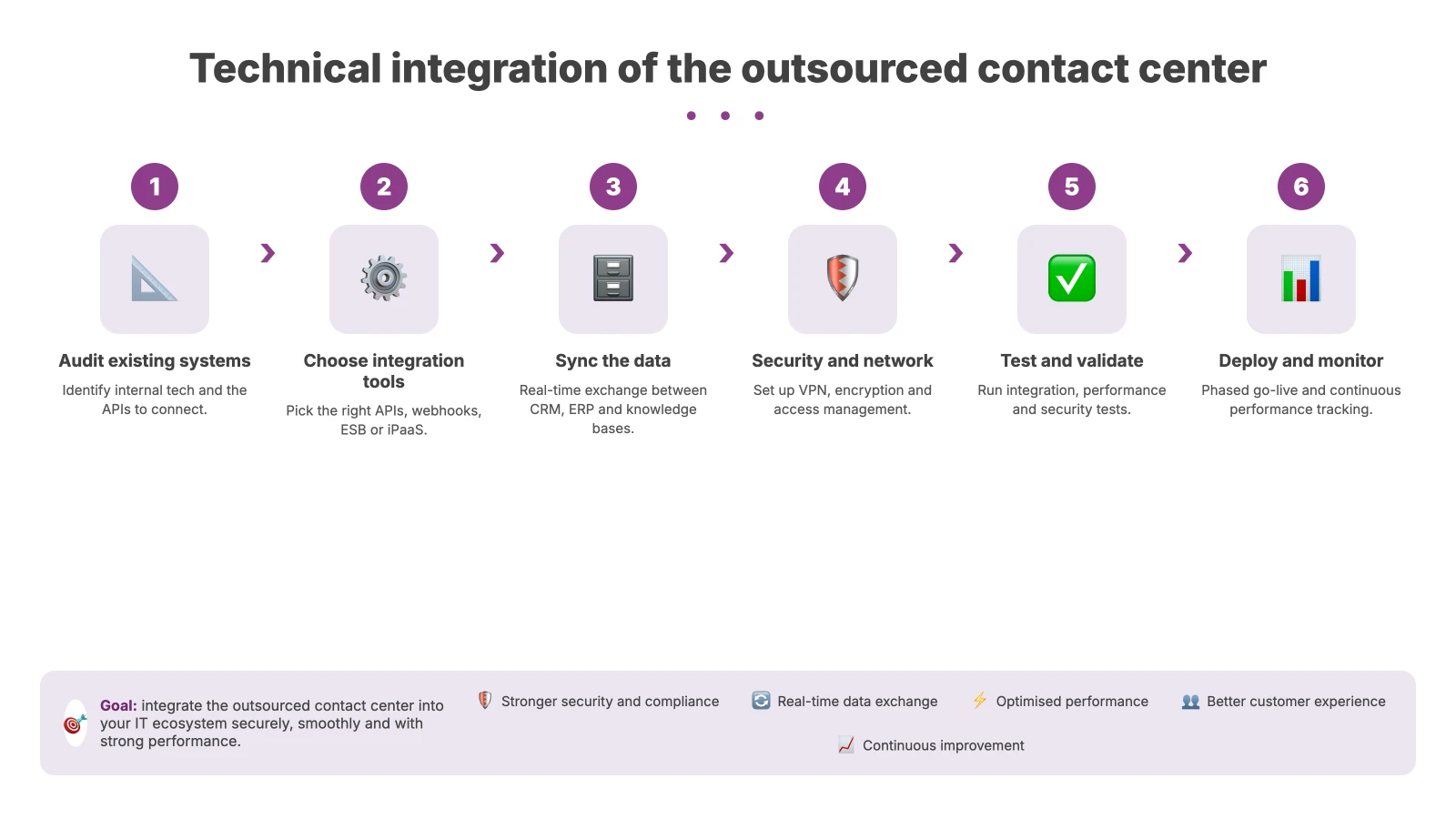
Keep the rollout gradual, too. A pilot on one queue, a reduced CRM scope, escalation tests, then a controlled ramp-up. That approach limits production incidents and stops you finding out too late that a sensitive field is surfacing in an external interface or that a call history isn't being logged properly.
Start from what a good provider will let you do to them. The best ones accept a precise frame, document their architecture, and let themselves be steered on useful metrics. Treat the biggest promises with the most caution, because the loudest sales pitch and the strongest delivery rarely come from the same vendor.
Operational KPIs are a good starting point. An outsourced center should target first-contact resolution above 75% and average handling time under 4 minutes, with the potential to cut operational costs by close to 30% when organisation, training and reporting are well run (performance benchmarks for an outsourced call center).
Keep price a secondary criterion until the structural points are validated:
Compliance and hosting. Check the EU location, the incident procedures and the subcontracting chain.
Integration capability. Ask how the provider connects to your cloud PBX, CRM, ERP and reporting tools.
Sector references. A provider comfortable in retail isn't automatically fit for healthcare, the public sector or technical B2B.
Management quality. Identify the supervisor, the QA setup, the call listening and how often reviews happen.
Reversibility. Plan how you'll recover data, scripts, history and numbers if the partnership ends.
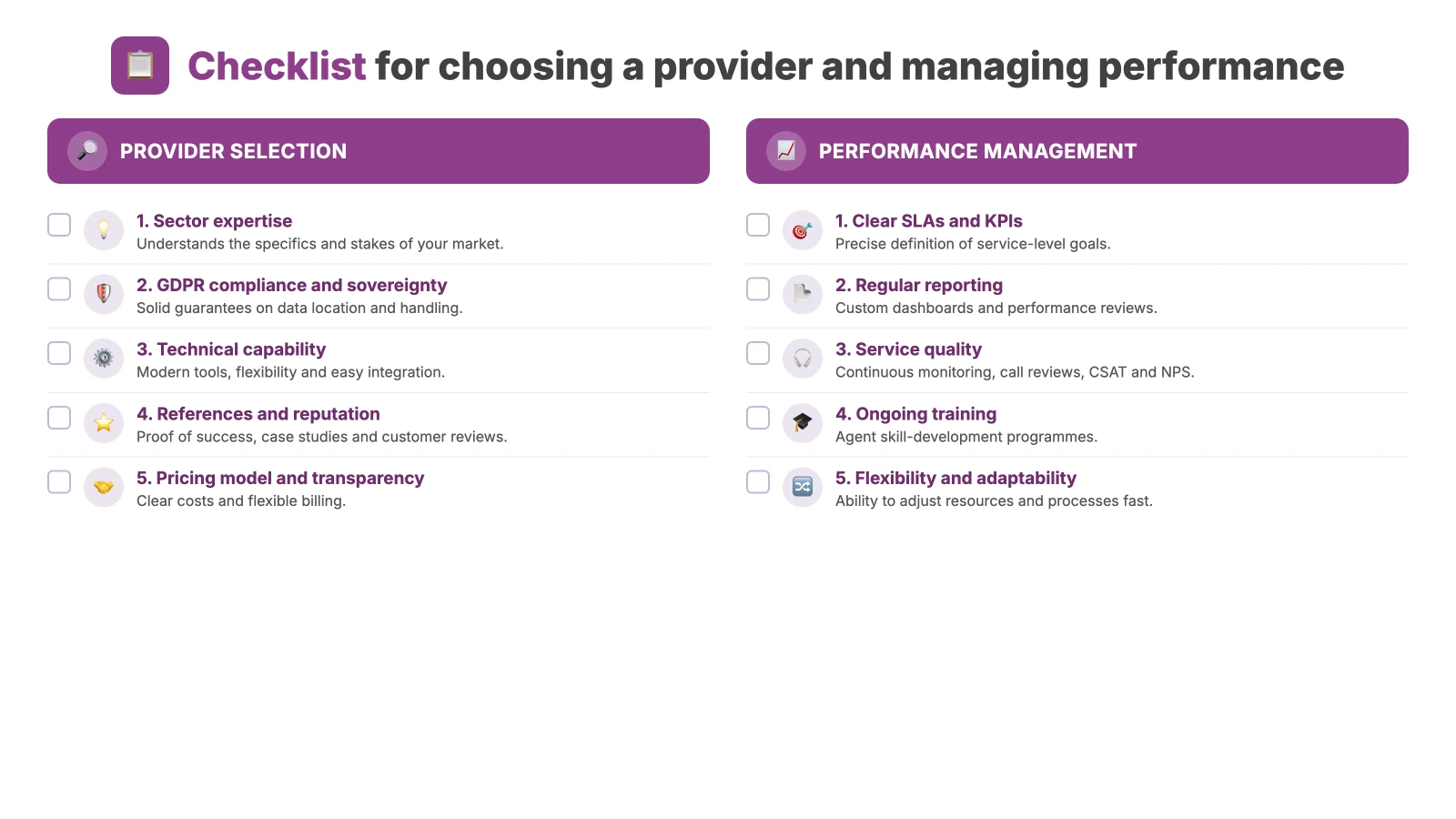
The steering has to be contractual and visible. A useful contract goes past hours and volumes: it spells out the SLAs, the KPIs, the escalation cases and the level of visibility you expect. Operationally, that usually means shared indicators (FCR, AHT, call quality, contact reasons, transfer rate), a review rhythm (daily at launch, then weekly or monthly as things stabilise), correction rules (who fixes scripts, who updates the FAQ, who signs off on messaging), and an audit scope covering quality, access and data use. A good provider takes the measurement as given and spends the conversation on how to read it well and close the gaps.
Frequently asked questions
Can we keep the same phone numbers?
Yes. In most serious projects the company keeps its numbers. Handle it early, because the telephony, the routing and the outsourcing contract all have to line up. What usually goes wrong isn't feasibility but poor coordination between carrier, integrator and provider.
What contract length is reasonable?
It depends on the level of integration, training and customisation. The more specific the setup, the more time you need to amortise the onboarding. A long contract with no reversibility clauses, no quality milestones and no auditability just creates dependency you don't need.
A generalist BPO can run several support functions. A contact center specialist is usually more mature on telephony, real-time supervision, scripts, QA, queues and CTI integration. For sensitive customer journeys, that specialisation often makes the difference.
How do providers bill?
The common models are per seat, per hour, per action, or a capacity package. The right one depends on the type of flow. For reception or continuous support, a capacity logic is usually clearer. For targeted campaigns, a per-action logic can fit better. Either way, transparency about what's included matters more than the pricing label.
Should you outsource everything?
No. Many companies get a better result from a hybrid model. They keep high-value interactions, complex complaints and the most sensitive access in-house, and hand the standardised volumes or extended hours to an outside partner.
Voxbi helps European companies, IT integrators and telecom resellers modernise their telephony with a cloud PBX hosted in the EU, built for data sovereignty, CRM integration and flow control. To weigh up a more controllable architecture before or during a contact center outsourcing project, take a look at Voxbi.