
DDI number: what it is and how call routing works
A DDI number maps one public number to one internal destination. How DDI routing works, how it sits next to the main company number, and how to configure direct numbers in a cloud PBX.

Your switchboard rings all day, and some of those calls still miss the person who could deal with them. A prospect lands on reception, a customer waits, a colleague passes the call along, and the enquiry drifts around the building. Reception can't guess which of forty desks a caller wants, and in plenty of companies the difficult part is getting each caller to the right desk on the first attempt.
A DDI number solves that at the routing layer. DDI stands for Direct Dial-In, the term used in the UK and across Europe, and North America names the same mechanism Direct Inward Dialling, or DID. One public number points at one internal destination, so an outside caller reaches the right person or team without a manual transfer. In France the same service is called Sélection Directe à l'Arrivée, or SDA: a telephone service option that reaches an extension on a private exchange without an operator stepping in (French-language dictionary entry for SDA).
A DDI number is a routing method, and the routing is what you design. For a small or mid-sized company, an IT integrator or a telecoms reseller, that shapes the switchboard, the extension plan and the caller's experience. French deployments fold the same idea into the ten-digit national numbering plan, a local convention that UK numbering doesn't share.
What a DDI number is
A DDI number is a public number mapped to one internal destination: an extension, a hunt group or a voice menu. The caller dials it, the platform reads the dialled number, and the call lands where the mapping says it should. No operator answers first, and the caller doesn't need to know an internal extension code.
The daily difference shows up in transfers. A traditional switchboard greets, sorts and then forwards. A DDI number fixes the destination before anyone answers, which cuts transfers for a sales desk, a workshop, a support team or a practitioner. The caller gets a shorter route in and one number to remember.
The term carries history in European business telephony. Companies that ran a PABX, then an IP exchange, then a cloud platform kept the same vocabulary, because the mapping idea outlived every generation of hardware. The mapping moved from a card in a cabinet to a server, and now to a web interface. For the layer underneath a DDI plan, our explainer on how a cloud PBX works covers the platform that holds those rules today.
Design in destinations and handling rules. Who has to be reachable directly, at which hours, and what the system should do when that person is busy, away or outside opening hours. Those answers decide the DDI plan, and the configuration follows from them.
How a DDI number reaches an extension
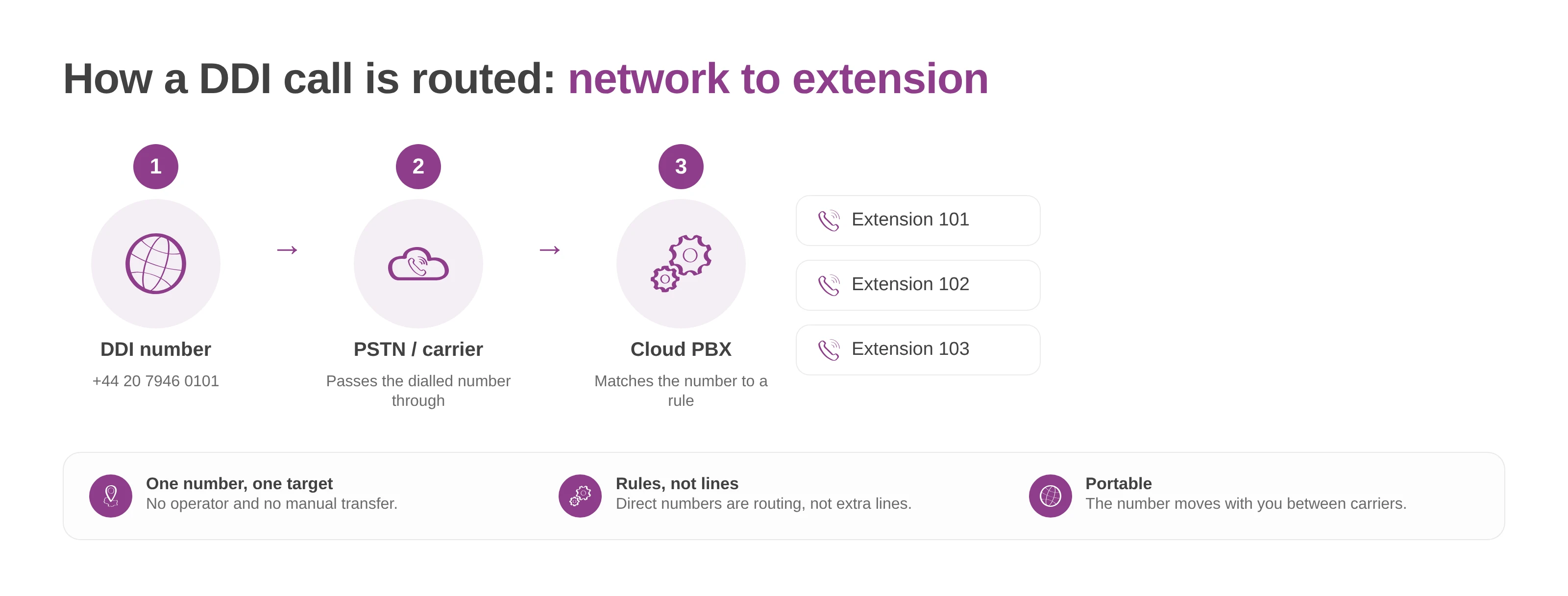
An inbound call doesn't simply arrive on a line. It travels a defined path that starts at the carrier and ends on an internal extension, a group of people or a voice server. In an IP setup the carrier hands the call over on a SIP trunk, and our piece on SIP trunks and CompanyFlex explains that handover.
The caller dials the public number. Someone outside the company starts the call.
The carrier network carries it. The network transports the call and keeps the dialled number with it.
The phone system reads that number. The private exchange or the cloud platform identifies the intended destination.
The system matches an extension. The call goes to the desk, the department or the group set in the mapping.
The mapping works with single numbers or with a block of consecutive numbers. A company that opens a department, hires a manager or splits a team differently extends the plan instead of rebuilding it. That flexibility is why the same approach fits legacy exchanges and cloud platforms, where routing changes often and the rules have to stay readable for the IT team.
Configuration goes past pairing a number with an extension. You also set what happens when the extension is busy, unattended, already on a call or outside working hours. Those are reception instructions written in advance, so the call doesn't depend on one person sitting at one desk at one moment.
Direct routing gives real operational precision. The switchboard handles general enquiries, and DDI numbers reach a specific extension, group or fallback destination with no extra work for the caller. Where several sites, several departments and several confidentiality levels share one system, the mapping document is the reference an IT team works from.
A large set of direct numbers costs nothing in physical lines. A DDI plan rests on the numbering plan and the routing rules, so administration stays central while access stays individual. Multi-site companies and sales teams get individual reachability without a cabinet full of cards.
DDI numbers compared with other call-handling options
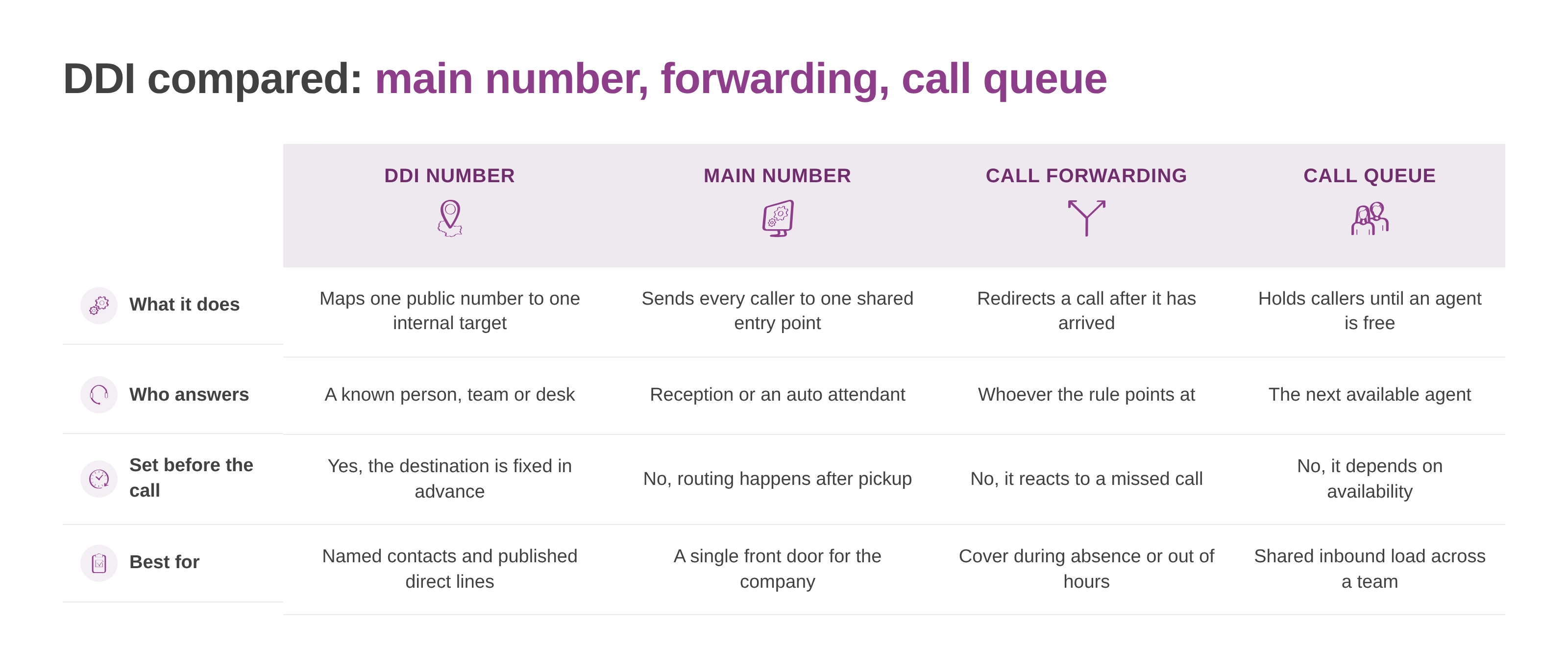
Several telephone features revolve around a number, and their purposes differ. A shared number gives several people one entry point to answer. A DDI number gives one target a direct and stable identity.
A call divert redirects a call that has already arrived. A DDI number picks the internal destination from the start, which makes it part of the call architecture rather than a patch applied afterwards.
The company's main number stays the general front door for reception, switchboard duty and unsorted calls. DDI numbers add targeted entry points for the people and departments who need to be reachable without central filtering. The two carry different expectations on the caller's side.
Naming stays important when a cloud platform bundles several building blocks. DDI is an addressing and routing mechanism, and it sits in the same plan as billing models, call queues and private networks. Integrators who record the exact role of each block keep the call plan readable a year later.
Four points keep a design straight:
A direct number complements the switchboard, and the two usually work best side by side.
Number assignment and routing are two halves of the same mechanism, so a DDI plan needs both.
A queue distributes calls among agents, while a DDI number addresses one destination.
Durable reachability comes from the numbering plan, and diverts handle the exceptions on top of it.
For the wider view of how a virtual switchboard and direct numbering fit together, our guide on choosing a cloud phone system compares the setups.
Where DDI numbers pay off for growing companies
A direct number for the sales team simplifies prospect handling straight away. The caller stops working through a general greeting and reaches a person or a group who already expects the enquiry.
In a law firm each partner can hold a direct number. The firm keeps a central switchboard for general calls, and sensitive matters or urgent appointments stop waiting on manual filtering. A clinic works differently and needs the same outcome, which is the right practitioner reachable without a detour.
A hotel usually runs reception, reservations, maintenance and management as separate desks. One DDI number per desk gives each of them a clear entry, the guest sees where the call goes, and the team doesn't have to re-explain who handles what.
Across a multi-site company the gain is consistency. Head office keeps central control while every site, department and manager holds its own telephone identity. Service continuity improves without stacking transfers and generic numbers on top of each other.
Rule of thumb: give a direct number to any department that handles the same request every week, and keep the main number for the general cases.
Reaching the right extension first time also changes how the company reads on the phone. The caller meets an organisation that knows where its own work sits, and that impression is part of the brand. Companies running everything through one central switchboard still lose a minute or two on every call.
Setting up DDI numbers in a cloud PBX
A cloud PBX makes DDI administration lighter than a hardware exchange ever did. Users, extensions, ring groups and routing behaviour live in one web interface, so a change takes a form and you don't wait for a site visit. In Voxbi that work happens in Voxbi Cockpit, the management interface built for European companies. Numbers, ranges and portability sit on the telco side with Mixvoip, and the routing rules on top of them sit in Voxbi Cockpit.
Set the destination of each DDI number first: a single extension, a team, or a fallback group when the first target is unavailable. Then set the schedule, because a direct number doesn't have to ring the same way inside and outside opening hours.
Voice menus, call queues and custom opening hours usually sit around those mappings. That combination turns a DDI plan into working routing rather than a directory of desks, including when a team works remotely or across several sites.
The platform centralises the rules and then allows adjustments without hardware work. Deployments get shorter for a customer who wants to go live quickly, and a numbering plan that follows the organisation chart survives a reorganisation.
Security belongs in the same configuration pass. Cloud telephony uses TLS and WebRTC in the call path, and integrations with business tools come in where a team needs them. Routing, user identity and availability rules stay aligned with each other, and a wider look at business communication tools places the DDI plan inside that set.
Portability, security and GDPR practices
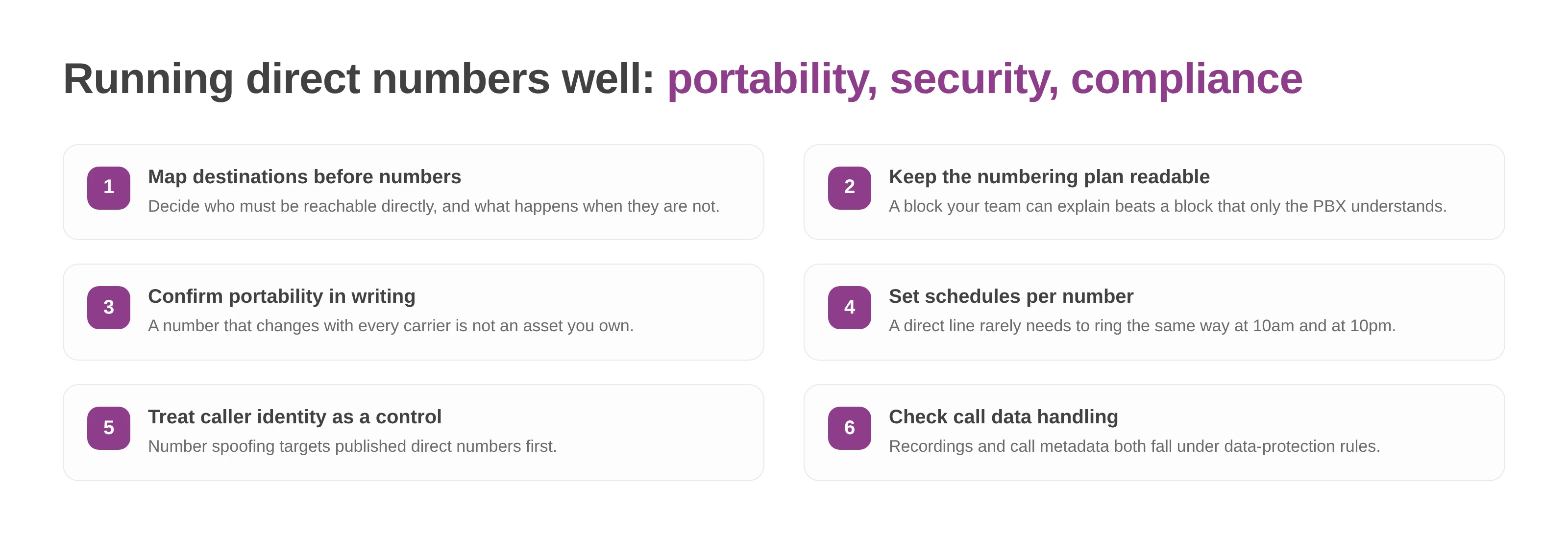
A DDI plan depends on more than routing. It depends on how the company protects its numbers, handles a change of provider and governs telephone data. Portability sits at the centre of that, because a direct number printed on contracts and signatures loses value if it changes with every carrier or office move.
Document the assignments first. Each DDI number wants a clear purpose, a named owner and a fallback rule for the days its recipient is away. Plan the continuity of that numbering before a change of provider, since direct numbers usually live in customer records. Call metadata and call recordings need the same review, because the GDPR asks for concrete attention on both.
Where the data sits is a genuine selection criterion. A European company that picks a cloud platform with European hosting has a more coherent frame for its compliance and sovereignty requirements, so it's worth having the hosting arrangement confirmed in writing for your own account. Telephony carries sensitive information, which puts it in the same review as any other business system.
Caller-identity risk deserves its own internal control, because a direct number is a published address. A DDI plan works inside a set where routing security, access management and traceability act together.
Getting started with a DDI plan
DDI stays one of the most useful ideas in business telephony, because it links a simple need to a durable architecture. Reaching the right person is the need, and a numbering and routing plan is the architecture. In a cloud setup that plan absorbs reorganisations, extra sites and changing service hours without new hardware.
Deployments that go well start with a map of use before the technology. Who has to be reachable, at what hours, from which number, and with which fallback when nobody answers. Once that map is clear the configuration is short, and there's little room left for two numbers pointing at the same confused destination.
The regulatory side carries the same weight as the routing. Telephone data handling, number portability and the hosting question all belong in the first design pass, which costs less than a cleanup later. Sketch the reachability map, name an owner for every direct number, and then build the plan in Voxbi Cockpit.
Voxbi runs a cloud phone system for European companies, with central management of numbers, extensions and call flows in Voxbi Cockpit. For a team working on a DDI plan, that's a practical base for direct numbers, handling rules and the records a compliance review asks for. To scope a setup for a small company, a growing group or a multi-site network, write to hello@voxbi.com.