A SIP trunk is a digital connection that lets your company phone system, usually an IP PBX, place and receive calls over the internet instead of over physical phone lines. Most teams asking what is a SIP trunk are already mid-project: a legacy line is being switched off, and something has to answer the calls before that date arrives.
Orange Business reported that 92% of French business fixed lines already ran on SIP trunking or VoIP in 2023, against 45% in 2018 (Orange Business on SIP trunking). That figure covers France alone and counts SIP trunking together with VoIP in general, so read it as a direction of travel rather than a measure of SIP trunk adoption on its own.
For the IT managers, telecom leads and integrators running these migrations, the move to IP is settled. The open questions are narrower: how to replace legacy public-network access cleanly, how to keep the phones answering during the switch, how to protect the voice streams, and how to keep call data in Europe.
A one-line definition won't get a migration signed off. You need to know what the technology replaces, how it behaves once it's running, and why it lands on budget, security and compliance at the same time.
What is a SIP trunk?
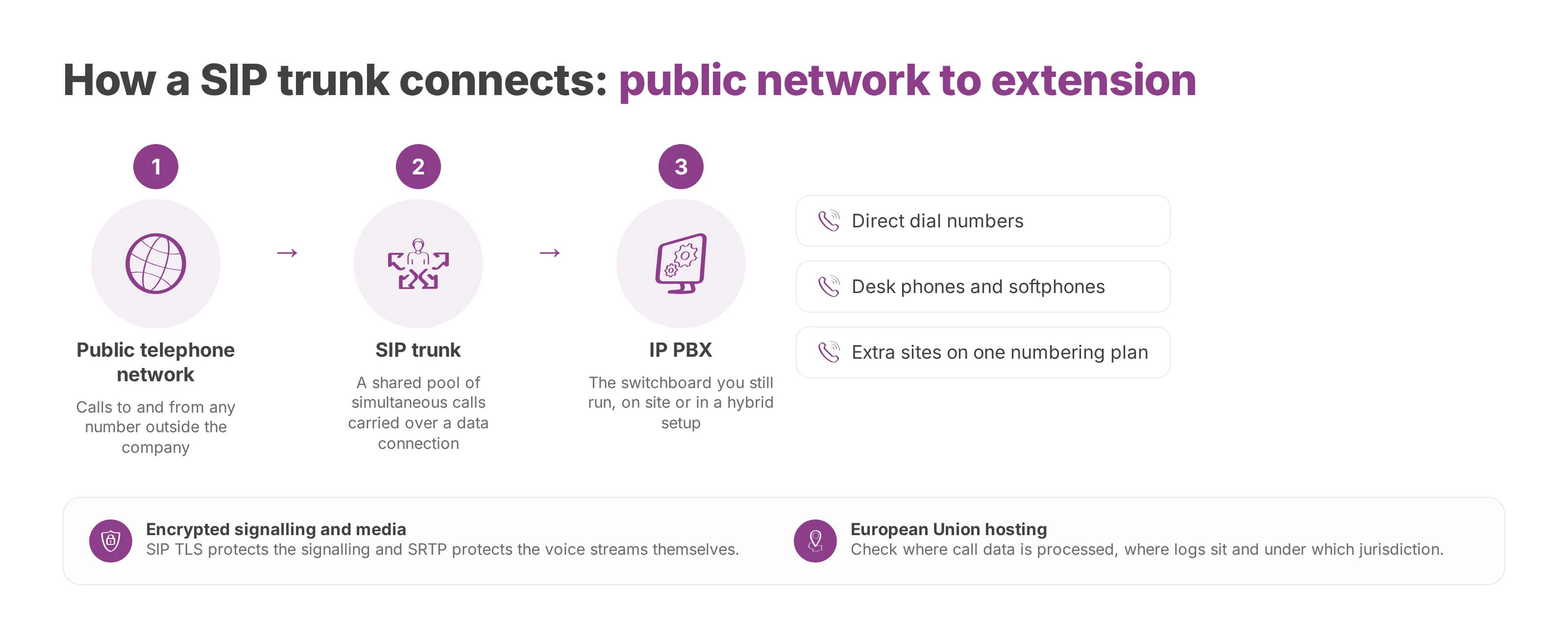
A SIP trunk is the logical connection between your phone system and the public telephone network, carried over a data connection. Instead of counting physical lines site by site, you buy a shared pool of simultaneous calls and hand out numbers behind it.
A definition your IT team can work with
The project-phase definition is short. A SIP trunk joins the company phone system, usually an IP PBX or a cloud telephony platform, to the public telephone network over IP. Capacity stops being a count of installed circuits and becomes a number of concurrent sessions.
Picture a bundled road rather than a set of private driveways. With older access types, an extension tended to sit closer to a logic of allocated lines. With a SIP trunk, you steer capacity as a shared pool. That changes how you size a switchboard, how you absorb a spike in inbound calls and how fast a new site starts answering.
Keep the scope tight. A SIP trunk covers the join between your business telephony and the public network. Consumer voice-over-IP apps belong to a different category of product.
Why SIP trunking becomes a strategic topic
Three questions arrive in the first meeting of every real project.
Cost. The migration usually aims to simplify subscriptions, stop multiplying access points and match capacity to genuine usage.
Security. Once voice travels over IP, it falls under the network policy, the encryption standard, access control and monitoring.
Data sovereignty. For an SME, a mid-sized group, a public body or a healthcare provider, hosting inside the European Union, documented processing and control over cross-border traffic all weigh on the decision.
SIP trunking therefore sits in telecom architecture and IT governance at the same time.
What "trunk" and "SIP" actually mean
The two words carry the whole idea. A trunk is shared call capacity, and SIP is the protocol that opens, steers and closes a session over IP. A precise definition matters because the follow-up questions are commercial. How many simultaneous calls do you actually buy? Where does call metadata travel? Can the provider guarantee European hosting?
The trunk: shared capacity
The word trunk comes from older telephone networks, where it described a bundle of lines carrying several conversations between two points. Over IP the shared-capacity principle survives without the underlying circuits.
Think of a motorway rather than a reserved lane. A traditional line behaves like that reserved lane. A SIP trunk behaves like shared tarmac, where capacity spreads across the calls in progress at that moment. Sizing changes with it, because you now plan in concurrent sessions, traffic priority and the quality of the connection carrying the voice.
The pooling has a direct business effect. Several numbers and direct dial ranges sit behind one connection and route cleanly into the IP PBX. Opening a site, riding a seasonal peak or merging two switchboards after an acquisition gets a lot less rigid.
SIP: the protocol that runs the session
SIP stands for Session Initiation Protocol. It handles the session rather than the audio. It starts the call, negotiates the exchange parameters, keeps the signalling dialogue alive and closes the session at the end.
That split clears up a common mix-up. VoIP is the wider family of technologies for calling over IP, and SIP is one of the signalling protocols used inside it. The voice itself usually travels over separate media transport. A SIP trunk, then, is a carrier interconnection built to join a business phone system to the public network, with routing rules, capacity and monitoring sized for professional use.
In a European project this goes past the technical layer. As soon as a call crosses IP infrastructure, you have to know where the associated data is processed, who administers the platform, which logs are kept and under which jurisdiction. Hosting inside the European Union, network segmentation, encryption, access control and audit trails are architecture decisions that move both risk and GDPR exposure.
What sits outside the SIP trunk
Three products get confused with a SIP trunk during migration projects.
A consumer calling app serves individual users. Connecting an IP PBX, running a company numbering plan and absorbing complex inbound flows all sit outside what it does.
An IP desk phone is the user's handset, while the SIP trunk carries every handset's calls to the outside world.
A cloud PBX replaces the switchboard function itself. A SIP trunk feeds a PBX you still run, on site or in a hybrid setup.
A quick test settles it. Ask which component connects your switchboard to the public telephone network, carrying carrier rules, call capacity and security requirements. If that component speaks SIP over IP, you're inside SIP trunking territory.
How SIP trunking works next to traditional lines
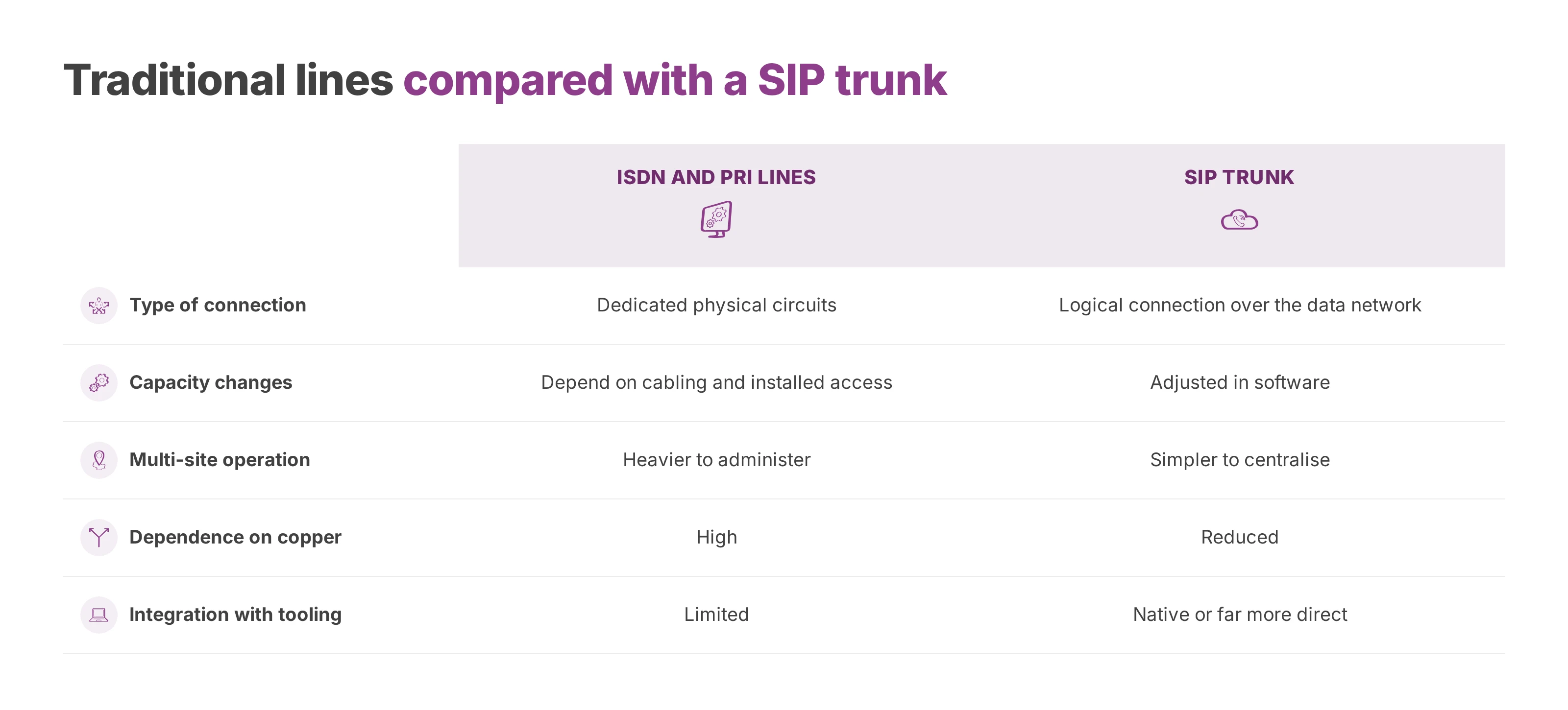
A SIP trunk moves the phone system's outside connection from carrier hardware onto your data network. In practice that changes how you size capacity, how you secure the streams and how you plan a multi-site cutover, especially when calls or technical logs have to stay hosted in Europe.
The architecture on your side
With legacy ISDN access (T0 and T2 in the French naming, with local equivalents across Europe), the switchboard depends on physical ports. Capacity follows the hardware: interface cards, cabling and usually a carrier visit. It works, and it slows down every change, from a new office to a reorganisation.
With a SIP trunk, the IP PBX talks to the carrier over an IP connection. Voice and signalling then live in an architecture closer to your corporate network than to the old telephone plant. The job stops being "order more lines" and becomes integrating telephony into the WAN, the security policy, the quality-of-service design and, depending on the sector, the residency rules covering hosting and technical records. Telephony turns into a managed network service.
SIP trunking compared with ISDN and PRI lines
A migration project treats the SIP trunk as part of the network and security architecture, so routing, traffic priority, encryption, resilience and the location of operational data all get validated before the first number moves.
Capacity and bandwidth set the real limit
Capacity questions land on the access connection. The practical version is how many simultaneous calls it carries without degrading audio, setup times or the stability of the site.
On traditional lines the answer came from the number of circuits you ordered. On a SIP trunk it comes from a wider set: subscribed capacity, the codec in use, connection quality, the priority given to voice, contention on the access and whether any redundancy exists.
So a serious migration opens with a survey of connectivity and real usage. Our guide to what drives voice quality on a business connection covers the measurements worth taking first. An internet connection that's fine for office work can still fall short for business telephony when there's no quality-of-service policy or when traffic peaks go unmanaged.
For European companies the same survey carries a regulatory reading. When calls, metadata or administration tools cross several countries, hosting choices, contract terms and the location of the supporting services all need checking. Replacing ISDN access is one part of the work. The architecture also has to match the traffic, the expected security level and the compliance rules the company already operates under.
Strategic benefits for European small and mid-sized businesses
An industrial SME in Lille buys a subsidiary in Belgium. A mid-sized services group opens an office in Barcelona and keeps its switchboard in France. Both need more than calls over IP. They need several entities joined together, costs under control and an architecture that fits European rules on security and data location.
SIP trunking answers all three at once: it cuts operational complexity for the IT team, it lets the business expand without ordering legacy access at every new address, and it makes costs track actual usage.
The cost structure changes first. A SIP trunk replaces physical lines and site-by-site engineering visits with call capacity you steer centrally. Fewer components to maintain, less dependence on legacy access, and lower charges for routine changes.
Call pricing is only part of it. The rest comes from how the architecture runs day to day. Adding direct dial numbers, reassigning them, connecting a new site or absorbing a temporary rise in activity takes less technical coordination than the same move on traditional access.
For a European SME that lands straight on the transformation budget. A well-planned migration avoids paying twice, once to keep the old system alive too long and again to rebuild in a hurry during a move, a merger or the shutdown of a legacy carrier service.
Scaling without waiting on cabling
Capacity moves as one number instead of a queue of line orders. You size the trunk against traffic, sites and business priorities, then adjust it as those shift.
The daily difference is concrete. A support team centralised on one site keeps answering for several locations without the same equipment being rebuilt at each address. When a seasonal peak arrives, capacity follows faster than a fixed-circuit model allows.
Typical cases look like this.
Multi-site SMEs centralise inbound calls and standardise one numbering plan, which lets scattered legacy access go.
Companies growing by acquisition fold a new entity in without rebuilding the voice foundation.
Healthcare, hospitality and customer service teams ride call peaks with more control over available capacity.
A flexible architecture also removes a familiar habit in traditional setups, where a company permanently oversizes to cover a peak that lasts a few weeks a year.
A base for unified communications
The third benefit usually shows up after the migration. The SIP trunk becomes one consistent connection point for tools already in the information system. Softphones, a cloud switchboard, mobility, CRM integration, contact centres and hybrid working all sit more easily on telephony built as an IP service.
The goal of a migration goes past reproducing ISDN with newer parts. A company that wants calls surfacing inside its business applications, activity tracked per team and traffic split between office and home working needs a foundation more flexible than a stack of dedicated lines.
For European organisations this carries a governance reading too. The closer telephony moves to cloud tooling, the more you need to know where administration data, call logs and supporting services are hosted. A good provider carries the voice well and documents its controls, its security scope and its data-handling practices.
Security and compliance for calls in Europe
A business call on IP falls under the company's security policy the moment it leaves the PBX. SIP trunking raises a governance question about traffic, logs, any recordings and call metadata, alongside the telecom one.
Two layers deserve attention on day one.
SIP TLS protects the signalling, meaning the messages that set up and control the call.
SRTP protects the voice streams themselves, so the media content in transit.
The principle is plain. Exposed signalling gives an attacker room to disturb call setup. Unprotected media puts the confidentiality of conversations at risk.
A serious provider also defines traffic separation, resilience, authentication, logging and monitoring for abnormal usage. In regulated sectors that's the starting requirement.
How EU hosting changes the decision
In Europe, security covers data location and contractual accountability as well as encryption. Under GDPR the practical questions are concrete: where call data travels, where logs are stored, who can reach them and under which legal jurisdiction.
A carrier or platform hosted inside the European Union raises the level of control you keep. European data centres, processing on European soil and clear contract terms about subprocessors close the usual compliance blind spots.
Some companies pick a hosted switchboard such as Voxbi for exactly that reason. It runs cloud telephony from EU data centres with a GDPR and European-sovereignty posture, in place of a spread of on-site equipment and scattered services.
What to check with a provider
A useful security specification stays concrete. A provider asked whether it's secure will say yes. Asked which flows are encrypted, where the data is hosted and how much control the company keeps, it has to produce specifics you can compare.
EU hosting. Ask for a clear statement on hosting and processing locations.
Compliance documentation. Check GDPR alignment, the contract paperwork and how subprocessors are managed.
Encrypted communications. Confirm that both signalling and media streams are protected.
Security operations. Look at logging practice, access control and service continuity.
Choosing and deploying SIP trunking
The provider choice decides the project. Migrations derail when teams haven't surveyed the existing setup or have underestimated the peripheral equipment hanging off it.
Questions to ask before you sign
A SIP trunking provider should answer four plain questions without hedging.
IP PBX interoperability. Does the trunk work with the switchboard you already run, whether that's 3CX, Asterisk, Mitel, Yeastar, Cisco or something else?
Operational quality. How does the provider handle quality of service, support, diagnostics and incident escalation?
Operational security. What protects the signalling, the outbound calls and the administration accounts?
Portability and continuity. How are number porting, the cutover and the rollback plan organised?
Comparing the commercial model pays off as well. Some contracts look flexible and hide their complexity in the pricing or the administration.
The mixed setups that stall migrations
Real sites rarely offer a clean architecture. Guides describe the SIP trunk as a tidy replacement for T0 or T2 lines and stop there, while the mixed cases decide the timeline.
Lifts, alarms, fax machines, analogue terminals, DECT phones and backup lines get the least coverage in help content. 3CX's SIP trunking overview presents them as the most frequent operational blockers when a company moves off the legacy public network.
Migrations stall in the plant room. A lift phone, an alarm dialler and one analogue fax set the go-live date more often than the protocol does.
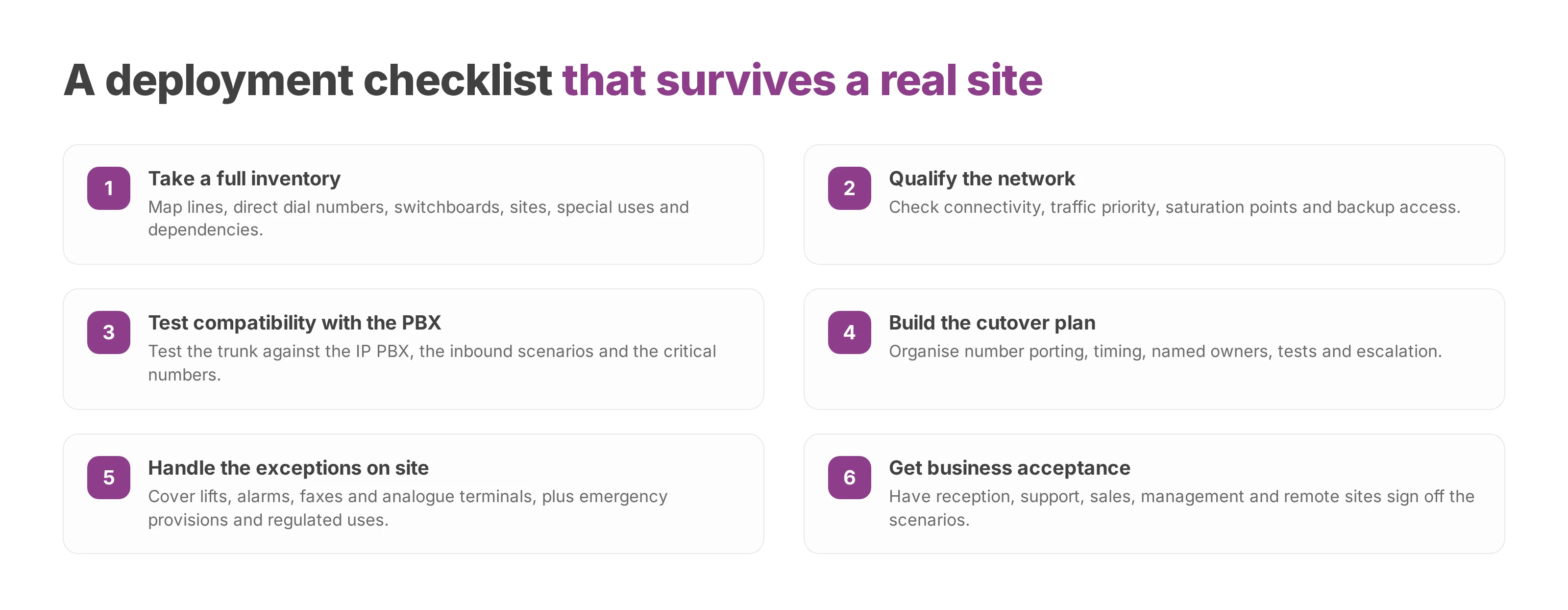
A deployment checklist that survives a real site
A clean migration usually runs in this order.
Full inventory. Map lines, direct dial numbers, switchboards, sites, special uses and dependencies.
Network qualification. Check connectivity, traffic priority, saturation points and backup access.
Compatibility testing. Test the trunk against the IP PBX, the inbound scenarios and the critical numbers.
Cutover plan. Organise porting, timing, named owners, tests and escalation.
Exception handling. Cover non-IP equipment, emergency provisions and regulated uses.
Business acceptance. Have reception, support, sales, management and remote sites sign off the scenarios.
That discipline separates a change of carrier from a controlled infrastructure project.
Beyond the SIP trunk: a fully cloud phone system
A SIP trunk stays a strong answer when the company wants to keep its IP PBX or modernise in stages. It brings a more flexible IP interconnection while the switchboard stays on site.
When an on-site IP PBX still earns its place
Some organisations have solid reasons to keep local equipment. A stable architecture already runs, specific business integrations sit on top of it, or a transition constraint calls for an intermediate step. The SIP trunk does its job there. It modernises the connection to the public network without forcing an immediate replacement of the whole telephony base.
Cloud PBX as the next step
For many companies the next move removes the physical switchboard as well. A cloud PBX replaces the on-site IP PBX with a hosted switchboard, administered from a web interface, updated on the platform side and run the same way across every site.
That step appeals to SMEs and mid-sized companies that want less hardware dependence, simpler administration and tighter control over where data is hosted in Europe.
The right choice follows the company's trajectory. A SIP trunk modernises the interconnection. A cloud PBX simplifies the whole system.
European companies leaving legacy lines behind while keeping a firm grip on hosting, security and compliance can run their telephony on Voxbi, a cloud phone system built for European deployments, with EU-hosted data, web administration in Voxbi Cockpit and the needs of integrators, resellers and mid-sized businesses designed in. Write down where your call data is processed today, then hold each provider's answer against it. Questions go to hello@voxbi.com.