An on-site PBX that's been running for eight years still works. Every change to it costs a ticket, a site visit or a call to an installer. Adding an extension, editing a voice menu, opening a second office or organising hybrid work all take more effort than they should.
A cloud PBX moves that same switchboard into a hosted service, so the decision belongs with your architecture. You still have to keep service continuity, keep control of your data, and hold a credible answer for the day an internet connection drops.
This guide is written for IT directors, IT integrators, telecom resellers and the people who run small, medium and mid-market companies in Europe. Flexibility is the easy half of the argument. Data sovereignty, the General Data Protection Regulation and resilience after the switched telephone network are the half that decides the project.
Why business telephony is changing now
Ageing equipment starts most of these projects. An on-premises switchboard turns fragile once it depends on one rack in one building, occasional visits from a technician, and a design drawn when everybody sat at the same desk every day.
The retirement of the copper network makes this deeper than a hardware refresh. Companies move to virtual lines that run on hosted servers, carry Voice over Internet Protocol, and come with centralised administration and remote maintenance. Bouygues Telecom Pro sets out that model in its analysis of cloud telephony.
For a company with several sites, the whole layout changes. The local switch stops being the centre of the system. Hosted architecture reduces your dependence on on-site hardware and lets you match the number of lines to real activity.
An ageing PBX slows down more than maintenance. It slows down opening a new office, running hybrid teams, and rebuilding how inbound customer calls reach the right desk. Telephony has become part of how you serve customers, and its cost line is the smaller part of that.
So treat the migration as an infrastructure choice with a five-year horizon. The useful question asks which architecture will hold continuity, governance and flexibility across that period.
Cloud PBX and cloud telephony, defined
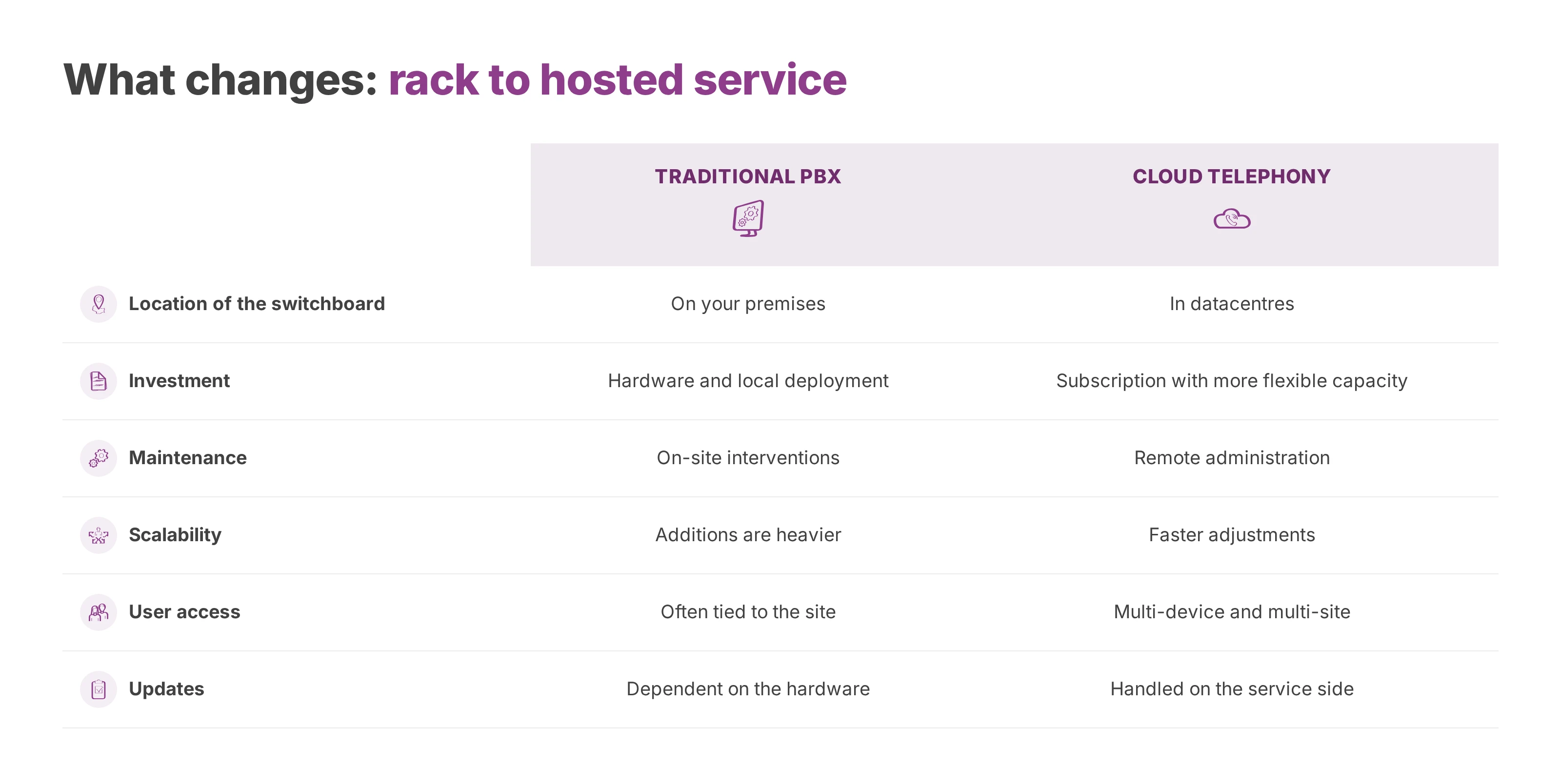
Cloud telephony keeps your switchboard in a provider's datacentres and delivers it as a service. A cloud PBX is that switchboard: extensions, call routing, auto attendants, queues, voicemail and call reporting, administered from a browser instead of from a rack in your comms room.
From an on-site PBX to a hosted service
Compare software on a CD-ROM with Microsoft 365 or Google Workspace. You used to own the server, run the updates and live with the hardware limits. With a hosted service the application logic stays available to you, and somebody else operates the infrastructure.
Telephony followed the same route. Instead of a private automatic branch exchange in a rack, you subscribe to a cloud PBX or to a Unified Communications as a Service offer. Your people call from an IP desk phone, a desktop application, a mobile or a browser tab.
The market has industrialised around that model. Global Voice over Internet Protocol services were worth 169.38 billion dollars in 2025 and are projected to reach 264.27 billion dollars in 2029, an average of 11.8% growth a year, according to the VoIP statistics Zoom publishes.
What changes in practice
The terms PBX, cloud PBX and Unified Communications as a Service overlap in vendor material. Our definition of a cloud PBX separates them without the marketing layer.
You're buying an operating model for your company's voice, and that model reaches IT, operations, procurement, security and the daily experience of your staff.
How the technical architecture works
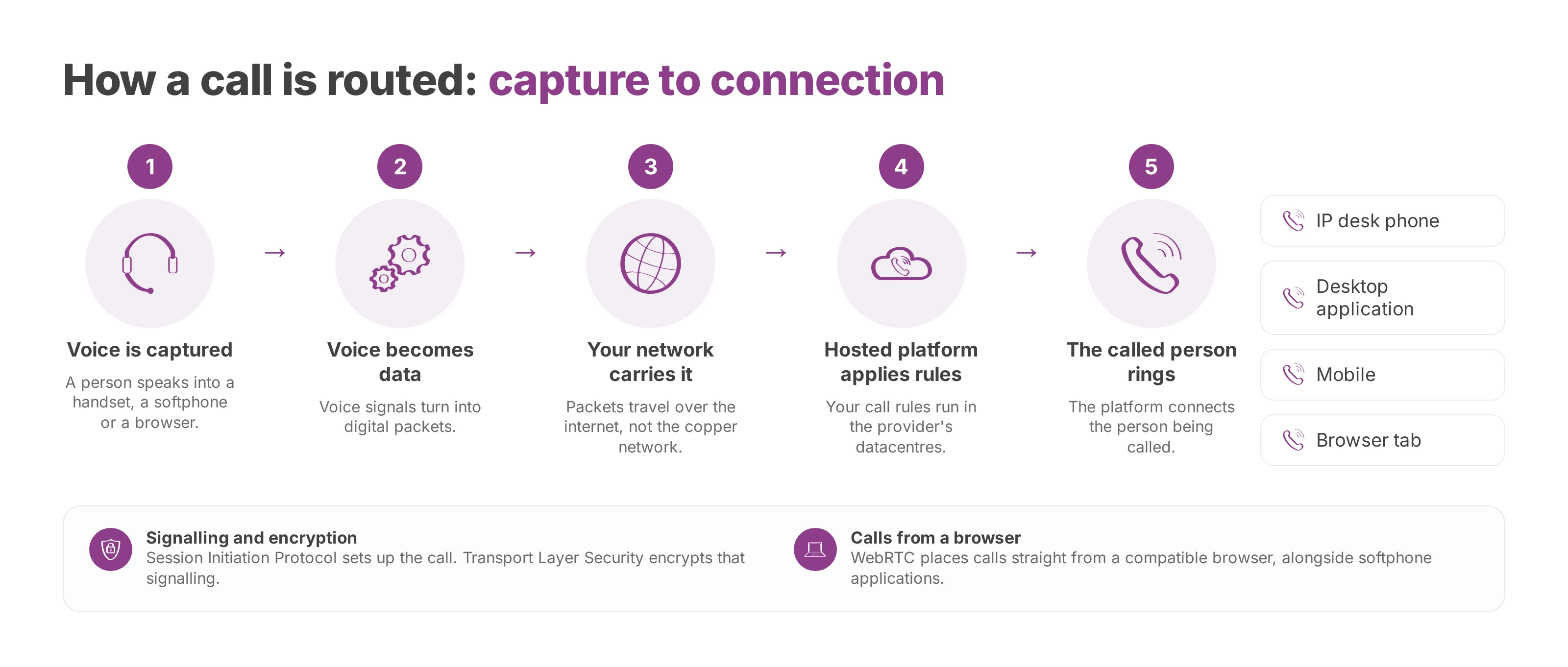
A call runs through four steps. Voice is captured. It becomes data. Your network carries that data. A hosted platform applies your call rules and connects the person being called.
The route a call actually takes
Cloud telephony runs on Voice over Internet Protocol. Voice signals become digital packets routed over the internet, which removes the need for the copper network, as Bouygues Telecom Pro describes in the analysis cited above. Any connected device can then place a call, and the same source presents hosted datacentre infrastructure as bringing high availability and immediate licence scalability with it.
Several components show up in nearly every project:
Session Initiation Protocol (SIP) for call signalling. It establishes, changes and ends the communication.
Transport Layer Security (TLS) to encrypt that signalling where the architecture provides for it.
WebRTC for calls placed straight from a compatible browser.
Softphone applications on computers and mobiles, alongside or instead of IP desk phones.
You don't need to be expert in each protocol to run the project. You do need the business effect of each choice. Voice as a software service means you can open a site faster, move somebody between desks with no telephony recabling, and change opening hours, queues and call forwarding remotely.
Why this architecture changes the economics
The budget shape moves from a hardware investment towards operating expenditure. You drop part of the load that came with local hardware, interface cards, on-site maintenance and physical upgrades.
Daily operations change with it.
A new colleague starts. You create the account, assign an extension and attach the user to a queue or a group.
A department moves floor or building. Numbers and call rules stay under control from the administration interface.
A team works from home. Calls keep flowing through the mobile application, the softphone or the browser, depending on the architecture you chose.
The technical shift is that the switchboard becomes programmable, administrable and deployable like any other service.
Tenders almost always ask about interconnection with the carrier network. How SIP trunks connect a company to the carrier network covers that part of the design.
Benefits for small and mid-market companies, and for specific sectors
A feature sheet doesn't justify a migration. The gains show up in daily operations, and they grow as soon as usage leaves the shape of one building with a few fixed handsets.
For a company with several sites
Picture a head office, a warehouse and two sales offices. With a physical PBX, each extension, transfer scenario or change of opening hours can turn into a small project. Hosted architecture gives your IT team one place to manage all four sites and one view across them.
Typical gains:
Opening a site gets simpler. A new office joins the numbering plan without a full local switch of its own.
Remote work gets cleaner. A sales rep keeps a business number from a laptop or a phone.
The company sounds consistent. Auto attendant, queues, ring groups and greetings live in one interface.
Capacity follows the business. You adjust users and lines for seasonality, hiring or reorganisation.
Management sees the speed of change. Your IT team also sees less dependence on local hardware and fewer repeat call-outs for small edits.
Healthcare, hospitality and public bodies
In these sectors the phone is the service, so continuity carries the most weight.
In a multi-site healthcare organisation, making a handset ring is the small part. You have to organise on-call rotas, transfers, reception desks and sometimes the recording or traceability of specific interactions. A hosted platform helps because the provider maintains the servers and your exposure to local hardware failure drops.
Hospitality has a different need. Reception, reservations, the floors and sometimes several properties have to stay coordinated. Cloud telephony makes central administration and consistent call scenarios practical, which pays off for a group that would otherwise maintain one system per property.
Public bodies usually put continuity of public service first, with variable opening hours and visibility over incoming calls. A hosted switchboard makes those changes faster than a strictly local system does.
With cloud telephony, the provider handles server maintenance. That matters most for hotel chains and multi-site hospitals, where service continuity is critical.
Flexible telephony pays off against a concrete operational problem. In healthcare it's the on-call rota. In hospitality it's multi-site operation. In a smaller company it's usually the speed of change. Mapping the real flows turns a telephony migration into a useful project: who calls whom, from where, at which hours, and who needs to supervise the result.
Data sovereignty and compliance decide the shortlist
Cloud telephony sold for years on three arguments: simpler, more flexible and cheaper to run. Those arguments still hold. A European buyer now adds a second set of questions before signing anything.
Where do calls, recordings and metadata live? Who can reach them? How does the company demonstrate compliance during an audit, a dispute or an internal governance review? DSTNY raises the same operational compliance questions about cloud telephony.
The questions to put to a provider
A serious tender goes past the feature list and asks for verifiable answers:
Data location. Do recordings, call history and metadata stay hosted inside the European Union?
Access traceability. Can you find out who viewed or exported a given set of data?
Retention policy. Are retention periods configurable against your business and legal needs?
Administration and rights. Are global administration, supervision and user access separate roles?
Analytics features. Are the artificial intelligence components attached to calls bounded by contract and by configuration?
For healthcare organisations, public bodies and companies under strong contractual obligations, those answers carry operational responsibility. Our checklist for choosing a cloud phone system puts them next to the commercial criteria.
An auditor reads hosting records, governance documentation, retention settings and access logs. A brochure line about the General Data Protection Regulation carries no weight in that review.
Why European Union hosting changes the decision
Sovereignty has a practical form here. A company that picks a cloud telephony platform hands over a sensitive share of its communication flows, its logs and its recordings. For an integrator or an IT director, the provider you keep becomes part of your own trust model, and part of what you have to explain to a customer or a board.
European Union hosting lines up with what many public and private buyers now expect. It makes technical architecture, contracts, access management and compliance requirements easier to align, and it keeps your dependency deliberate. You're choosing a supplier whose operating model fits your governance constraints, alongside the phone service itself.
The question sharpens as soon as a platform adds call analytics, transcription or other assisted features. Presenting compliance with the coming European regulation on artificial intelligence as already settled would be careless. It's reasonable to hold that a provider aligned on European hosting and on data protection requirements starts from a more favourable structure for following those developments.
Preparing the migration and planning for resilience
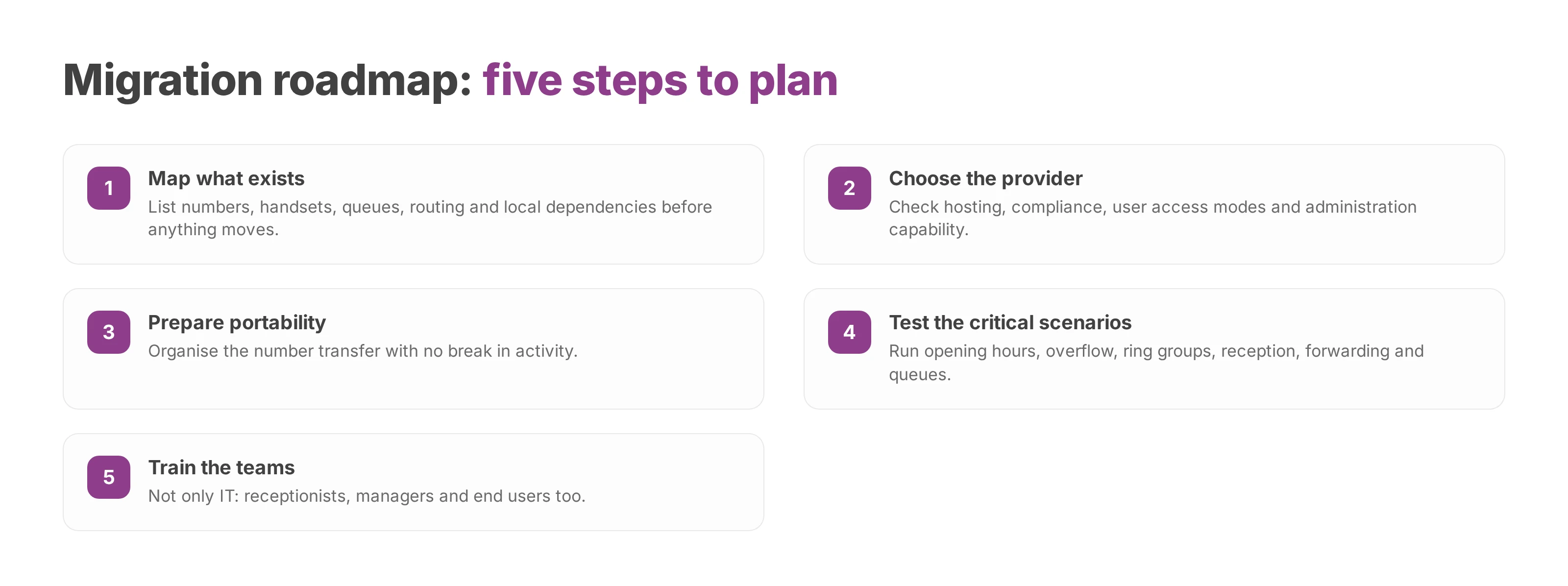
A migration starts well before the day the numbers port. It starts with an honest inventory of what you run today and with named risk scenarios.
A solid migration starts with a simple audit
List what most companies only half know: direct dial numbers, ring groups, any analogue extensions still in service, voice menus, fax machines, mobility use, security constraints, per-site internet access, opening hours and supervision needs. Direct dial inwards numbering has its own explainer if that part of the plan is unclear.
A clear roadmap usually looks like this:
Map what exists. Numbers, handsets, queues, routing and local dependencies.
Choose the provider. Check hosting, compliance, user access modes and administration capability.
Prepare portability. Organise the number transfer with no break in activity.
Test the critical scenarios. Opening hours, overflow, ring groups, reception, forwarding and queues.
Train the teams. Not only IT: receptionists, managers and end users too.
Adoption gets underestimated. A system can be technically ready and still create friction when people don't know which device to answer on, how to transfer a call properly, or how to read a presence status.
Resilience deserves a plan
Fibre fails. Local Wi-Fi turns unstable. A whole site loses its main access. Payplug covers that concern in its review of cloud telephony in business, where companies weigh pure cloud against mobile backup and redundant access, with the hidden costs of business continuity, quality of service and failover planning in view.
A credible resilience strategy stacks several layers:
A properly sized main connection. Voice copes badly with a saturated line.
Mobile backup. A 4G or 5G fallback keeps essential usage alive.
Call failover. Critical numbers redirect to mobiles or to another site.
A scenario per site. A head office and a warehouse rarely share the same priorities.
Regular tests, with the results written down.
An untested failover plan stays theoretical.
During this phase, ask which services stay available when one site or one access connection has an incident.
Comparing offers at this stage works on practical criteria. Voxbi, for example, may suit European companies that want a cloud PBX hosted in European Union datacentres, with browser administration, Microsoft Teams or Odoo integration, and number portability with no interruption, according to the information the vendor provides. That kind of comparison holds up when it stays factual and tied to what the project actually needs.
The safest migration handles telephony, operations, governance and failure scenarios together, and it usually runs longer than the fastest plan on the table.
More than a technology change
Replacing a physical PBX with a hosted platform changes the model. Company voice leaves the perimeter of local hardware and enters a managed, configurable service that you can align with how people actually work.
For a small, medium or mid-market company that means telephony fit for several sites, hybrid work, reorganisations and continuity requirements. For an IT director it adds two criteria that now decide European tenders: data sovereignty and the ability to prove compliance.
The best decision picks the architecture that lasts, survives incidents and keeps communication data under governance you can explain. Modern telephony earns its budget through what it makes possible. You open a site in a day. You nurse less local hardware. You keep control of communication data in Europe, which several of your customers will ask about.
Before you sign, write down where the data is hosted, who can access it, and what happens when a site loses its access.
Voxbi runs a cloud telephony platform built for European companies, with hosting in the European Union, administration through Voxbi Cockpit, business integrations and support through a network of integrators and resellers. Mixvoip supplies the numbers and the carrier side. You can reach the team at hello@voxbi.com.