The on-site phone system still works. Every change needs a site visit, remote work makes daily operation awkward, and each new office reopens questions about cabling, maintenance and service continuity. For a small or mid-sized company, an integrator or a reseller, the job now goes past swapping an ageing private automatic branch exchange for a newer box. You're taking back control of a critical part of the information system.
A SIP phone does that job once you treat it as a network component. Voice travels over IP, administration becomes software, and switchboard logic moves into a cloud PBX. That shift changes how you deploy, administer and secure business telephony.
Europe adds one more criterion. Telephony carries sensitive data, so the platform, the hosting and the operating model all have to account for data sovereignty, European Union residency and the General Data Protection Regulation.
IP telephony as an infrastructure decision
A phone system earns its keep by following the real organisation. Open a site, move a team, change opening hours or send part of the staff home, and telephony has to follow without friction. Older private automatic branch exchanges hit their limit at exactly that point.
IP telephony replaces dedicated lines and specialised switches with network logic. Voice rides the IP infrastructure, switchboard functions sit in one place, and administration looks far closer to IT practice than to traditional telecom work. You get less dependence on a local rack, faster deployments and better fit with the tools already running.
None of this is new. Voice over IP was commercialised from 1995, the first standardised version of SIP dates from 1999, and Voice over IP already carried 25 percent of all voice calls in 2003 against under 1 percent at the end of 1998, according to a history of Voice over IP and the SIP protocol. The technology has been industrialised for two decades.
A clean project starts with architecture, network, usage patterns and compliance constraints. The handset comes later. Read a SIP phone rollout across four layers:
Infrastructure. Voice joins the data network, with everything that implies for segmentation, prioritisation and security.
Operations. New users, call queues, groups and time-of-day scenarios get managed as services.
Compliance. Hosting, call logs, recordings and metadata stay compatible with European requirements.
Continuity. Migration from an existing exchange runs in stages, with no hard cutover.
That reading is what separates a proper deployment from a handset swap.
What a SIP phone is
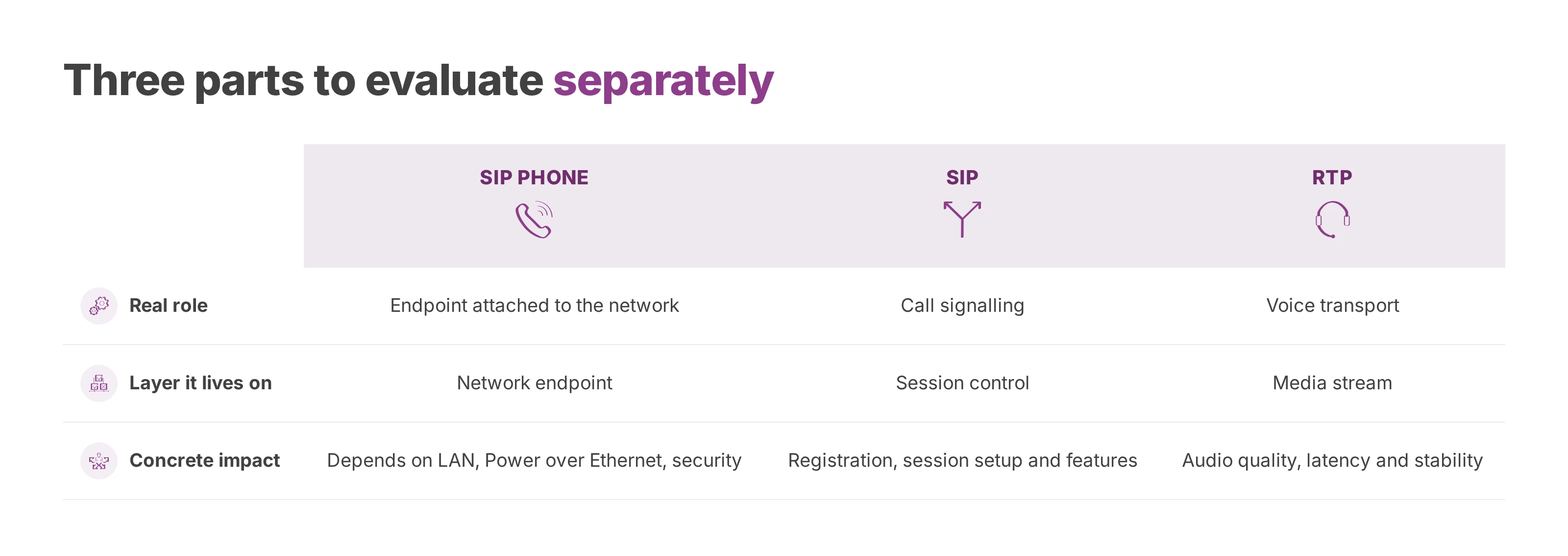
A SIP phone is a piece of network equipment first. It picks up speech, converts it into IP packets and sends them across the local or wide area network. So it depends on addressing, Power over Ethernet where you use it, the voice VLAN, quality of service and local network security.
SIP, the Session Initiation Protocol standardised in IETF RFC 3261, handles signalling. It lets the handset register, advertise that it's reachable, set up a call, negotiate session parameters and close the conversation. The audio itself travels over RTP, the Real-time Transport Protocol. That separation is simple on paper and decisive in the field: a handset can register perfectly over SIP and still sound bad when the RTP path is badly prioritised or badly routed.
The IP network carries the packets. SIP opens, steers and closes the session. RTP carries real-time audio.
Registration failures, login problems and dial-plan errors usually sit with SIP or the phone platform. Echo, latency, jitter and dropouts usually sit on the media path, so with the network, the codecs, the firewall or the prioritisation policy. Sorting a symptom into the right layer saves you a week of the wrong diagnostics.
Why SIP stayed the common ground
SIP won because it makes handsets, phone systems, carrier trunks and business tools work together, provided you check the compatibility profiles in detail. Full plug-and-play is rare. Function keys, busy lamp field, auto-provisioning, encryption, codecs and forwarding behaviour all vary by manufacturer. If you build offers, that variation is an opening: you can stay open on hardware while controlling exactly which combinations you support.
A well-chosen SIP environment also cuts dependence on a single vendor, and it lets you pick the hosting, the carrier and the cloud PBX that fit your data residency, compliance and continuity requirements.
Three parts to evaluate separately
How a SIP phone works with a cloud PBX
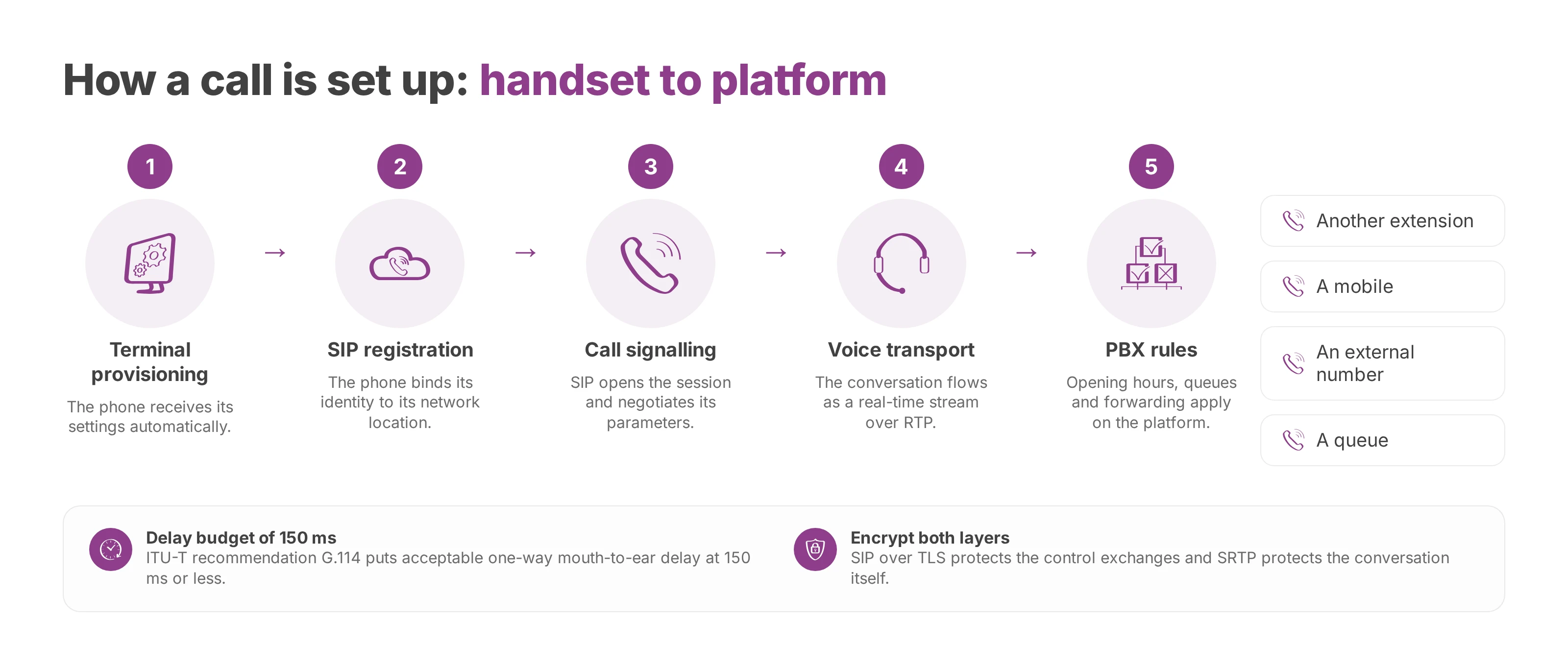
A cloud PBX gives the handset its purpose. Call logic, the dial plan, groups, queues, forwarding and administration policy all live on the platform, and the phone becomes one endpoint of a system you steer centrally.
The handset boots, fetches its configuration, registers with the platform and becomes reachable on its extension. When someone dials, signalling goes to the PBX, which decides where the call lands: another extension, a mobile, an external number or a queue.
A call, step by step
Terminal provisioning. The phone receives its settings automatically, which removes handset-by-handset configuration and the field errors that come with it.
SIP registration. The phone announces itself to the platform and binds its logical identity to its current network location.
Call signalling. SIP opens the session and negotiates its parameters.
Voice transport. The conversation flows as a real-time stream over RTP.
PBX rules. Opening hours, queues, groups, forwarding, voicemail and multi-site routing apply on the platform side.
Network quality sets the ceiling on call quality
Voice on a SIP phone rides RTP, so latency, jitter and packet loss decide what a caller hears. ITU-T recommendation G.114 puts acceptable one-way mouth-to-ear delay at 150 ms or less. Hold jitter under roughly 30 ms and packet loss under 1 percent, and conversations stay natural. Quality of service keeps voice ahead of bulk transfers, and a technical guide to SIP phones and quality of service ties network congestion directly to robotic audio, echo and dropped calls. Our own notes on Voice over IP call quality list the measurements worth taking before a rollout.
Voice needs its own network policy on the LAN and the WAN. Without one, perceived quality slides within weeks of go-live.
Technical choices with concrete impact
Signalling encryption. SIP over TLS reduces exposure of the control exchanges.
Media encryption. SRTP protects the conversation itself.
Firewall and NAT behaviour. A serious platform handles both cleanly, because both are everywhere in enterprise networks.
Codec selection. It sets the trade-off between audio quality, compatibility and bandwidth.
Monitoring. Visibility on terminal registration and early degradation signals turns support preventive instead of reactive.
Multi-site environments
Across headquarters, branches, home workers and mobile users, telephony stops depending on one physical location. The cloud PBX holds the logic centrally while handsets connect from very different environments. Administration gets simpler, and network discipline at each site matters more than before. The working model treats voice as a critical service on IP, with the same expectations as a core business application.
The operational and legal upside in Europe
IP telephony moves three practical levers: daily operation, flexibility and data governance.
Market numbers put that base in perspective. The global Voice over IP phone market is estimated at 66.02 billion USD in 2026 and projected at 132.33 billion USD by 2034, a compound annual growth rate of 9.08 percent over 2026 to 2034, according to a global Voice over IP phone market study. IP telephony is now dominant infrastructure.
Early operational wins
With several sites, field teams or remote work, flexibility shows up fast. One business line works from a desk phone, a browser, a laptop or a mobile handset, within whatever the platform allows. The phone identity stops belonging to a single desk.
Hotels, healthcare providers, local authorities and branch networks gain most from centralisation. Call scenarios, numbers, opening hours and users all move to one interface, which is how Voxbi's European cloud PBX runs them from Voxbi Cockpit.
Data residency and GDPR
A European company needs to know where calls, recordings and metadata live, who can reach them, and under which compliance framework the service runs. A cloud PBX hosted in the European Union gives concrete answers:
Data residency. Traffic and associated data stay inside a European perimeter.
GDPR compliance. Documentation and technical governance line up with what regulated organisations have to prove.
Supplier risk. A provider anchored in Europe removes some of the uncertainty around transfers and extraterritorial reach.
Commercial argument. In tenders, data sovereignty has become an answer buyers score.
Many consultations now weigh where the data lives and under whose control alongside the feature list.
If you sell and integrate telephony
The offer moves from handsets and licences to an operating model. Advice carries more weight, because the outcome rests on network scoping, migration, security and integrations. Hardware still counts, and architecture plus support quality decide who wins the deal.
A good purchase starts with a selection grid. Score the handset and the platform separately, because they fail in different ways.
Choosing the handset
A modern enterprise SIP phone is a complete network endpoint. An enterprise SIP phone datasheet shows doubled Gigabit ports, integrated Power over Ethernet and up to 45 direct station selection keys, which lets a PC and the phone share one wall socket and raises the capacity for team supervision or quick function access. Older Cisco models confirm the same two-port architecture, and current enterprise handsets broadly follow that pattern.
For an integrator the checklist stays short:
Dual Ethernet port. Useful whenever the phone and the PC share one wall socket.
Power over Ethernet. It removes scattered power bricks and simplifies rollout.
Programmable keys. Necessary for receptionists, front desks, team supervision and assistants.
Real SIP compatibility. Verify it in a test environment, not in a sales deck.
Day-to-day ergonomics. Screen, directory, soft keys, headsets and provisioning get judged per role.
A handset that suits an administrative open space won't necessarily suit a hotel reception, a medical secretariat or an internal contact centre.
The platform usually weighs more than the handset. Attractive feature lists turn painful in production when administration, support or migration paths are thin.
A working demonstration beats a brochure, and a live walk-through of the administration interface with your own call scenarios tells you more than any feature table. A cautious IT director looks for a system that's operable, testable and reversible.
SIP phone security: the risks that matter
Unsecured IP telephony inherits exposure from both the telecom world and the network. Five risks account for most incidents:
Eavesdropping on unencrypted signalling and media. Plain SIP and plain RTP are readable to anyone on the path.
SIP registration hijacking. Stolen credentials let an attacker take over an extension's identity.
Unauthorised terminal access. Unprotected web interfaces and default passwords on handsets open a door into the voice network.
Toll fraud on outbound calls. Compromised accounts get used to dial expensive destinations, usually overnight or over a weekend.
Metadata exposure. Call detail records reveal who spoke to whom, for how long and how often, even when the audio stays private.
Security belongs in the design phase. Teams that park it until operations have to correct architecture already deployed across every site, and that correction costs several times the original design work.
A phased migration also creates a hybrid period. Flows multiply, temporary exceptions pile up and configuration mistakes get more likely, so that window deserves its own review.
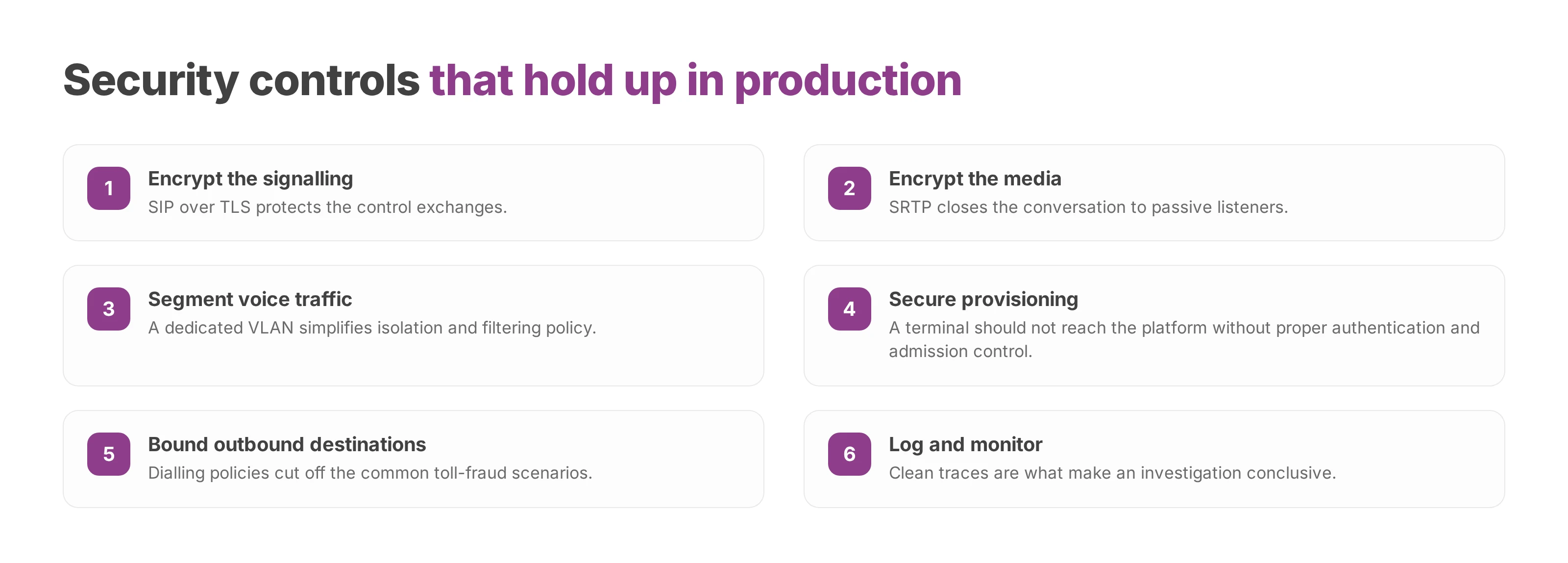
Controls that hold up in production
Encrypt the signalling. SIP over TLS protects the control exchanges.
Encrypt the media. SRTP closes the conversation to passive listeners.
Segment voice traffic. A dedicated VLAN simplifies isolation and filtering policy.
Secure provisioning. A terminal shouldn't reach the platform without proper authentication and admission control.
Bound outbound destinations. Dialling policies cut off the common toll-fraud scenarios.
Log and monitor. Clean traces are what make an investigation conclusive.
A secure telephony architecture layers those controls from the handset through to the platform. A provider operating inside the European Union, with its hosting, encryption and data governance written down, gives you one consistent frame for all of them. That's risk control as much as commercial positioning.
Planning the migration
Replacing a legacy private automatic branch exchange with SIP telephony changes more than voice transport. The company moves from local equipment to a managed service, integrated with the information system and administered remotely. Day-to-day operation gets more flexible, and the value on offer runs wider than supplying terminals.
Success rests on sober scoping rather than a sales pitch. Assess the network before deployment. Treat quality of service as engineering. Pick handsets that fit each role. Verify encryption, provisioning and monitoring. Plan a phased migration whenever a legacy environment has to coexist for a while.
Europe applies one more filter. Telephony carries critical data, so the right partner treats EU hosting, data sovereignty and GDPR compliance as foundations rather than options bolted on later. Write down where your calls, recordings and metadata will live before you sign anything, then send that page to hello@voxbi.com and we'll map it against your site plan.