
What is DTMF and why cloud phone menus depend on it
DTMF sends two tones per key so a phone system can read the choice. How the tones work, how they travel over VoIP, and what breaks them in a cloud PBX.

What is DTMF in one line: dual tone multi-frequency, the pair of tones a phone sends every time someone presses a key. Interactive voice response systems still read those tones to move a call, confirm a step or trigger an action. Cloud telephony keeps that need and moves the difficulty into transport, codec settings and the agreement between carrier, SIP trunk, cloud PBX and the voice menu. IT managers and integrators planning a PBX migration usually meet the subject at the worst moment, when a menu stops registering digits a week after go-live. Menus that reloop, missing digits and stalled automations all point at the same layer.
What is DTMF
DTMF stands for dual tone multi-frequency. Each key sends one tone from a row group and one from a column group at the same time, inside the ordinary voice band, and the receiving system reads that pair as a single command. The mechanism dates from analogue exchanges and it still carries concrete business actions in VoIP architectures, every time a caller has to choose, confirm, identify or validate a step. Decoding stays reliable as long as the audio path preserves both tones, as the French technical definition of DTMF sets out.
Keypad input still drives routing
Keypad input drives routing decisions, triggers actions and gates steps inside a call flow. Plenty of estates send every inbound call through a voice menu that waits for one digit or a short numeric answer. When the tone degrades, the caller loops, the queue never receives the call, and you get an operational ticket within the hour.
The protocol survives partly because mixed estates need it. French IP interconnection use cases still show DTMF passing between analogue telephony and interactive voice services, which keeps it a live concern for small and mid-sized companies that hold on to older equipment while moving to the cloud.
A cloud PBX keeps the need and moves the risk
A cloud PBX still needs simple input signals from callers. The work shifts to transport, codec configuration and consistency between carrier, SIP trunk, IPBX and voice menu. Companies that migrate without testing that step learn that cloud telephony is a signalling system to maintain, with its own configuration and its own regressions. A wider view of how a cloud PBX is put together helps you place DTMF inside the platform rather than inside the handset.
How DTMF tones work
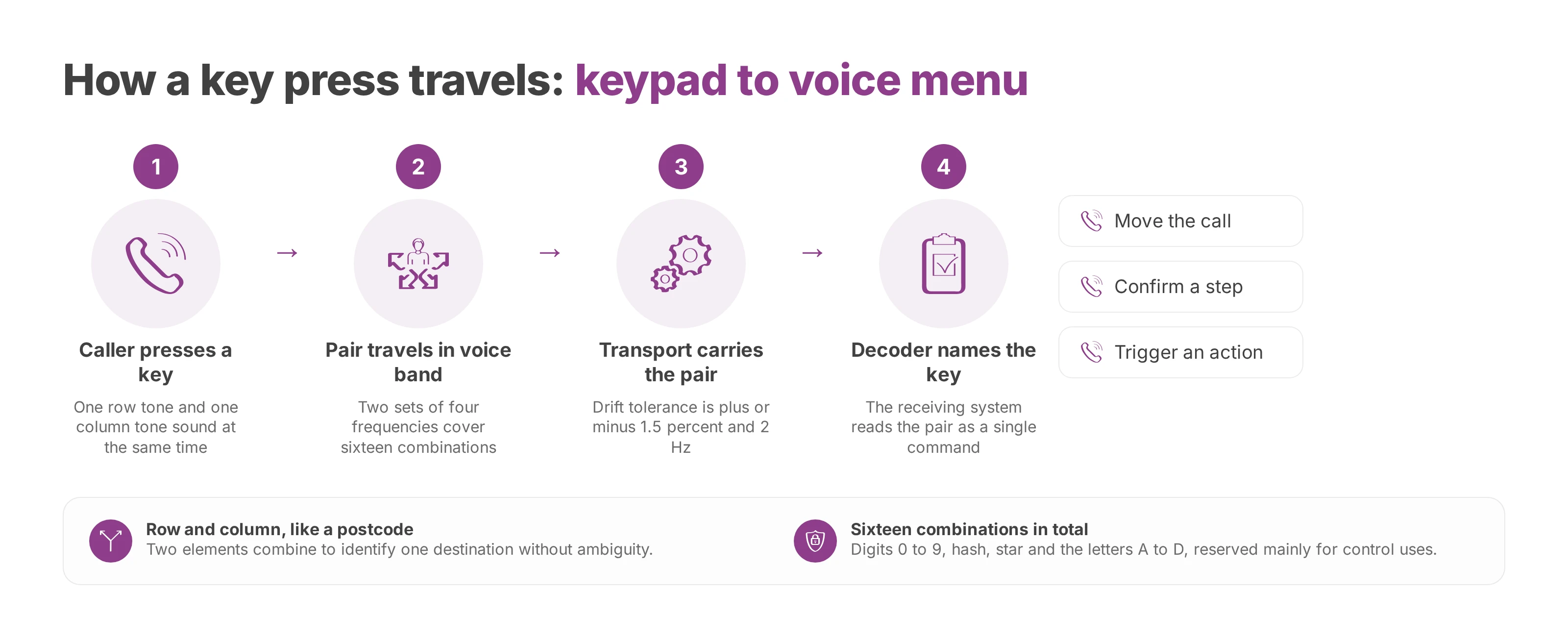
DTMF tones come in pairs. One frequency identifies the row of the key, the other identifies the column, and together they name the key without ambiguity. A postcode works on the same principle: two elements combine to identify one destination.
The frequency matrix in practice
The standard covers sixteen combinations. Those are the digits 0 to 9, the hash and star keys, and the letters A to D, which MDN's glossary entry describes as reserved mainly for control uses. Two sets of four frequencies produce them, sent as pairs inside the voice band, and the name dual tone comes from that pairing.
Stability during transport decides whether the pair still decodes. The specification gives a tolerance of ±(1.5% + 2 Hz), attributed to ETSI ES 201 235-3, which tells you how little drift a decoder will accept once the audio has been altered. A menu can work perfectly from a desk phone on site and then fail after a VoIP migration, because the tones didn't survive the trip intact.
Why two tones per key
Two simultaneous tones let a decoder tell one key from another with high confidence, provided the transport respects the nature of the signal. That property keeps DTMF compatible with IVR platforms, control systems and the analogue interfaces still in service. Inside a VoIP architecture the same property stays decisive, since DTMF is the input language between the caller and the voice menu, and mishandled tones alone are enough to sink a call flow.
Where businesses use DTMF every day
In a contact centre the keypad structures entry into the service. It names a reason for calling, sends the call to the right team, and can open automated functions with no agent involved. A well-designed voice menu handles the first thirty seconds of the call, and outsourced contact centre operations depend on those digits arriving intact.
Call centres, clinics and hotels
In customer support the keypad separates an order query from a complaint or a technical request. A missed digit puts the caller in the wrong queue, and the adviser spends the first minute requalifying the request. In a clinic the same digits reach reception, confirm an appointment or switch the caller to an emergency message, which removes friction without removing the human contact.
Hotels follow a comparable pattern. A multi-site group can use DTMF sequences to send a call to the front desk, to reservations or to a night team, with a different experience per property. Public bodies still use keypad input to prioritise certain requests, because a reception flow open to the whole population has to stay simple.
Access and identity checks
DTMF also carries access and control tasks. Some automated environments use it to open equipment, validate a step or confirm a caller's identity by phone, as the Starface knowledge base records. Those uses keep working when there's no web interface within reach, so they persist in places a consumer definition never covers.
Treat DTMF as an interaction component in its own right. It secures business sequences, cuts misrouting and holds continuity between traditional telephony and cloud environments.
Mapping the keys that trigger a real action
Integrators and IT departments documenting a voice menu should record every moment where a key press causes a real action. Incidents cluster in exactly those spots after a migration, above all when the testing covered the telephony side and skipped the business side. Voice prompts and menu recordings belong in the same review pass, because the wording is what tells the caller which digit to press.
DTMF transport in VoIP and where it breaks
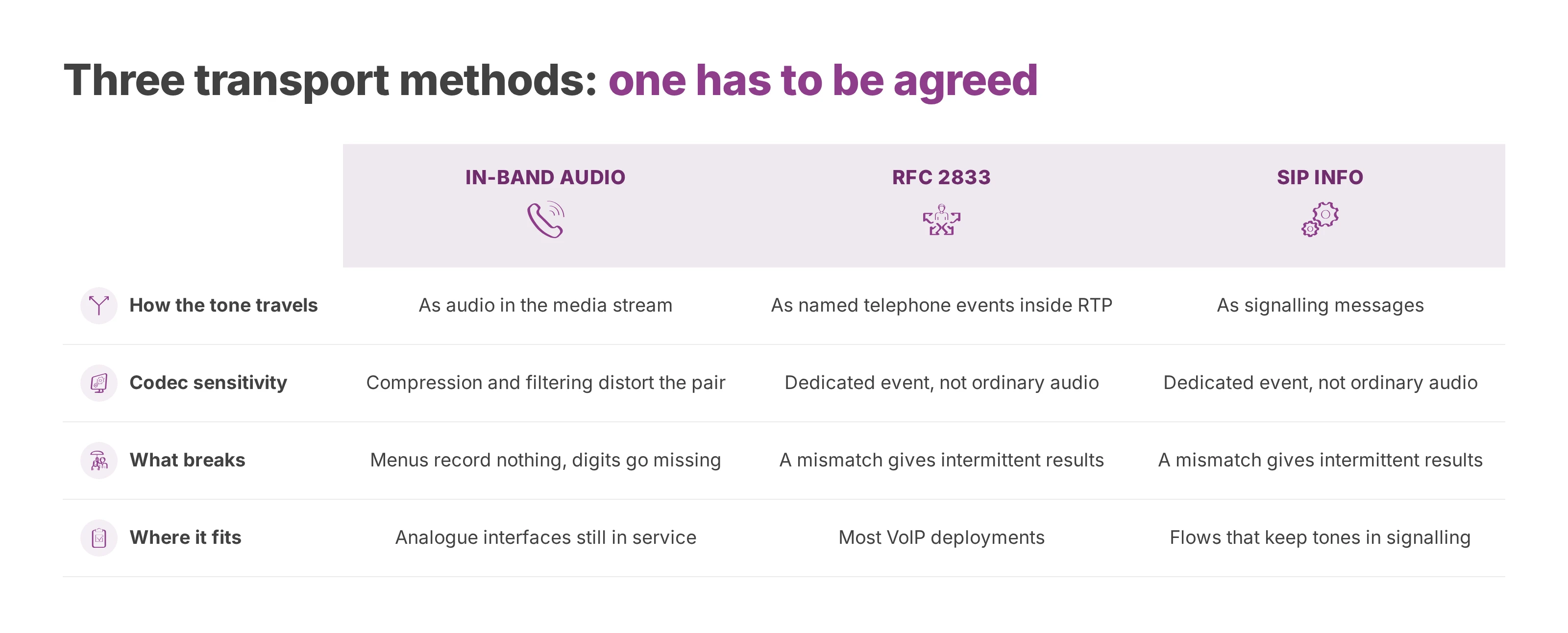
Migrations get fragile at the transport layer. The difficulty sits in how the tone crosses the architecture, and the keypad itself contributes almost nothing. French IP interconnection guidance from FFTelecoms makes the point directly: a DTMF tone handled as ordinary voice audio degrades, while a dedicated signalling event survives.
What breaks most often
Codecs and audio processing top the list. Compression, filtering or an aggressive voice pipeline distorts the useful frequencies, and the pair reaches the voice menu in a state the decoder rejects. Second comes an optimistic assumption, that a cloud handset, a SIP trunk and an IVR will agree on a method with nobody configuring one.
In production this shows up as menus that record nothing, missing digits, or a validation that fails on the last key. On a support flow the caller picks the wrong department, loses the history of the request, or hangs up before reaching anyone. On a healthcare or public-service flow the impact turns operational within minutes.
In-band audio, RFC 2833 and SIP INFO
Three transport methods cover most deployments. In-band sends the tones as audio in the media stream. RFC 2833 carries them as named telephone events inside RTP. SIP INFO passes them as signalling messages. The method you pick decides whether the voice menu ever sees a clean digit, and a mismatch between two devices produces intermittent results that look random from the outside.
A bad DTMF hop causes IVR navigation errors, incomplete entries and failed automations. Inside a small company mid-migration it reads like a user problem, while the cause sits in the telecoms configuration.
A sound deployment preserves the signal
A sound deployment aims to preserve DTMF from end to end. Settings agree from handset to IVR, the audio path stays clean, and the business scenarios that matter get tested for real. Cloud telephony can carry the voice perfectly and still drop the command when one device on the route disagrees about the method.
SIP trunking belongs to the same discussion, since calls and tones travel the same operational route. How SIP trunks are provisioned matters here, because a route split across several suppliers with no end-to-end test makes DTMF anomalies close to inevitable.
Diagnosing and configuring DTMF in a cloud PBX
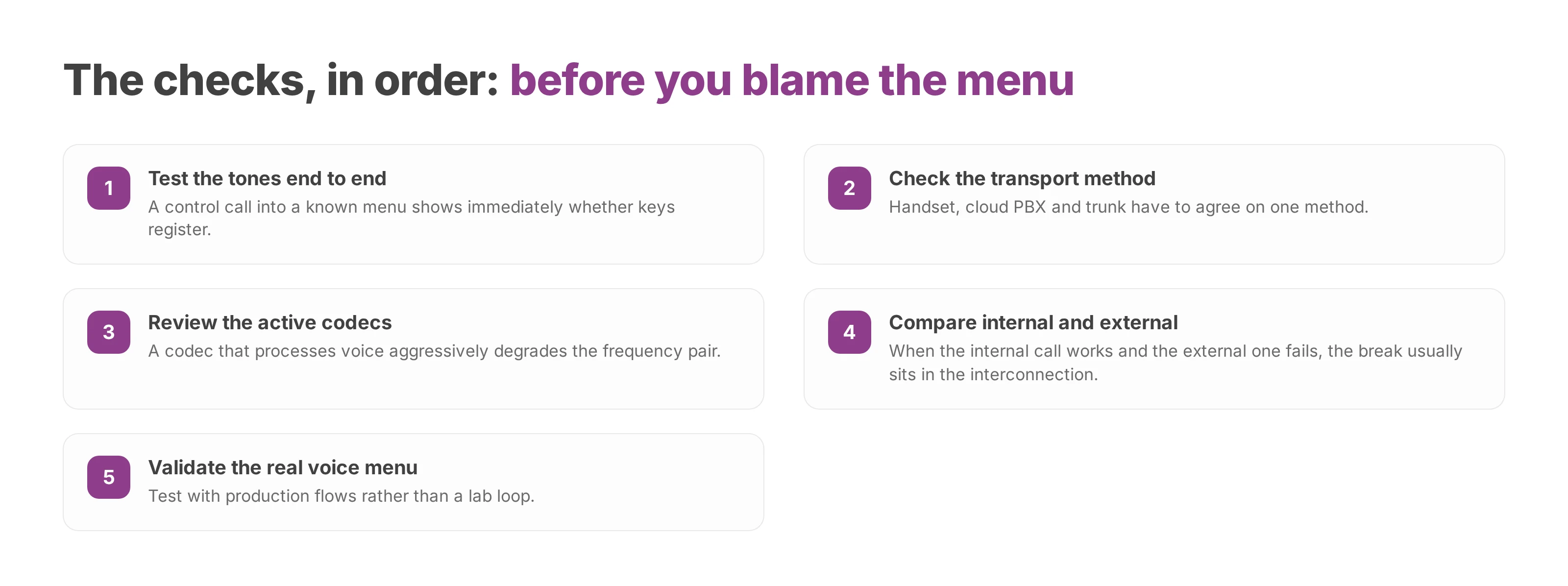
A DTMF incident responds to method. The first test checks whether the tone survives a simple call, before you blame the voice menu, the CRM or the agent. During a cloud migration that discipline saves days of ticket ping-pong between integrator, carrier and application support.
The checks, in order
Test the tones end to end. A control call into a known menu shows you immediately whether keys register.
Check the configured transport method. Handset, cloud PBX and trunk have to agree on one.
Review the active codecs. A codec that processes voice aggressively degrades the frequency pair.
Compare an internal call with an external one. When the first works and the second doesn't, the break usually sits in the interconnection.
Validate against the real voice menu. Test with production flows rather than a lab loop.
A tone that works on an internal call proves nothing about the carrier to cloud PBX to voice menu route.
What to document
In a cloud PBX estate the configuration deserves a written record. Keep the chosen DTMF method, the permitted codecs and the services that actually consume keypad input. Integrators and telecom resellers both gain from that record, since it cuts the tickets that come back after every route change or equipment swap.
Treat DTMF as a production feature. When a voice menu waits for a key to route the call, the smallest configuration drift becomes visible to the end customer, and critical flows in support, healthcare and multi-site reception won't absorb that kind of drift quietly.
Validate before go-live
Equipment compatibility. Every handset and gateway follows the same DTMF logic.
Call route consistency. Internal and external routes get tested separately.
Business menu behaviour. Real cases, such as a queue selection or a validation, beat a theoretical test.
Behaviour after updates. A codec or trunk change alone can break navigation that worked the day before.
Data sovereignty and European compliance
Hosting decisions weigh as much as routing quality in a cloud telephony project. Calls, recordings and metadata live somewhere physical, and for small and mid-sized companies, healthcare sites and public bodies that location is an architecture decision, written into the design.
European hosting and GDPR obligations
Telephone flows that handle customer, patient or staff information make the hosting location material. Keeping the data on European soil helps you set out the GDPR obligations and clarifies governance between provider, integrator and company. In a modern cloud model that requirement gets defined at design time, and retrofitting it after go-live costs considerably more.
IT teams carry two duties at once. They keep the service running, and they limit how far data spreads toward regions or subcontractors nobody has visibility over. Multi-site structures feel this hardest, because calls move between entities while a single policy has to cover all of them.
Sensitive sectors
In healthcare the phone system touches highly sensitive information. In public bodies calls carry administrative subjects under strict governance. In hotels and multi-site networks the question turns to operational data and reservation flows instead.
DTMF enters indirectly here, and it does enter. When a voice menu collects a selection or a caller steers toward a specific department, those choices become traces of the call. A well-designed cloud PBX combines European hosting, consistent privacy rules and clear access control for internal teams, as the European-built Voxbi platform sets out.
What decision-makers should ask for
IT leaders should ask where the data lives, how it's protected and who reaches it. They should also check that the provider documents its governance mechanisms without promising guarantees it can't hold. Precision beats broad claims in this area, above all when one telephony project serves several countries or several entities.
Alternatives to DTMF and their real maturity
Web call-control interfaces, signalling APIs and speech recognition all take a growing share of modern telephony. Their maturity varies, and the value of each one depends on the use case and the depth of integration expected.
When an alternative fits
A web interface suits a user already in front of a screen: a supervisor, an agent or an administrator. An API suits automation between business tools, where no caller interacts directly. Speech recognition earns its place inside voice menus that have to accept free wording from the caller.
These options add flexibility and move the complexity elsewhere. A web interface assumes a connected workstation and a coherent user path. An API needs clean integrations and strict control over the events exchanged. Speech depends heavily on detection quality, accent, background noise and the engine you choose.
Choosing per context
DTMF holds a clear advantage where ease of use outweighs expressive range. It stays readable, works from any phone, and deploys quickly inside structured flows. Speech or an application interface gives more comfort when the goal is capturing a request in the caller's own words.
Judge each option on reliability, implementation cost and tolerance to transport errors. In many small and mid-sized companies DTMF stays the most stable answer for the first routing step, while the alternatives take over richer or more administrative tasks. Comparing cloud phone systems is easier once you know which interaction model each flow actually needs.
A short decision list
DTMF for short flows, simple menus and mixed infrastructure.
Speech recognition for more natural exchanges once the application side is ready.
Web or API for internal operations, integrations and supervision interfaces.
Pick the right tool per position, with an architecture that keeps keypad input intact when the call crosses several technical components.
Voxbi runs a cloud phone system for European companies, with call handling, IVR menus and voice transport designed for multi-site estates. Mixvoip supplies the numbers and the carrier side underneath. For a PBX migration where DTMF, data sovereignty and European compliance have to stay aligned, write down your current DTMF method and your permitted codec list, then send it to hello@voxbi.com before the first test call.