Your phone system still works. The maintenance bill keeps climbing though, small changes need a visit from an installer, and hybrid work doesn't fit the wiring. That's usually when someone asks what VoIP is, and why the subject turned urgent this year.
The short answer: VoIP, or voice over IP, carries calls over an IP network instead of a dedicated telephone line. The old switched telephone network drops out of the path. Calls run over the company's internet connection, which it reaches through fibre, a business broadband line, Wi-Fi or mobile data. That arrangement suits multiple sites, mobile teams and SaaS tools far better than copper wiring ever did.
If you run a small or mid-sized business, or you integrate and resell telephony for a living, call quality is one part of the decision. Architecture, running costs, daily administration and above all the location of your communication data carry as much weight. In Europe that last point reaches straight into GDPR, digital sovereignty and the coming demands of the EU AI Act.
What VoIP is, in plain terms
VoIP stands for voice over IP. Your voice becomes digital data, crosses an IP network as packets, and turns back into sound at the far end. The number, the ringing and the transfer to a colleague all behave as before, so the change lands on the transport and the administration rather than on the call itself.
Three terms get used loosely and they mean different things. VoIP is the transport. IP telephony is the wider practice of running business voice over that transport. A cloud PBX is the phone system itself, hosted by a provider and reached over the network, with auto attendants, call queues and ring groups configured in a browser. Our guide to what a cloud PBX is shows how those parts fit together.
Existing numbers come with you. Porting moves them to the new provider, and each direct dial-in number can point at a person, a team or a queue without any new cabling.
Business telephony in the cloud era
Monday, 8.30 am. A branch opens a new office, the support team moves to part-time remote work, and a department head wants call statistics by Friday. On an ageing on-premise PBX those three requests become three separate projects. On a hosted IP platform they're mostly configuration, provided you picked the right level of hosting, administration and control.
That's the real shift. Business telephony has moved from a box in a rack to a software service, connected to the network, administered remotely, and wired into how people actually work across sites, home offices, mobiles, contact centres, CRM and collaboration tools.
The retirement of the old circuit-switched network pushed the move along. Timetables differ country by country, and the French PSTN switch-off is one of them, so the date that binds you is your national operator's. The live question in most companies is which deployment model reduces operational load without creating heavy dependency on a single supplier.
Europe adds its own layer. A cloud telephony contract commits you on hosting location, on how call metadata is handled, on traceability of administrator access and, increasingly, on AI features such as transcription, summaries and conversation analysis. For a healthcare provider, a local authority or a company under strict contractual duties, those points land directly on GDPR compliance, data governance and EU AI Act readiness.
Treat cloud telephony as critical infrastructure and the questions get concrete. Who hosts the data, and in which country. Who can read the call logs. Which features depend on non-European subprocessors. How you recover your numbers, your configuration and your call history if you change operator. Our overview of business communication solutions sets those models beside each other.
The durable gains come from a simpler operating model. Fewer parts to administer, a closer fit with hybrid work, and hosting that answers the sovereignty questions European tenders keep asking.
How voice over IP works
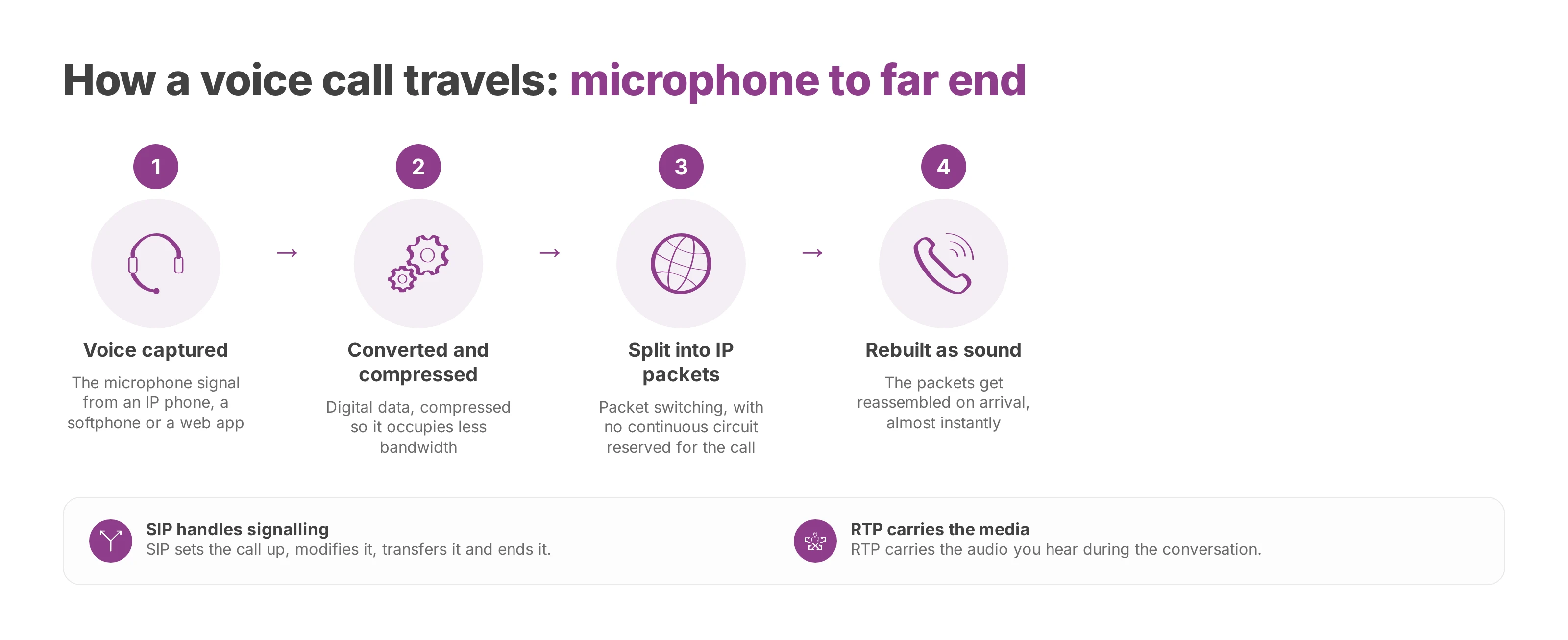
A paper letter travels whole from A to B. Email travels as data, and a VoIP call works the second way: the voice gets captured, converted, split, transmitted and rebuilt almost instantly.
From analogue voice to IP packets
When you speak into an IP desk phone, a softphone or a web app, the microphone signal is captured and converted into digital data. That data is then compressed so it occupies less bandwidth and moves efficiently across the network.
VoIP runs on packet switching. The voice travels as small packets across the IP network and gets reassembled on arrival, so nothing reserves a continuous end-to-end circuit for the length of the call.
What SIP, RTP and codecs actually do
Three building blocks come up in every VoIP project.
Codecs compress the voice. OPUS cuts the data volume while holding sound quality high.
SIP handles signalling. It sets the call up, modifies it, transfers it and ends it.
RTP carries the media itself, so the audio you hear during the conversation.
Together they shape call quality, handset behaviour and whether your operator, phone system and business applications work with each other. As a rule of thumb, roughly 100 kbps per call is enough for HD quality, a figure that moves with the codec.
The usual causes of bad VoIP audio are an unprioritised network, unstable Wi-Fi and a poorly equipped desk.
Three questions worth asking before you buy
You don't need to be a telecom engineer to steer this project well. Three questions cover most of the risk.
Is the network stable? Voice traffic needs priority on the link, and a bandwidth test alone won't tell you whether it has any.
Are the users fixed, mobile or hybrid? A reception desk, a customer service team and a manager on the road live with different constraints.
Is the endpoint hardware or software? An IP phone, a desktop app, a mobile and a web client each give you a different degree of control.
Bandwidth makes a good starting point. Available throughput, perceived quality and real capacity to carry voice are three separate things, and separating them with your IT team or your client saves arguments later.
VoIP benefits for your business
The costs that fall first are the ones tied to hardware on site, local maintenance visits and heavy change work such as adding extensions, opening an office or reworking a routing plan. For a smaller company the most useful gain is often budget clarity. Subscription, options, supervision, support. Telecom becomes more predictable for finance and less time-hungry for IT.
That holds when the architecture matches how the company works. A standardised, multi-site or hybrid environment gains most from a cloud model, while a few contexts call for heavier local control. Compare the two models before you price the project.
Lower running costs without moving the risk
The figure that matters covers three years. It includes reorganisations, incidents, administration time, dependency on an installer, and how easily the service changes without a technical project behind it.
The cost lines that drop most often:
phone equipment to maintain at every site
on-site visits for simple changes
lead time and setup cost when an office opens
scattered contracts across operator, access and maintenance
the indirect cost of rigid telephony that slows teams down
A poorly chosen VoIP service can create fresh dependencies of its own. Slow support, advanced features billed as options, data hosted outside Europe, thin self-administration. Those surface in the second year.
Flexibility for teams, control for IT
The value shows up in daily use. An employee keeps one business number at the desk, at home and on the road. A reception manager edits a call flow when opening hours change. A support team spreads calls across several sites without rebuilding the whole phone plan.
Business teams get continuity through a move, a new hire or a shift to remote work. IT gets fewer manual operations and less dependency on hardware. When every change to a voice menu, a queue or a ring group needs a ticket, a quote and several days of waiting, telephony becomes a source of operational friction.
Growth and reorganisations
Adding users, creating call groups, splitting flows by department or by country and absorbing a load increase all happen in configuration. The common cases are concrete:
onboarding new staff with defined profiles and calling rights
opening a second site without installing a switch there
merging several reception desks into one central administration
keeping calls flowing for remote teams without exposing personal mobile numbers
Regulated sectors get a further benefit that generalist guides skip. A well-chosen VoIP platform helps you pin down data sovereignty, the location of recordings, traceability of access and retention rules. As voice analytics and conversational assistants spread, a provider able to host and process data in Europe turns into a governance question as much as a features question.
Cloud PBX or traditional PBX
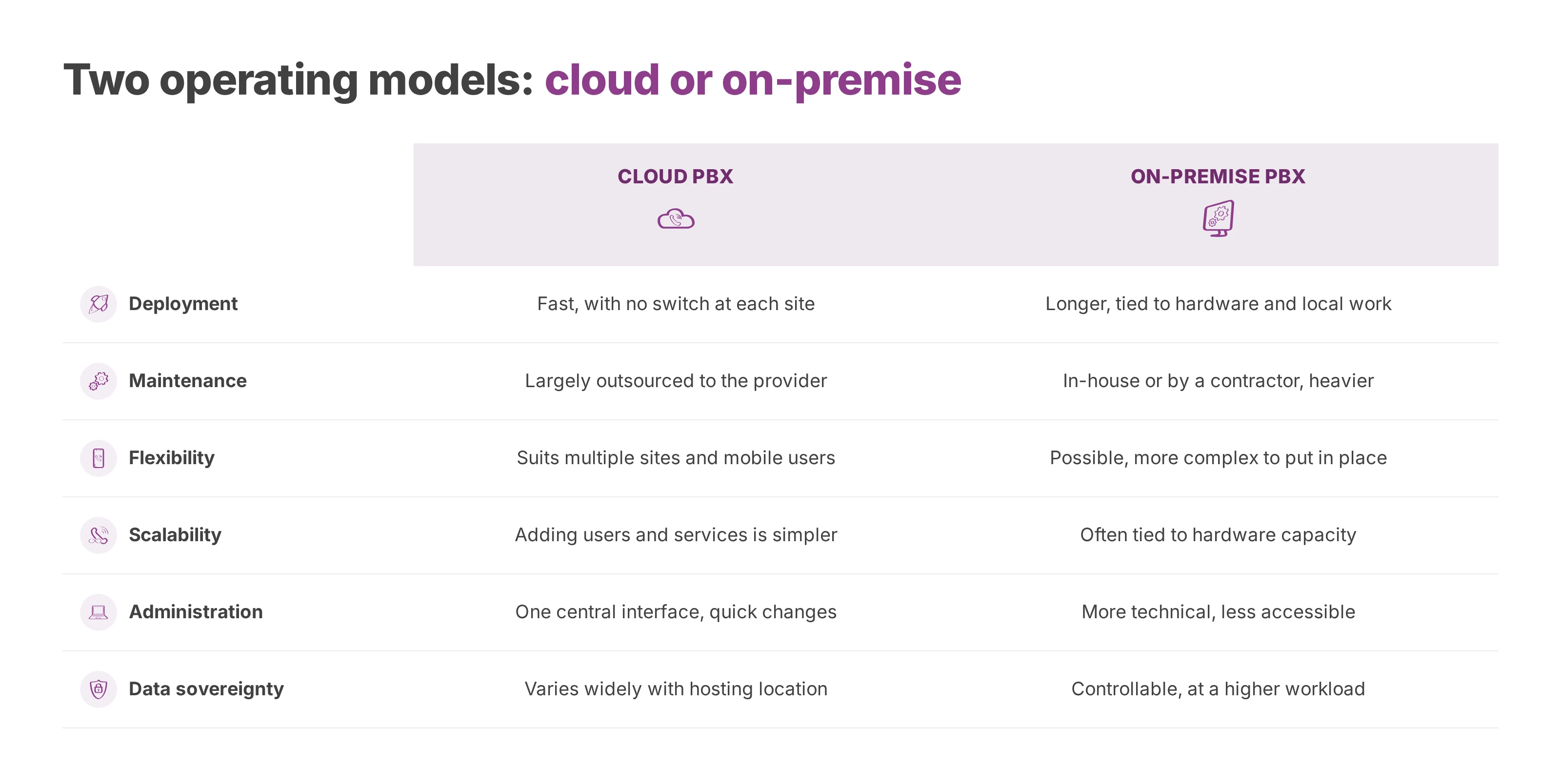
Two operating models sit behind this choice. One is equipment your company keeps alive on site. The other is a phone system delivered as a service.
The comparison that helps you decide
Those rows describe typical patterns rather than guarantees. Maintenance in particular depends entirely on what the provider takes on.
A cloud PBX fits a company looking for operational flexibility. An on-premise PBX holds its value where the organisation wants to keep maximum technical control itself, with the in-house resources that requires.
Where an on-premise PBX still fits
Some environments carry firm constraints: historical dependencies, ageing peripheral equipment or specific isolation requirements. On-premise is a defensible choice there, and a demanding one.
The hidden cost sits in keeping it operational. Patches, redundancy, backups, security, vendor support, documentation and in-house skills add up across the life of the system.
Cloud leaves the responsibility with your company and shifts it toward governance of the provider, the contract, the connectivity and the compliance evidence.
Security and compliance in IP telephony
Plenty of projects reach this point too late. A phone platform can feel modern, fast and rich in features while raising a serious question about data location, subprocessing or compliance.
Where the call data lives
Call metadata, logs, recordings and administration records carry operational and legal value. In sensitive sectors their storage location becomes a governance matter as much as an infrastructure one.
One figure captures the gap. A sponsored piece in a French IT publication on VoIP and its compliance stakes states that 84% of small and medium businesses don't know where their metadata is stored, and argues that VoIP solutions hosted outside the EU may fail GDPR requirements for sensitive data. The article names no primary study, so read the percentage as an indication.
For a clinic, a local authority or a group with several legal entities, that blind spot creates concrete risk. A provider can be excellent on voice and weak on sovereignty, and that's where consumer-grade comparison sites stop being useful.
What to require from a provider
A reasonable minimum comes down to a few firm checks.
Hosting in the European Union, with named data centre locations.
Contractual traceability over subprocessors and data flows.
Security guarantees on encryption, authentication and logging.
Evidence of maturity, such as ISO 27001 or SOC 2 certification, plus demonstrable alignment with recognised frameworks including the CISPE code of conduct, as this review of GDPR compliance for cloud data storage sets out.
Clarity on responsibility. Your company stays accountable for GDPR even when hosting sits with someone else.
One further point deserves attention. The subprocessor has to meet localisation and control requirements for personal data storage, with encryption to match.
Preparing for what regulation is coming
The EU AI Act adds scrutiny to every component that applies AI to communications. The workable posture is to pick an architecture and a provider that make future compliance straightforward, particularly on data governance, documentation and hosting.
For integrators and resellers this already decides deals. Clients ask less about which AI features exist, and more about where the data goes, who processes it and under which legal framework.
VoIP in action, sector by sector
A hotel group, a care home and a local authority need different architectures, so the benefits read differently in each.
Hotels and restaurants
A hotel group unifies reception handling, reservations and transfers between properties. With a cloud phone system, head office standardises the call flows while each property manages its own hours, groups and front desk. The payoff shows up as a consistent guest experience across the group.
Healthcare and care homes
In a care home or a clinic, reaching mobile staff matters most. A well-designed VoIP setup gives each person one business number, retires the workarounds on personal mobiles and keeps usage inside defined rules. EU hosting weighs heavier here, because the phone system handles sensitive metadata at minimum.
In sensitive environments, the right provider documents where the data sits, who can reach it, and under whose responsibility.
Local government and public services
A town hall or a local public service keeps its reception reliable through reorganisations, call peaks and work spread across several buildings. VoIP centralises the routing logic, absorbs absences and holds service continuity without one local switch as the single point of failure.
Three things decide the outcome in all three cases. An architecture that matches the use, administration that changes quickly, and hosting you control inside Europe.
Migration checklist for moving to the cloud
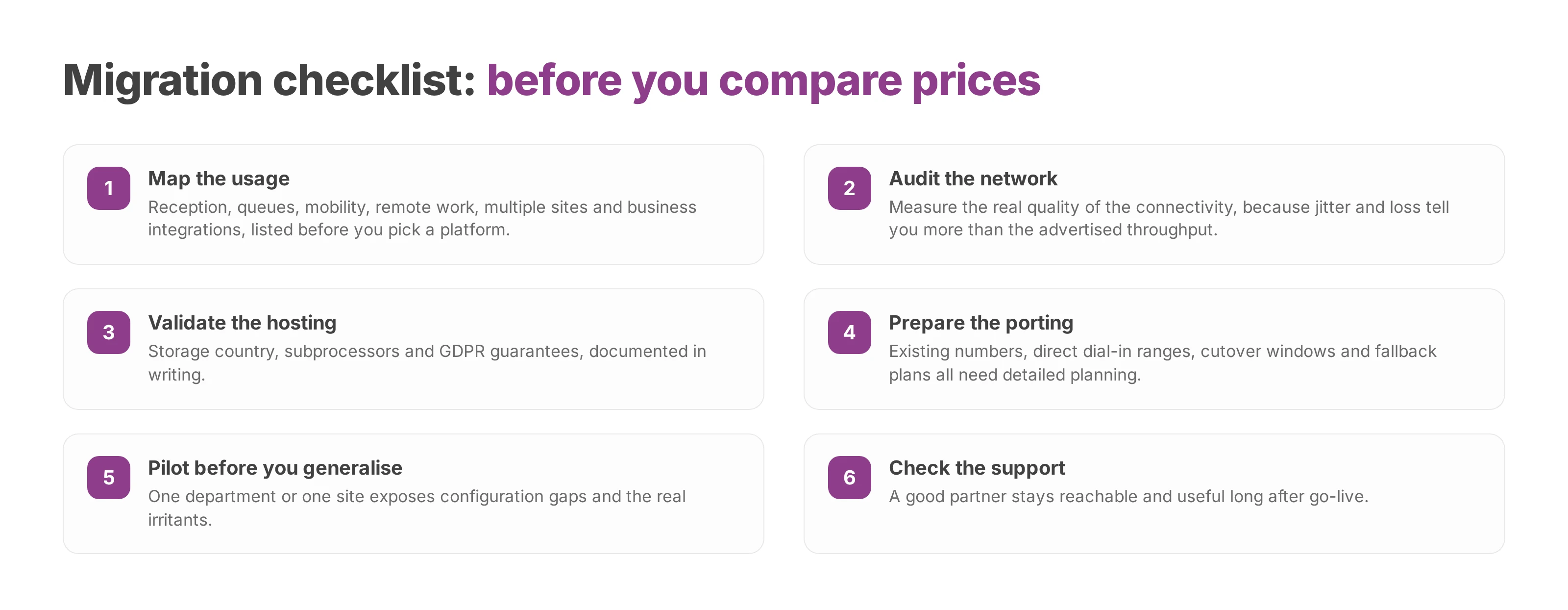
A VoIP migration starts with clean scoping rather than a handset shortlist. The projects that go well treat telephony as a critical service, with network, security, operations and change-management decisions taken at the outset.
Checks that prevent surprises
Map the usage. Reception, queues, mobility, remote work, multiple sites, business integrations. List all of it before choosing a platform.
Audit the network. Measure the real quality of the connectivity, because jitter and loss tell you more than the advertised throughput.
Validate the hosting. Storage country, subprocessors and GDPR guarantees documented in writing.
Prepare the porting. Existing numbers, direct dial-in ranges, cutover windows and fallback plans need detailed planning.
What secures adoption
Train the users. Even a simple interface needs a little guidance to head off early mistakes.
Pilot before you generalise. One department or one site exposes configuration gaps and the real irritants.
Check the support. A good partner stays reachable and useful long after go-live.
A well-run migration cuts friction inside the first weeks. Teams keep their numbers, IT regains control, and management gets a more flexible system without new technical debt. Write the hosting and porting answers into your tender document before you compare prices.
Voxbi runs a cloud phone system built for European companies, hosted in EU data centres, with data sovereignty and GDPR guardrails designed into the architecture. If you're weighing up a cloud PBX that's simple to administer, works across multiple sites and is ready for European requirements, see how Voxbi 2 was built as a cloud PBX in Europe.