
Ringover alternatives: Voxbi and Ringover compared plan by plan
Ringover alternatives compared plan by plan: Voxbi Managed Business Flat against Ringover Business, Voxbi Plus against Ringover Talk, with costs for 10, 25 and 50 users.
Sep 13, 2026
A cloud IVR answers, greets and routes your calls from a hosted platform. What it is, what it costs, how deep the menu should go, and how to check the hosting before you sign.

A cloud IVR answers your inbound calls from a provider-hosted platform, plays a menu, and sends each caller to the right team without anyone picking up first. It's the same interactive voice response most companies already know, delivered as a subscription service instead of a box in a comms room. For an IT manager, an integrator or a telecom reseller weighing one up, the decision rests on load, reachability and control over voice data inside a European frame.
This guide covers the definition, the cost model, the network dependency, menu depth, and the hosting questions to put to a provider before you commit.
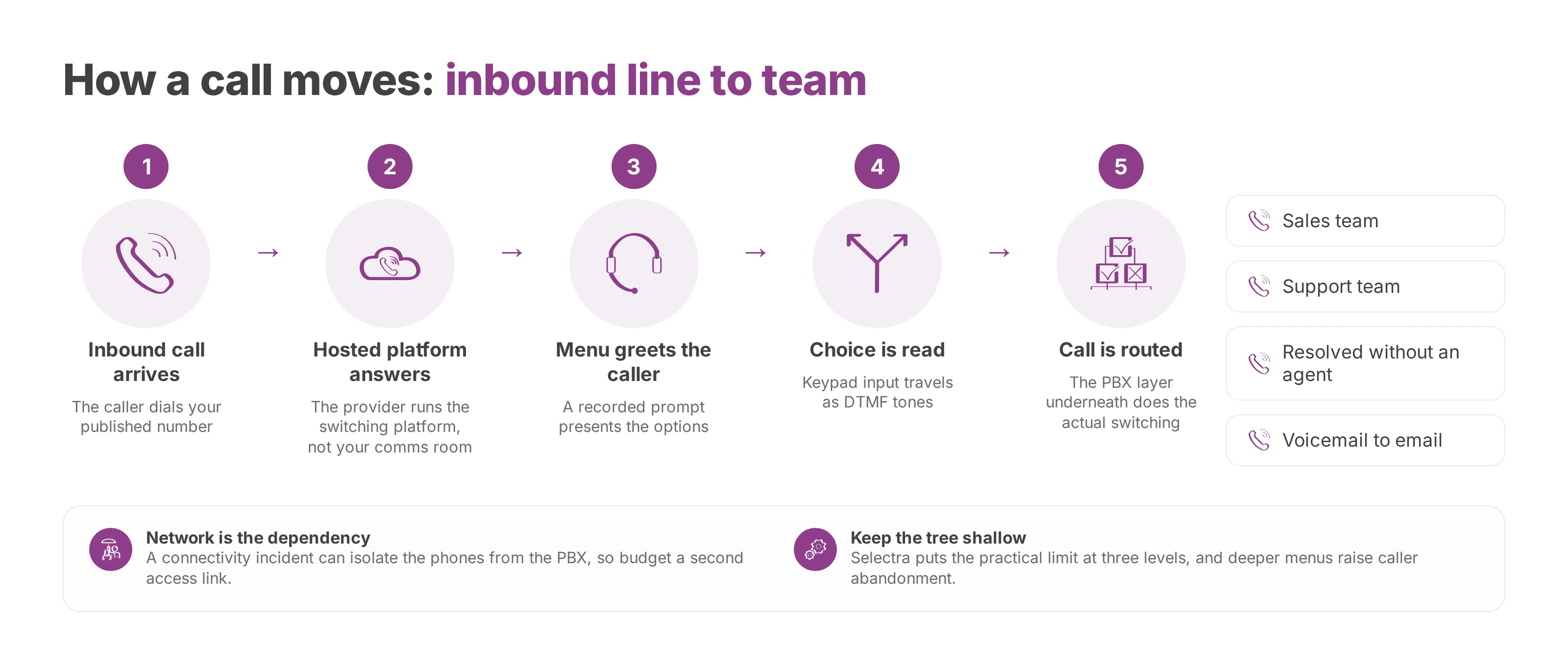
A cloud IVR greets the call, presents a menu, reads the caller's choice, then routes to the right resource or resolves the request without an agent when the scenario allows it. The provider runs the switching platform, and your desk phones, softphones and browser tabs reach it over the internet. There's no telephony hardware on your premises to size, patch or replace.
Underneath sits the private branch exchange, the PBX, which does the actual call switching. The IVR is the layer on top that guides the caller and automates the first line of reception. Our explainer on how a cloud PBX works covers that platform layer on its own terms.
PBX means the company's private telephone switch. IVR is the layer that greets the caller, sometimes collects input, and hands the call onward. Keypad input travels as tones, and DTMF signalling is the mechanism behind every "press 1 for sales". SIP TLS and WebRTC concern transport and encryption, which become central as soon as you're dealing with browser access, encrypted media and staff working from several devices. Agreeing those four words with the business teams on day one keeps a migration from turning into a vocabulary debate.
Capacity is the clearest operational argument for a cloud IVR. Adding channels means changing a subscription rather than installing telephony servers, so a seasonal peak, a new site or a merged reception flow doesn't wait on procurement. Companies that absorb call spikes or standardise reception across several entities get that elasticity without a hardware decision attached.
A cloud IVR also handles calls 24 hours a day, seven days a week, and takes several calls in parallel. That cuts missed calls and keeps queues from saturating. Reference material on automated reception from Bouygues Telecom Pro and the telecom guide published by Selectra makes both points.
The dependency runs through your network. A connectivity incident can isolate the phones from the PBX, which is why a second access link is worth budgeting on sites where voice carries revenue. Quality is a network question too, since jitter and packet loss degrade a call long before a line actually drops. For an integrator, the technical answer sits in the peaks, the opening hours, the geography of the sites and the depth of the voice paths.
Selectra puts the practical limit at three levels, and reports that a deeper menu raises the risk of callers abandoning the call. Treat that as a design constraint. A menu that answers the three or four most common reasons for calling, then passes anything complex to a person, works better than a decision tree mirroring your org chart. Support teams that build long menus give away the advantage automation was supposed to deliver.
Prompts carry as much weight as the tree does. Wording, recording quality and consistency across languages decide whether a caller trusts the first option they hear, and our notes on recording professional voice prompts walk through that.
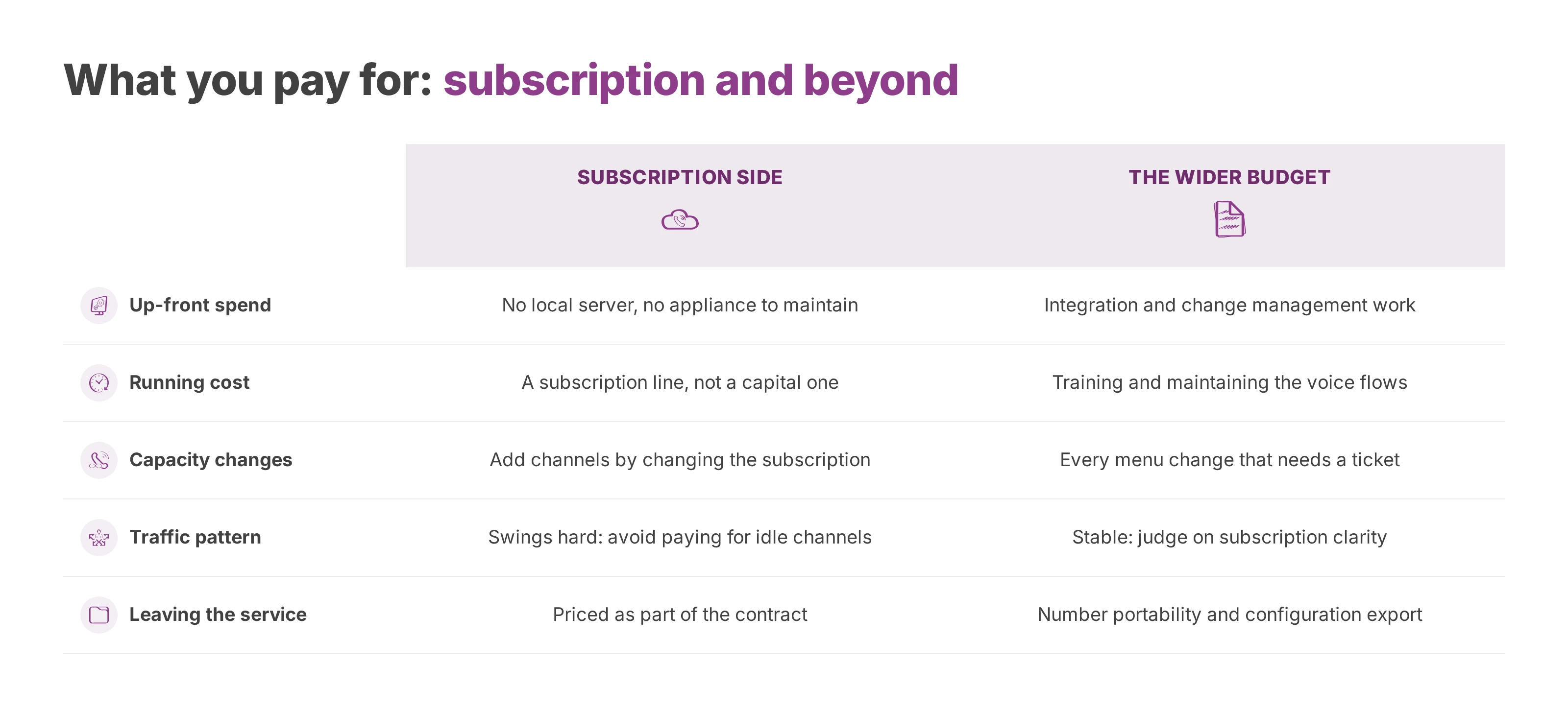
The purchase side stays small. There's no local server to buy, no appliance to maintain, and the spend moves to a subscription line rather than a capital one. Comparisons of cloud telephony describe the same shape, and it's usually easier for a smaller company to carry, especially when the need centres on reception, multi-site consistency or mobile teams. Telephony stops being a heavy infrastructure project and becomes a service the business runs day to day.
The budget runs wider than the subscription price. Integration, change management, training the reception team and maintaining the voice flows all cost real money. Exit costs count too: number portability, configuration export and the work of moving routing elsewhere. A service that looks cheap turns expensive when every menu change needs a ticket and a two-week wait.
Where traffic is stable and predictable, the discussion lands on subscription clarity and running cost. Where traffic swings hard, cloud capacity avoids paying for idle channels most of the year. That's the point where the commercial model meets the operational one.
Voice data covers more than call recordings. Metadata, change logs, access rights and hosting location all sit inside the same question. For a European company, data sovereignty and GDPR alignment stay central, particularly when the IVR touches caller identifiers, recorded audio or internal routing rules.
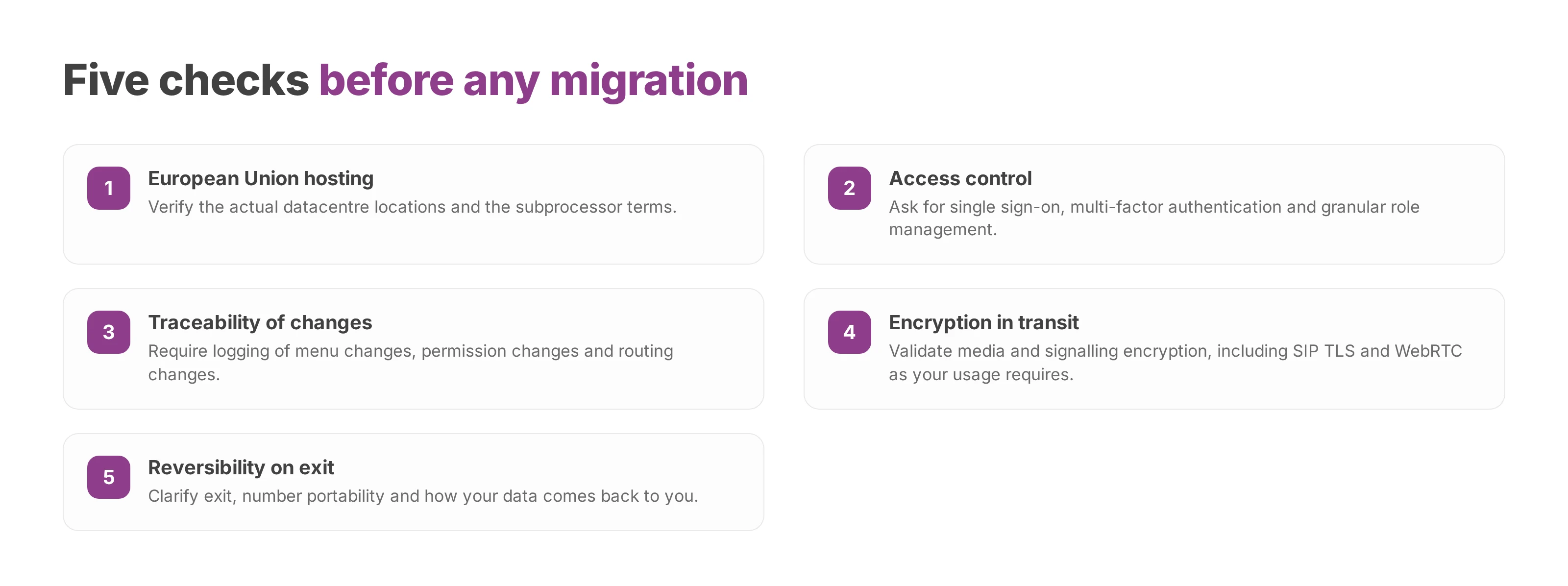
Ask where the data resides, who administers access, how changes are traced and how the media is encrypted. Confirming European Union hosting belongs at the start of the evaluation rather than in a contract annex. Five checks earn their place before any migration:
EU hosting. Verify the actual datacentre locations and the subprocessor terms.
Access control. Ask for single sign-on, multi-factor authentication and granular role management.
Traceability. Require logging of IVR changes, permission changes and routing changes.
Encryption. Validate media and signalling encryption, including SIP TLS and WebRTC as your usage requires.
Reversibility. Clarify exit, number portability and how data comes back to you.
Keep the EU AI Act discussion measured. A provider adding AI to a voice flow doesn't settle on its own whether the regulation applies, and it certainly doesn't make the service compliant. Separate the hosting of the service, the processing of the data and the AI features grafted on top, especially if the IVR reads from production systems or internal directories.
A clean interface proves nothing. Compliance shows up in the contract, the logs, the roles and the security options that are genuinely switched on.
Cloud hosting becomes acceptable when the provider documents hosting, governance and protection mechanisms clearly, and when your own team keeps control of access policy. For regulated sectors, that discipline is worth more than a generic security narrative.
A small business runs a different calculation from a group with its own IT department. The reception load is a handful of repeated questions about opening hours, order status and who handles invoices. A three-option menu with a clean fallback to a person covers most of it, and it stops the one person who answers the phone from spending the morning transferring calls.
Keep the build small. Two or three options, one recorded greeting per language you actually serve, and a rule that pushes after-hours calls to a mobile. A short menu with reliable voicemail-to-email delivers more for a small team than a routing tree nobody maintains.
Local government uses the menu to absorb routine calls and point residents at the right department without an agent answering every time. Parallel, continuous handling helps here, because public services don't open and close on the same rhythm as the demand arriving at them.
Healthcare turns on path clarity and a controlled technical environment. Calls need to reach the right service fast, with no unnecessary menu depth, and access rights, roles and encryption belong in the first review. Cloud suits it when the hosting and security frame is locked down from the start.
Multi-site hospitality wants consistent reception across properties, simple administration, and routing that adapts to seasons, opening hours and booking peaks. Menus and queues evolve without a local project each time. The same logic applies to companies working through agencies, franchises or several service centres.
Industrial small companies usually want stable running above all. When telephony mostly filters inbound calls towards the workshop, support or logistics, the choice rides on connectivity quality and configuration simplicity. The menu has to stay short, clear and dependable, or it becomes one more detour.
One published example deserves a qualitative mention. The Commune de Quaregnon replaced its analogue phone system with a Voxbi cloud PBX using menu routing, and Voxbi reports fewer daily support requests after the migration. Presented plainly, that kind of feedback shows a well-designed menu reducing unnecessary contacts, with no headline time-saving figure attached to it.
Voxbi fits organisations that want a cloud phone system with IVR menus managed from one central interface. The platform emphasises EU hosting, continuity of administration and business integrations, which speaks to IT integrators and to companies that would rather subscribe to a PBX than maintain one on site.
An IVR project is won before deployment. The network check comes first, since a voice service depends on local connectivity, bandwidth and a fallback plan. Governance comes second, because IT has to know who edits the menus, who approves permissions and how changes are traced.
Bandwidth and line quality. Does the provider document the network dependency, the throughput needed and the backup options?
Redundancy. Which fallback links exist, how does failover trigger, and what are the recovery conditions?
Data location. Where are the media streams, the recordings and the metadata hosted?
Access control. Does the service support single sign-on, multi-factor authentication and fine-grained roles?
Logging. Are IVR, routing and security changes traced in a usable form?
Reversibility. How do you leave, and in what format do you get the data and the configuration back?
Support. Who responds to a network incident, an application fault or a configuration error?
Encryption. Is transit encryption active on the voice media and on the admin interfaces?
Integrators do better treating these as a prerequisite than as an end-of-project questionnaire. A service that answers quickly but documents neither security nor exit costs more to run than one with a little more structure behind it. The same reasoning holds for telecom resellers handling staged migrations, where several sites have to switch without a break in service.
A quick read for IT leads and integrators: a stable, redundant network makes cloud IVR a strong fit; long menus need simplifying before go-live; sensitive data puts EU hosting and traceability ahead of interface comfort; and multiple sites make remote administration the deciding capability. The product that stays workable when the network, the access rights and the teams all change is the one to shortlist.
A cloud IVR earns its place as soon as growth, multiple sites, remote work or speed of change become central. The decision itself rests on connectivity, menu depth and compliant data handling in the EU.
For a small company, the right choice usually simplifies administration without weakening control over access. For a mid-sized one, the subject becomes governance, reversibility and the ability to change routing without launching a project. Teams that secure those points before migrating avoid design rework, over-deep menus and unpleasant network discoveries.
Voxbi runs a cloud phone system with IVR menus, centralised administration and EU hosting, which makes it a concrete option for PBX migrations focused on lean operation and data control. Write down your peak call volumes, your backup link and your three most common caller intents, then send that page to hello@voxbi.com and ask how it maps to your telecom environment.
Ringover alternatives compared plan by plan: Voxbi Managed Business Flat against Ringover Business, Voxbi Plus against Ringover Talk, with costs for 10, 25 and 50 users.

Ringover bills a cloud PBX per user, per month: 20 € on Talk and 47 € on Business with an annual commitment, Advanced on quote. Here's what each tier includes, what monthly billing adds, and which cost lines a quote has to show before you can compare it with anything else.
Telavox publishes €29 for an unlimited fixed seat but no price for its business tier. Voxbi publishes every tier. Compared at 10, 25 and 50 users.
Talk to us or to a certified Voxbi partner.