
Ringover alternatives: Voxbi and Ringover compared plan by plan
Ringover alternatives compared plan by plan: Voxbi Managed Business Flat against Ringover Business, Voxbi Plus against Ringover Talk, with costs for 10, 25 and 50 users.
Sep 13, 2026
The Odoo licence buys the ERP and its phone connector. Here's what the SIP provider, numbers, channels, integration and support add, with Voxbi One and Voxbi Managed priced for 10 and 50 users.

Odoo VoIP pricing has two parts, and Odoo's price list shows only the first one. Your Odoo subscription buys the ERP and the connector that puts a dial pad inside it. A VoIP provider supplies the numbers, the minutes, the concurrent calls and the support behind the line, and bills them on a separate invoice. This guide is for the IT lead, integrator or telecom reseller who has to fit both parts into one budget before an Odoo rollout goes live. Odoo's own per-user price depends on edition and region, and it's published on the Odoo pricing page.
The split matters because seat counts and call volumes move on their own. A 12-person sales team can hit eight simultaneous calls on a Monday morning. A 60-person company where most staff phone twice a week may never pass five. In both cases the number of Odoo licences tells you very little about the phone bill.
| Cost line | What's billed | What moves the budget | Question to ask |
|---|---|---|---|
| Odoo licence | Access to the ERP and its apps | Edition, user count, apps in scope | Is the VoIP app part of the edition you're buying? |
| SIP connectivity | Numbers, trunk, minutes or bundles | Destinations, porting, channels | How many calls can run at the same time? |
| Phone infrastructure | The PBX, hosting, network and security | Uptime target, number of sites, monitoring | Who runs and secures the phone layer? |
| Integration | Configuration, API and CRM data flows | How complex your processes and tools are | Do calls and their data land in the right Odoo records? |
| Operations | Support, maintenance, changes and training | Service level and in-house skills | Which costs keep recurring after go-live? |
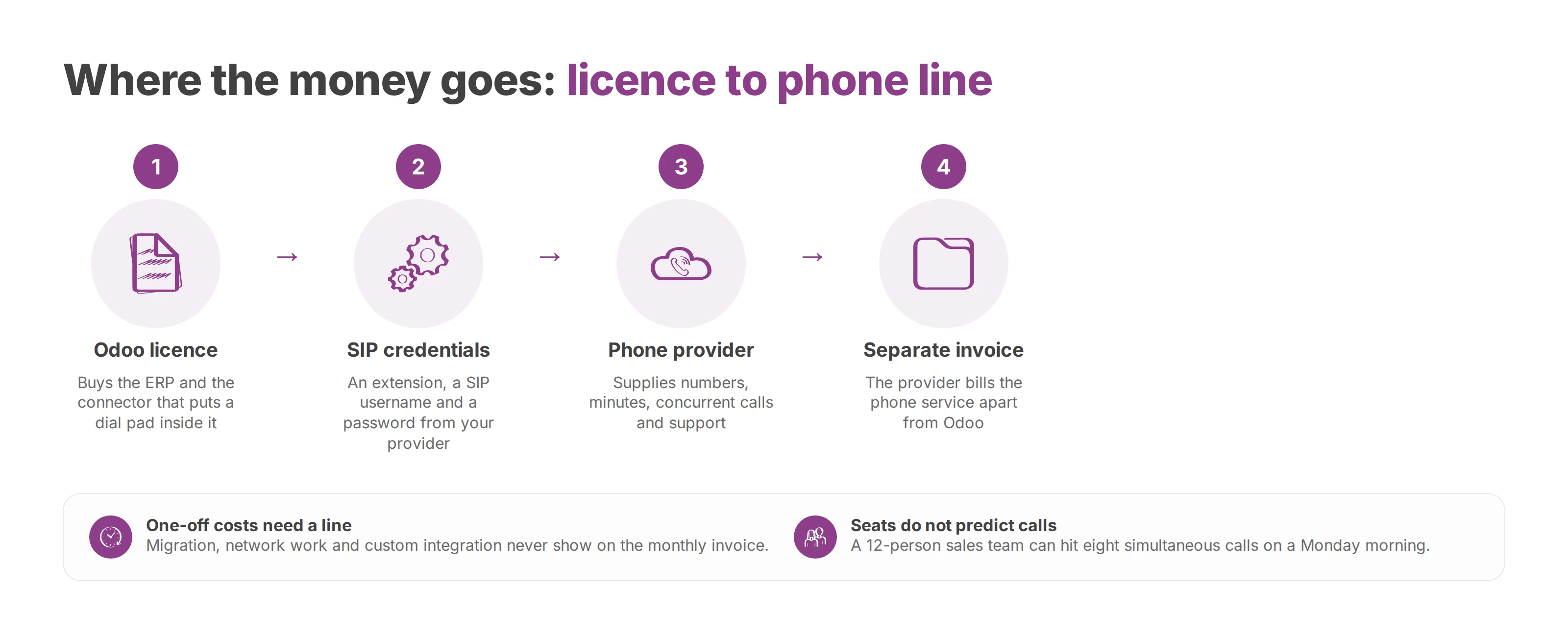
Odoo VoIP pricing is the total monthly and one-off cost of making and taking calls from inside Odoo. Odoo's documentation treats VoIP as a feature you switch on with credentials from an outside provider: an extension, a SIP username and a password (Odoo's VoIP documentation). The ERP licence brings no phone number and no call minutes. Those lines come from whichever provider you connect.
The budget therefore has two layers. The first is Odoo itself, with its users and its place in your sales and support processes. The second is the phone service. It covers the SIP connection and the numbers, inbound and outbound minutes, the calls you can hold at once and the admin work that keeps the line up. A total built from licences alone gives a sticker price that won't survive the first invoice.
Even on a cloud service, a migration, network work or a custom integration creates one-off costs. Those never show on the monthly invoice, so they need their own line in the business case.
Odoo works as the application layer on top of a telephony service. The provider terminates the calls, holds the numbers and sets how much calling capacity you get. Older Odoo releases documented a self-hosted Asterisk route, and current releases connect to a compatible SIP provider. Trunk compatibility, codecs, NAT traversal, TLS or SRTP encryption and the channel limit all belong in the checks you run before signing.
Replacing an on-site PBX usually means a move to IP access, ported numbers and features that live in software. The recurring per-user price then sits on one line of the business case. Migration, configuration and connectivity sit on another.
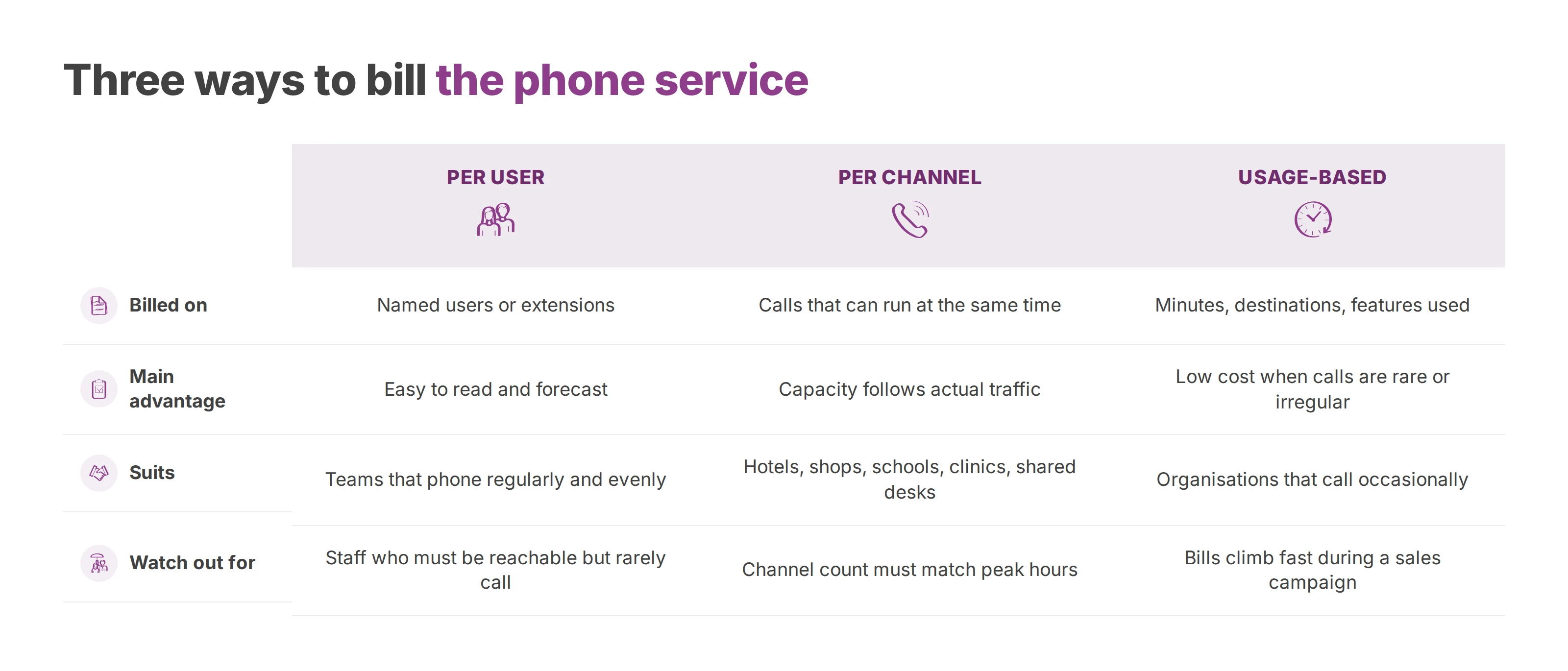
A phone provider can bill per user, per concurrent channel, per minute or a mix of the three. That choice usually moves the budget more than the Odoo seat count does, especially when your calls bunch into a few hours of the day.
| Model | Billed on | Main advantage | Suits |
|---|---|---|---|
| Per user | Named users or extensions | Easy to read and forecast | Teams that phone regularly and evenly |
| Per channel | Calls that can run at the same time | Capacity follows actual traffic | Hotels, shops, schools, clinics, shared desks |
| Usage-based | Minutes, destinations, features used | Low cost when calls are rare or irregular | Organisations that call occasionally |
| Hybrid | Users, channels and options combined | Fits several usage profiles at once | Multi-site firms and customer service desks |
Per-user billing reads simply when everyone on the plan phones regularly. It fits less well when many staff must be reachable but rarely call. A hotel gives extensions to reception, housekeeping, the restaurant and management, and the simultaneous calls still stay on a handful of lines. On Voxbi One, 40 extensions on Voxbi Plus cost 40 × €2.90 = €116.00 a month. Voxbi Channel sized for six concurrent calls costs 6 × €14.50 = €87.00 a month (October 2026 prices, excluding VAT, calls billed per minute on both).
Per-channel pricing follows the busiest moment of the day. A booking line, a clinic switchboard or a service centre can need many calls at once with few named accounts. The channel count has to line up with peak hours, queue lengths and overflow rules.
Usage-based pricing suits organisations that rarely call or whose destinations swing a lot. You'll track minutes, countries, mobile and premium-rate numbers, and the options switched on. A quiet month's bill can climb fast during a sales campaign or a push into new countries.
Hybrid pricing combines accounts, channels and options, which matches multi-site firms and service desks with several kinds of user. It needs close control of what's included, where the caps sit and which fees vary.
Available capacity is written in the contract. It should state the channels, queues, overflow rules, included destinations, inbound calls and number porting terms. An offer that bundles one national number with calls to landlines gets harder to forecast once your team rings mobiles or international numbers. Our guide to porting a business phone number covers the porting side in detail.
Switchboard features, call recording, hot-desking and conferencing can also change the bill. Your own destinations, expected volumes and peaks then go through the provider's rate card. On Voxbi One, calls are billed per minute at the destination rate on top of the plan price, so this exercise sets the size of that line.
The TCO of an Odoo VoIP project adds what you pay the provider to what the company carries itself. Over the reference period it sums the ERP subscription, the telephony, the integration, the migration and day-to-day operation.
Fixed costs come first. They cover Odoo licences, phone accounts and numbers, plus the SIP trunk, any PBX you host yourself and the monitoring tools. The variables follow, such as minutes, destinations, extra channels and recording options.
Migration is a line of its own. It can include a network audit, call-flow design, trunk configuration, number porting, quality tests and user training. The Odoo integration may also need API work, depending on how tightly calls should sync with contacts, opportunities and support tickets.
These items deserve separate prices in any quote:
Number porting, with lead times, the paperwork required and how service stays up during the switch
Technical set-up, covering the PBX, the network, security rules and compatibility tests
Application integration, stating which data flows into Odoo and in which direction
Onboarding, with training, documentation and help during the first weeks
Resilience, meaning monitoring, backup and recovery sized to how critical the phones are
A comparison against a cloud PBX only holds when both sides carry the same items. A cloud offer can include the infrastructure, the updates and part of the operations. A self-hosted setup leaves more of that work with your integrator or IT team.
Three columns per year put competing offers on equal terms. The first holds fixed recurring costs, the second holds variable call costs and the third holds operating services. The one-off migration cost goes in separately as a launch investment, and it stays out of the monthly price.
TCO per active user is the indicator to watch, read next to the cost per concurrent channel. Together they expose projects where a cheap licence hides oversized infrastructure.
For a 10-user team the Odoo licence is only part of the phone budget. Numbers, SIP connectivity, call-routing rules and the integrator's time come on top. The table prices the phone layer on Voxbi per month, excluding VAT, at October 2026 prices. It leaves out calls and the Odoo licence.
| Option | Monthly cost, 10 users | Odoo integration | Calls | Support |
|---|---|---|---|---|
| Voxbi One Plus | 10 × €2.90 = €29.00 | Included | Per minute at the destination rate | |
| Voxbi One Plus AI | 10 × €3.10 = €31.00 | Included | Per minute at the destination rate | |
| Voxbi Channel, 3 channels (the minimum) | €43.50 | Included | Per minute at the destination rate | |
| Voxbi Managed Professional | 10 × €7.70 + €29.50 = €106.50 | €29.50 per phone system, in the total | Per minute | Phone support, SLA with downtime credit |
| Voxbi Managed Professional, unlimited calls | 10 × €14.10 + €29.50 = €170.50 | €29.50 per phone system, in the total | Unlimited | Phone support, SLA with downtime credit |
On Voxbi One a number costs €2.00 a month, available in Germany, France and Switzerland, so two numbers add €4.00. Voxbi Managed covers more countries today. Talk to us for the price of a number there.
The two lines buy different things. On Voxbi One you set the system up yourself with our guides and the Voxbi Cockpit manual, with email support and no SLA. Voxbi Managed adds a team that sets it up and runs it, phone support, an SLA with downtime credit and the unlimited-calls option.
Per-user plans suit staff who call regularly. A channel plan suits a team that mostly needs to stay reachable. In either case the quote should list accounts, channels, numbers and implementation services on separate lines, which shows how much of the spend actually goes to telecom.
A 50-person company spread over several sites sizes its access around opening hours, local reception desks, geographic numbers, transfers and peak periods. One line per person rarely matches that pattern. On Voxbi One Plus, 50 users cost 50 × €2.90 = €145.00 a month before calls and numbers. On Voxbi Managed Professional the same team costs 50 × €7.70 + €29.50 = €414.50 a month with calls billed per minute.
Voxbi Managed Business costs 50 × €11.20 + €29.50 = €589.50 a month. It adds in-depth analytics, monitoring of your PBX and single sign-on. It also carries the Business SLA level, which means 99.90% monthly uptime and a maximum response time of 3 hours. Audit, network, deployment and training work come on top of any of these figures.
In a multi-site setup, SIP trunks, network quality of service, monitoring and continuity can weigh more than the Odoo seats. Centralising the phone system cuts local hardware. It also raises what you need from your internet access and your operations team.
A customer service desk is sized on concurrent traffic, queues, the IVR, overflow and recording. The number of named accounts can stay flat while the capacity you need jumps during a campaign, a booking season or certain opening hours.
Your integrator can price three options with the same numbers, destinations and features: per user, per channel and hybrid. Side by side, the three quotes show which model absorbs the peaks without paying for idle capacity. They also show what the telecom layer behind the headline price actually costs.
Calls, recordings, call metadata, activity logs and admin accounts can all hold personal data. Where that data sits and where it travels belongs in the specification, next to channel counts and routing rules.
Under Article 30 of the GDPR, the record of processing activities has to document any transfer to a third country or an international organisation. Hosting in the European Union narrows the transfers you have to review. Access rights, subprocessors and backups still need their own checks. Voxbi is built and hosted in the European Union, so your calls and data stay within its borders.
Your integrator should give written answers on storage locations, admin access, subprocessors, backups and the data flows around recordings. The same check applies to call metadata and speech analytics tools.
Which regions host the data, and which categories are kept
Which admin profiles exist, and what support staff can do with them
Which subprocessors can handle calls or recordings
How long each category is kept, and how it's deleted
Which lawful basis and which accountable party each processing activity has
AI Act compliance is assessed one function at a time. Obligations for general-purpose AI models and the governance rules have applied since 2 August 2025. The European Commission's Q&A on the AI Act dates most of the remaining rules, including the Article 50 transparency rules, to 2 August 2026.
Article 50 requires telling people when they're interacting directly with an AI system, unless that's obvious from the context (the Commission's guidance on Article 50). Transcription, voice assistants and automated call analysis each need classifying and documenting before they're switched on. Each one also needs its place in the contract and the architecture.
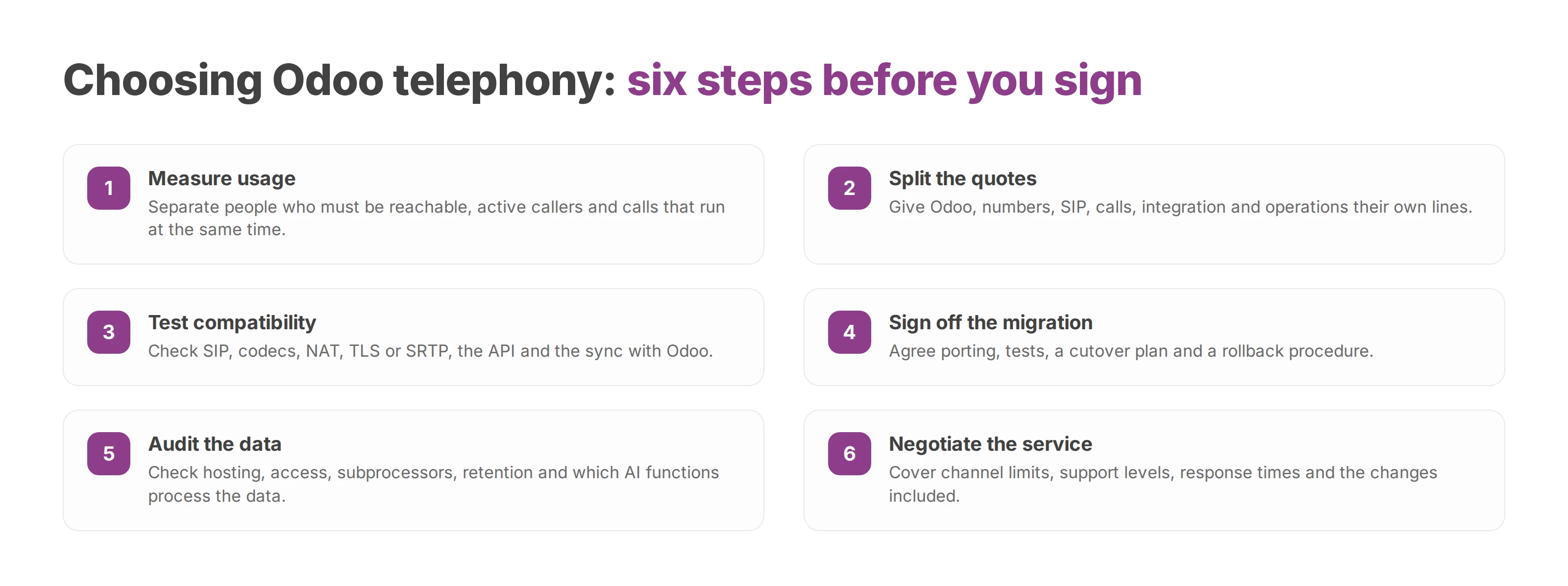
A good selection starts with an inventory of how you use the phone. It lists users and sites, numbers to port, opening hours and call peaks, destinations, queues and recording needs. The catalogue price comes later.
Measure usage. Separate the people who must be reachable, the users who call actively and the calls that run at the same time.
Split the quotes, with separate lines for Odoo, numbers, SIP, calls, integration and operations.
Test compatibility across SIP, codecs, NAT, TLS or SRTP, the API and the sync with Odoo. Our Odoo VoIP configuration guide walks through the setup step by step.
Sign off the migration, with porting, tests, a cutover plan and a rollback procedure.
Audit where the data is hosted, who can access it, which subprocessors touch it, how long it's kept and which AI functions process it.
Negotiate the service, including channel limits, support levels, response times and the changes included.
Negotiation point: a clear monthly price is where the contract starts. It also has to say what happens when traffic grows, a number is ported or a new site joins.
Voxbi is a cloud PBX built and hosted in the European Union, with an Odoo integration on both lines. On Voxbi One it's included from Voxbi Plus at €2.90 per user a month, and in Plus AI and Channel. On Voxbi Managed it's an add-on at €29.50 a month per phone system, from Professional up. Weigh it like any other option on feature coverage, the channel model, hosting and the operating contract. Our round-up of the best cloud PBX for Odoo users sets it next to the alternatives.
To check your budget against a European cloud setup for Odoo, send your user count, sites, numbers to port and peak concurrent calls to hello@voxbi.com. Ask for a sizing of channels, migration and data requirements before you sign the contract.
Ringover alternatives compared plan by plan: Voxbi Managed Business Flat against Ringover Business, Voxbi Plus against Ringover Talk, with costs for 10, 25 and 50 users.

Ringover bills a cloud PBX per user, per month: 20 € on Talk and 47 € on Business with an annual commitment, Advanced on quote. Here's what each tier includes, what monthly billing adds, and which cost lines a quote has to show before you can compare it with anything else.
Telavox publishes €29 for an unlimited fixed seat but no price for its business tier. Voxbi publishes every tier. Compared at 10, 25 and 50 users.
Start a free trial, or work with a certified Voxbi partner.