
What is vishing? How to spot and stop voice phishing at work
Vishing tricks staff over the phone into sharing codes or paying fraudsters. Learn the business scams, the warning signs and a short procedure that stops them.
Nov 14, 2026
What a freephone number is, who pays for the call, the UK's 0800 and 0808 ranges and how other countries differ, and how to route and test the line before launch.

If a call is free for your customer, who pays for it? You do, and the call charge is the smallest part of the bill. Before you pick a freephone number, work out who will answer it, at what hours, and what happens when every line is busy.
That holds for a small business, a clinic or a group of sites alike. The prefix takes a minute to choose. The slow questions are about reach: whether callers on a mobile or abroad get through for free, and where a call goes when nobody can pick up.
A freephone number is a number that costs the caller nothing. The organisation that owns it pays for every call it receives. You will also see it called a toll-free number.
Take a company that runs its technical support from one line. A customer rings about a fault and an adviser takes the request. The customer pays nothing for the call. The adviser's time and the phone system behind the line are still on your books.
Customer service and technical support are the usual homes for these numbers. So are public information lines and helplines, where someone may hesitate to call if it costs them money.
The free status comes from the number range, and each country sets its own ranges. An 0800 number in the United Kingdom and an 0800 number in France sit in two separate national plans with separate rules. The digits look alike, and that tells a caller nothing about what they will pay in another country.
In the United Kingdom, the freephone numbers a business can publish start with 0800 or 0808. The UK government's guide to call charges lists both as free from landlines and from mobiles, alongside free public service numbers such as 116 and 111. Here is how they sit next to the other ranges your callers will recognise:
| Number starts with | What it is | Cost to the caller (approximate, per minute) |
|---|---|---|
| 0800, 0808 | Freephone | Free from landlines and mobiles |
| 01, 02 | Geographic numbers | Up to 16p from landlines, 3p to 65p from mobiles |
| 03 | UK-wide numbers | Up to 16p from landlines, 3p to 65p from mobiles |
| 09 | Premium rate, regulated by Ofcom | Up to £3.60 plus the caller's access charge, plus 5p to £6 per call |
| 999, 112 | Emergency services | Free |
The same guide notes that these figures are approximate and that callers ringing from abroad should check with their own provider. So "free" on your website means free inside the UK.
You get a freephone number from a phone provider, as part of your phone service. Before you sign, ask the provider four things:
Whether it can supply an 0800 or an 0808 number, and what the number costs each month.
What you pay for each minute a caller spends on the line, and whether calls from mobiles are billed at a different rate from calls from landlines.
Whether callers outside the UK can reach the number at all.
Whether the number can ring your existing phone system, or only the provider's own.
If the freephone number rings into the same cloud phone system as the rest of your lines, it gets the same queues, opening hours and call reports, and you have no second platform to look after.
Outside the UK the logic is the same and the digits differ. France is a good example of how far apart two plans can be. The French regulator Arcep's guide to special numbers sorts them into three price groups:
| French numbers starting with | Price group | Cost to the caller |
|---|---|---|
| 0800 to 0805 | Free | Free call, free service |
| 0806 to 0809 | Normal rate | The caller's normal call price, no service charge |
| 081, 082, 089 | Premium rate | The normal call price plus a service charge, which on 089 numbers can reach €0.667 a minute or €2.50 a call, excluding VAT |
Since a reform on 1 October 2015, French numbers carry a colour code: green for free numbers, grey for normal-rate numbers and purple for premium-rate numbers. An 0806 number shares the 080 digits with a freephone number, but it is a normal-rate number with a grey label.
Every other country has its own regulator and its own plan. If you serve callers in several countries, check each one before you print a number:
which number types a provider can give you there;
whether calls from landlines and from mobiles are both free;
whether callers from other countries can get through, and at what price;
what your website promises, so it never says more than the contract covers.
A "low-cost line" label on a normal-rate number is a marketing phrase, and the caller still pays the normal rate. If you want to promise a free call, take a number from the country's free range.
Freephone works like Freepost. The sender posts the envelope for nothing and the recipient pays the postage. Your caller dials for free and you pay for the call, plus everything it takes to answer it.
Premium-rate numbers turn that round: the caller pays more than a normal call, and part of the charge goes to the service. Emergency numbers are a third case. Arcep's page on emergency numbers puts it plainly: operators carry emergency calls free of charge, and, unlike the holder of a freephone number, the holder of an emergency number does not pay for the calls. In the UK, 999 and 112 are free to call too.
So the caller pays for a premium call, the business pays for a freephone call, and for an emergency call neither of them does.
Keep telecoms charges and running costs apart in your budget. The call bill counts minutes on the line. The staff time each request takes never shows up on it.
On the telecoms side you pay for the minutes callers spend on the line, priced by your contract and often by where the calls come from, plus any service or routing fees. Ask for those fees itemised before launch. The running costs are mostly people: the conversation itself, the look-up and the follow-up work. Longer opening hours need a staffed team or an on-call rota. If calls overflow from one site to another, check what a transfer costs and whether the receiving site has anyone free.
Picture a group of clinics that books appointments through one central line. The central desk answers and transfers the call to a clinic, where a third person may handle it. Your budget has to cover every leg of that path, up to the last pick-up.
Voxbi publishes its call rates per destination. They give you an order of magnitude for calls. They are not the price of a freephone number, which you agree for the number and country you need, along with how it bills incoming calls and transfers.
Regulation fixes what the caller pays. Your contract decides what you pay, call by call. Get written answers to these:
Do calls from mobiles fall inside the free scope you advertise?
Can callers abroad reach the number, and at what rate?
Who pays for each billed part of the routing?
When a call moves to another site or an outside number, does the provider keep billing the first leg while the platform holds the call?
The answers have to be precise enough to build a budget and to write accurate public information. "Free call" on its own does not cover every international case.
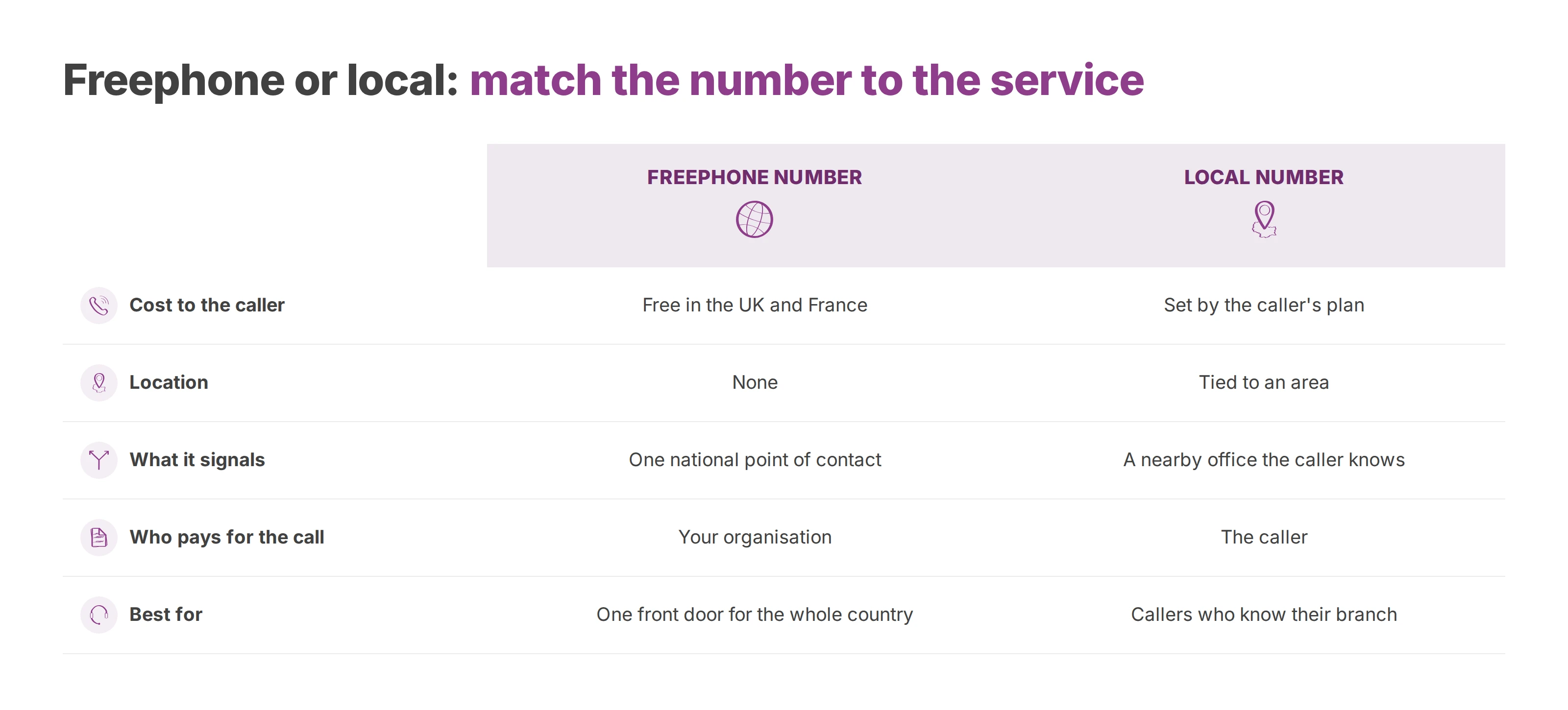
Freephone numbers are non-geographic. The prefix says nothing about the town or the site that answers. A geographic number ties the line to an area in the national numbering plan.
| Freephone number | Local number | |
|---|---|---|
| Cost to the caller | Free from landlines and mobiles in the UK and France; check other countries | Set by the caller's plan |
| Location | None | Tied to an area |
| What it signals | One national point of contact | A nearby office the caller knows |
| Who pays for the call | Your organisation | The caller |
Pick a freephone number when you want one front door for callers anywhere in the country, whichever site handles the request. Pick a local number when the caller already knows their branch, hotel or practice and wants to reach it. The same goes for a DDI (direct dial-in) number, which points straight at a person or a team.
Start from what your callers expect. A central desk has no need to look local, and a corner shop rarely gains anything from a national line. Never charge callers on a line your service promise presents as free. Keep a familiar local number unless the customer gains something from the switch. And find out what mobile and international callers will pay before the number goes on anything you print.
| Use | Number to choose | Main reason | Watch out for |
|---|---|---|---|
| Customer support and after-sales | Freephone | Free call, one national entry point | Queue staffing at peak hours |
| Hotel or restaurant bookings | Local, or freephone for a multi-site group | A single venue gains from a local anchor | Opening hours and overflow to another site |
| Patient line for a practice or clinic | Local for the site, freephone for a central desk | Patients recognise their own practice | Waiting times and accessibility |
| Central appointment booking | Freephone | One entry point for several sites | Reliable routing to the right site |
| Seasonal or crisis information | Freephone | No cost to callers during peaks | Capacity planning outside the season |
| Prospecting or local sales | Local | Trust and proximity | A number that matches the sales area |
After-sales support is the classic case, especially when your customers are spread across the country. People can report a problem without wondering what the call will cost them. Somebody still has to answer, though, and a free call that waits forever loses the customer anyway.
The first menu option should match the reasons people actually call. A request to track a case shouldn't land with a technical team that can't deal with it. Set the destinations before the number goes on your packaging and your invoices.
For bookings, the size of your network changes the answer. An independent restaurant usually does better with its own local number, which callers already link to the venue. A hotel group may prefer one shared desk, as long as the team identifies the property before confirming availability. If another property takes an overflow call, the person there needs the context and the system access to finish the booking.
In a practice, patients usually want to reach a place and a team they know. A local number keeps that continuity, especially when reception also answers questions about access and opening hours.
A central appointment line does a different job: it sends each request to the right clinic or specialty, and a healthcare phone system often runs one for several sites. Freephone works well there, provided the call path separates a new booking from a call meant for a department the patient already deals with. Ask only for the sensitive information that the routing step needs.
The right number is the one that makes the caller's next step obvious.
A seasonal information line has to open, scale up and close down cleanly. Plan an out-of-season message and a sensible fallback, so callers never hear a phone ringing in an empty office.
For local sales, proximity usually decides. A prospect who wants to book a visit needs to know which branch answers and which area it covers. If the "local" number always routes to a remote desk that doesn't know the area, it works against the trust it was meant to build.
Your line can be free to call and still impossible to get through on when someone needs it. The free call takes away the price. Whether anyone answers depends on how many calls the line accepts at once, how many agents are free, and what your rules do when demand outruns both.
Track abandoned calls, waiting times and the periods when the line is saturated. Read those figures against your opening hours, your campaigns and the reasons people call. An abandonment spike that comes back every lunchtime points to a staffing gap. Adding a queue with no team behind it only moves the wait somewhere else.
Before you open the number, decide what happens to each call that nobody can take straight away. It can wait in a queue or overflow to another team. If your system offers it, the caller can take an automatic callback or switch to a written channel. Your call queuing rules should also cover unplanned closures and absences, so nobody waits in a queue that will never be served.
Each queue should lead to a team that can actually resolve the request, and the overflow destination should have people free. Prepare announcements and calendars for exceptional hours before the date arrives. Decide, too, how the line behaves if one site goes offline.
A free call is no use to someone who can't follow the line. In the European Union, the European Accessibility Act has applied to telephony services since 28 June 2025, with micro-enterprises that provide services left out of its scope. Whatever your legal position, a line that a part of the public can't use shuts those people out.
Seasonal lines are where this usually goes wrong. They open at the moment demand peaks, so nobody has time to fix the call path after launch. If your line serves patients or the public, build in:
a spoken greeting that names the service straight away;
a short path to a person, through an IVR (interactive voice response) menu with only a few options;
an accessible written alternative for people who can't use their voice;
plain prompts that never use internal team names.
Test the caller's whole path, including the case where no agent is free, and check what happens at each destination. A ringing phone proves very little.
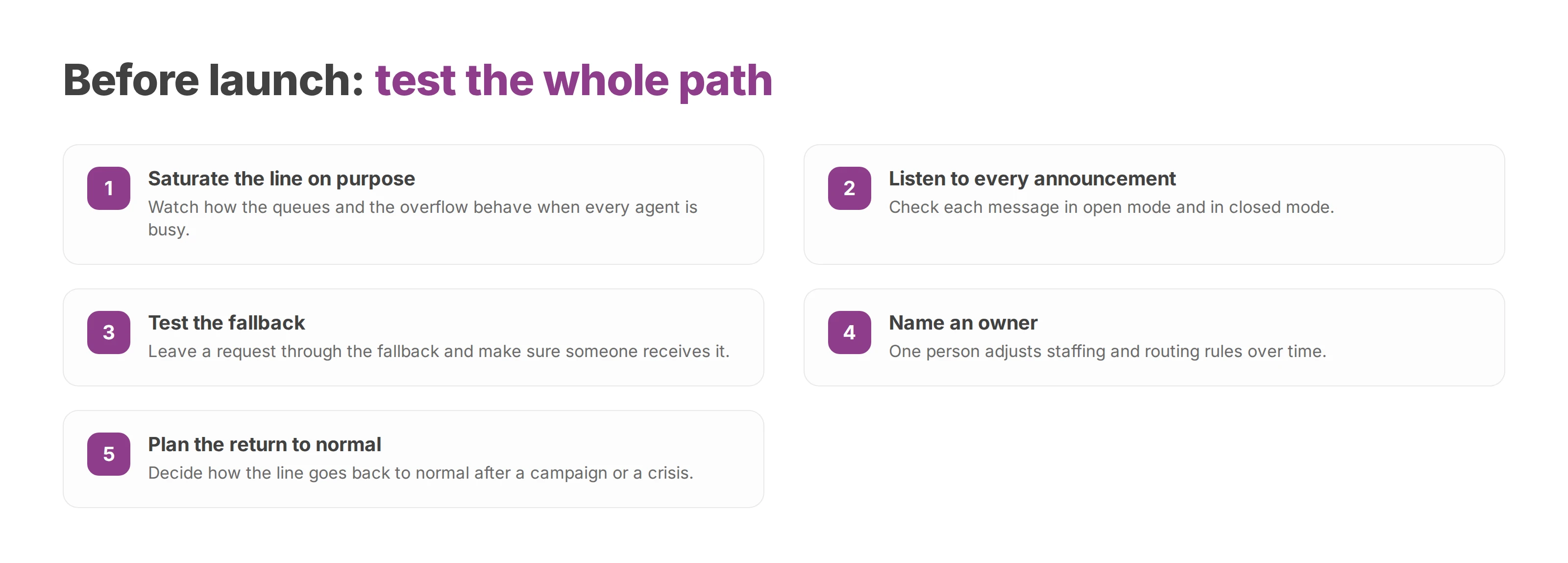
Saturate the line on purpose and watch how the queues and the overflow behave.
Listen to every announcement, in open mode and closed mode.
Leave a request through the fallback and make sure someone receives it.
Name an owner who adjusts staffing and rules over time.
Plan the return to normal after a campaign or a crisis.
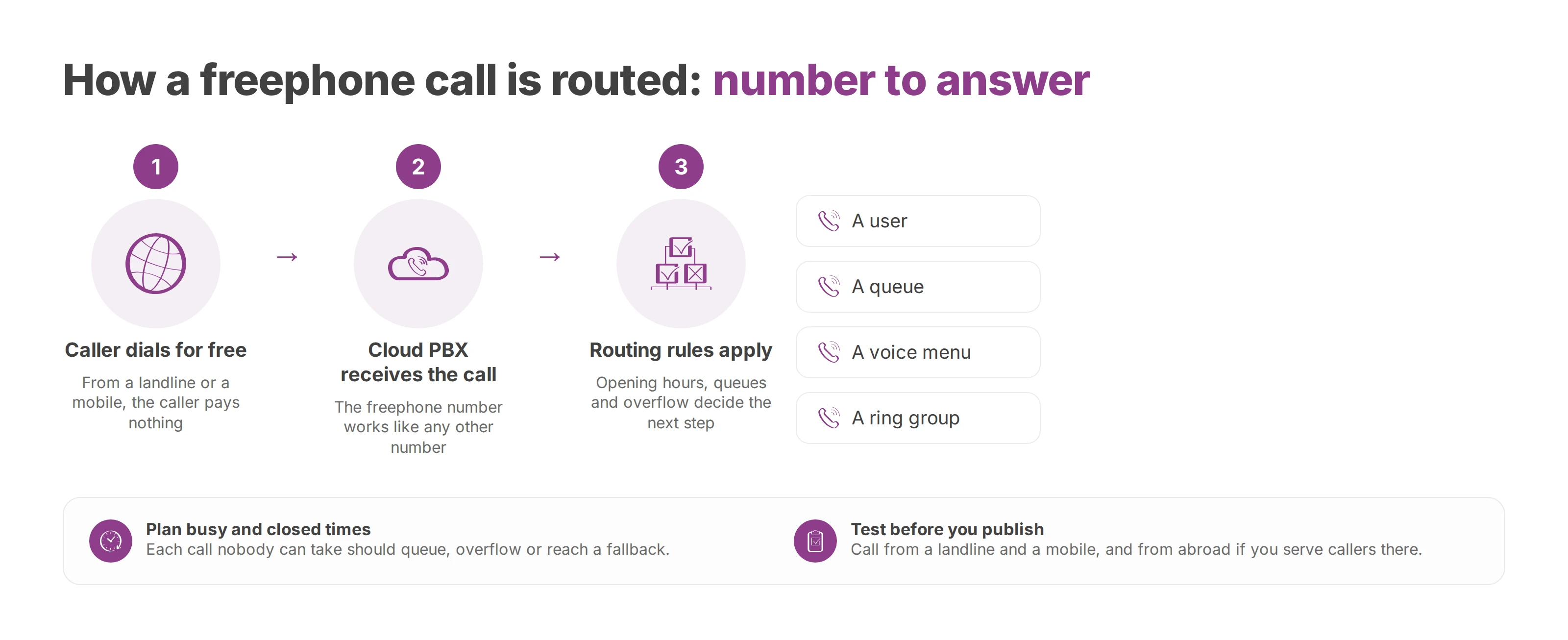
Once the number is live, your cloud PBX (private branch exchange, the phone system that routes your calls) treats it like any other number. It can ring a user, a queue, a voice menu, a ring group or a whole site, and call flows handle the exceptions.
Decide first who takes the call: a named person, a queue, a menu or a ring group, depending on why people ring. Your routing rules then deal with everything else.
Then call the number yourself from a landline and from a mobile. If you serve callers abroad, call from another country too, and check both that you get through and what it costs. Finish with a full rehearsal of the opening hours, the overflow and the call reporting before the number goes public.
Ask your provider three more things: where it hosts call data, who has admin access and how it complies with the GDPR (General Data Protection Regulation). You want to know where the data is processed, which subprocessors handle it and who can reach it. A supplier's registered address tells you little about any of that. Voxbi is built and hosted in the European Union, so your call data stays in the European Union.
On Voxbi One, a virtual number costs €2.00 a month, in Germany, France and Switzerland, and more countries are coming. Voxbi Managed covers more countries today. A UK freephone number, or one in any other country, is arranged case by case: talk to us about the country, the call volume you expect and your queue and opening-hours needs, and we'll come back with your options and the price of the number. If you'd rather buy through a local reseller, our partner directory lists them.
Whichever number you choose, test the whole path from the first ring to a useful answer before you publish it.
Vishing tricks staff over the phone into sharing codes or paying fraudsters. Learn the business scams, the warning signs and a short procedure that stops them.
What cold calling means in B2B, how it differs from warm calling, which calling rules apply, and how to script and measure a call that books a meeting.
How to choose music on hold, license it for each country, prepare a seamless loop and give every call queue its own audio file.
Start a free trial, or work with a certified Voxbi partner.