
Music on hold: a guide for your business phone system
How to choose music on hold, license it for each country, prepare a seamless loop and give every call queue its own audio file.
Nov 7, 2026
What cold calling means in B2B, how it differs from warm calling, which calling rules apply, and how to script and measure a call that books a meeting.

Cold calling is an outbound call to a prospect who has never dealt with your company. In B2B the first call rarely closes a sale. Its job is to qualify the account and book a meeting, and the selling comes later.
This guide is for sales managers and IT leads who are bringing the phone back into prospecting. Your team probably has a customer relationship management (CRM) system, target account lists and some inbound traffic. The pipeline is still short of direct conversations with the right people. A quick call tells you whether an account deserves sales time or should leave the pipeline. It works best as one step in a sequence that also uses email, LinkedIn and follow-up calls.
The term gets used loosely, and that causes trouble once compliance comes into it. Telephone prospecting, warm calling and consumer telemarketing have different goals and different data obligations. Where your call data is hosted belongs to the same decision, because the General Data Protection Regulation (GDPR) covers the contact list and the call records alike.
A cold call reaches someone who has no traceable relationship with your business: no download, no demo request, no earlier conversation. Aircall defines it as calling leads who haven't asked to hear from you. On that first call you're checking for a need, a project or a priority that would justify a meeting.
Calling back someone who downloaded a white paper or asked for a demo is a warm call, because that prospect already knows your name. A reply on LinkedIn is a warm signal too. It changes your opening line, your tone and what you can reasonably ask for at the end.
Telephone prospecting is the wider family. It covers cold calls, follow-ups on known leads, calls after an email and calls after a trade fair. Cold calling is the one case where you start from zero.
If you can't point to any earlier contact, it's a cold call. Any signal or exchange makes it warm.
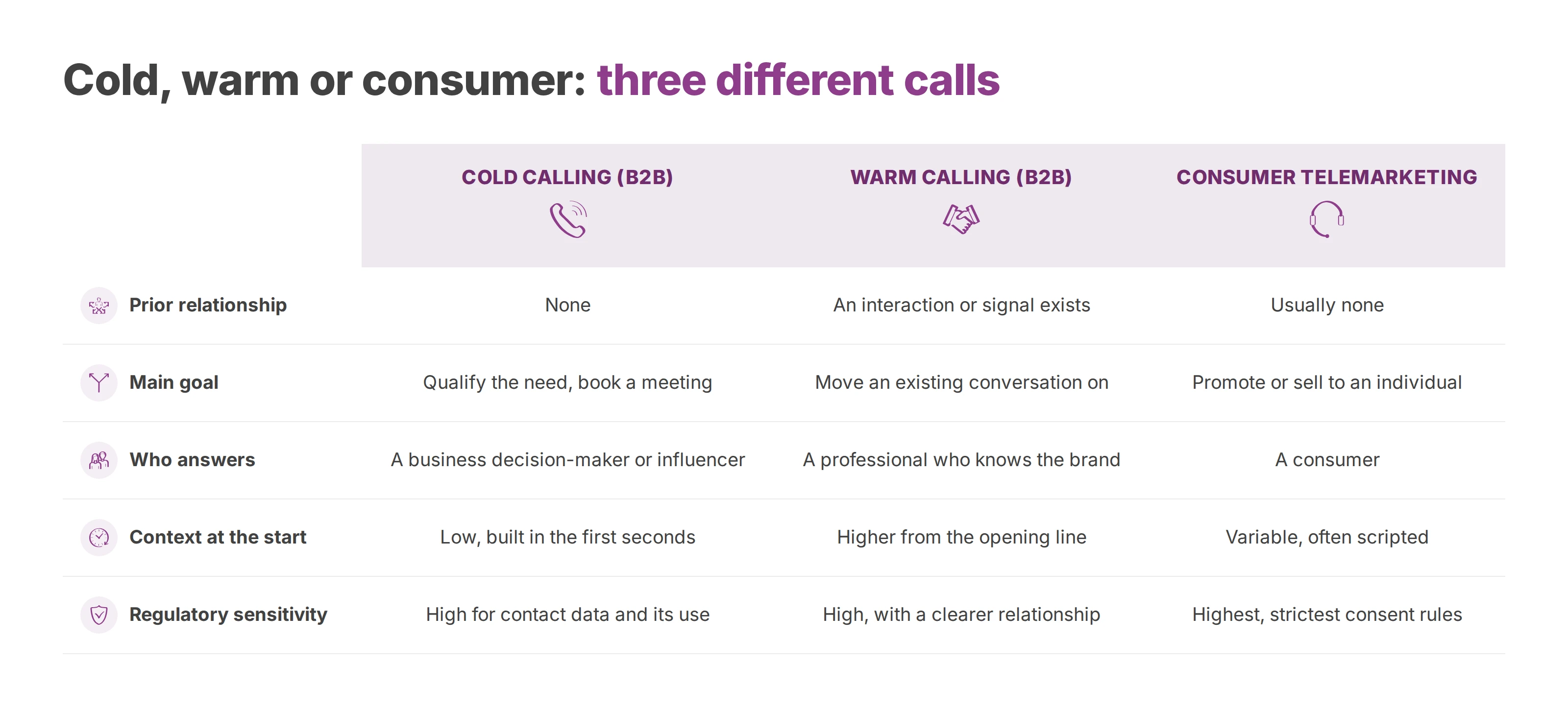
| Cold calling (B2B) | Warm calling (B2B) | Consumer telemarketing | |
|---|---|---|---|
| Prior relationship | None | An interaction or signal already exists | Usually none |
| Main goal | Qualify the need and book a meeting | Move an existing conversation forward | Promote or sell to an individual |
| Who answers | A business decision-maker or influencer | A professional who already knows the brand | A consumer |
| Context at the start | Low, built in the first seconds | Higher from the opening line | Variable, often scripted |
| Regulatory sensitivity | High for contact data and how it's used | High too, with a clearer relationship | Highest, with the strictest consent rules in some countries |
Each type needs a separate list, script and privacy notice. Teams get two things wrong most often. They log a CRM follow-up as a cold call, and a segmentation problem disappears from the reports. Or they run a B2B cold call like consumer telemarketing, and the prospect hears a generic pitch that colours how they see your brand.
The GDPR decides how you may use a contact's personal data. National telemarketing laws decide whether you may call at all, and those can be stricter. Check both for every country on your list.
Under the GDPR, a B2B caller can use legitimate interest as the lawful basis instead of consent. Recital 47 says processing for direct marketing "may be regarded as carried out for a legitimate interest", but only after a careful look at what the person could reasonably expect. A procurement manager at a target account expects suppliers to call about procurement. A personal mobile number copied from a forum is much harder to defend. Under Article 21, anyone can object to direct marketing at any time, and their data may then no longer be used for it. Put that number on your internal do-not-call list the same day.
National rules sit on top of the GDPR, and two examples show how far they can differ:
Germany. Section 7 of the Act against Unfair Competition (UWG) treats a sales call to a consumer as unacceptable harassment without prior express consent. For a call to a business, you need at least that business's presumed consent, so you must be able to argue why this company would want your call.
United Kingdom. The Information Commissioner's Office says B2B callers must screen their lists against both the Telephone Preference Service (TPS) and the Corporate Telephone Preference Service (CTPS), plus their own do-not-call list. You can call a number on those registers only if that person has specifically agreed to your calls.
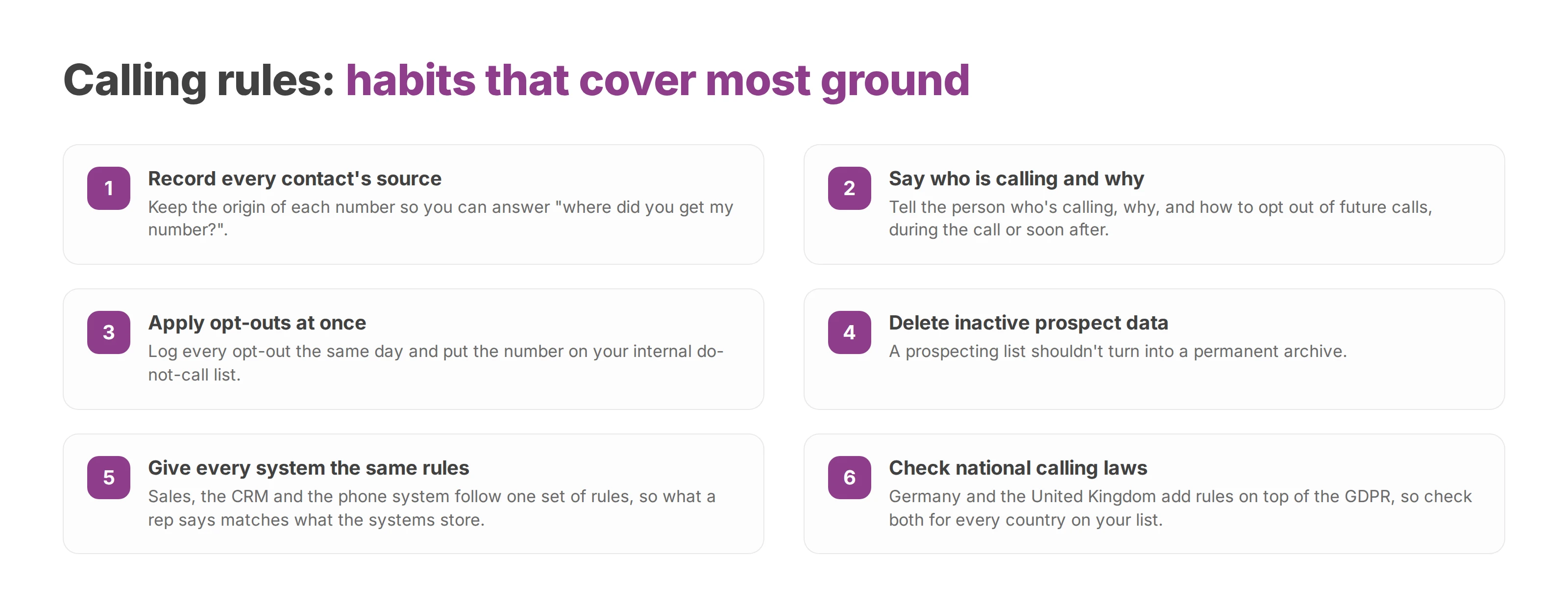
You don't need to turn your sales team into lawyers. A few habits in the process cover most of the ground:
Record where every contact came from, so you can answer "where did you get my number?".
Tell the person who's calling, why, and how to opt out of future calls, during the call or soon after.
Log every opt-out and apply it at once.
Delete prospect data that has gone inactive. A prospecting list shouldn't turn into a permanent archive.
Give sales, the CRM and the phone system the same rules, so what a rep says matches what the systems store.
B2B prospecting usually has more room than consumer calling. That room doesn't cover vague answers about how you process data, or contact data scattered across tools. Your phone system holds personal data too, in its call history, recordings and metadata, so where it stores them is a GDPR question just as it is for the CRM. Prospects also judge the number on their screen before they pick up, so show a consistent business number (see our guide to outbound caller ID).
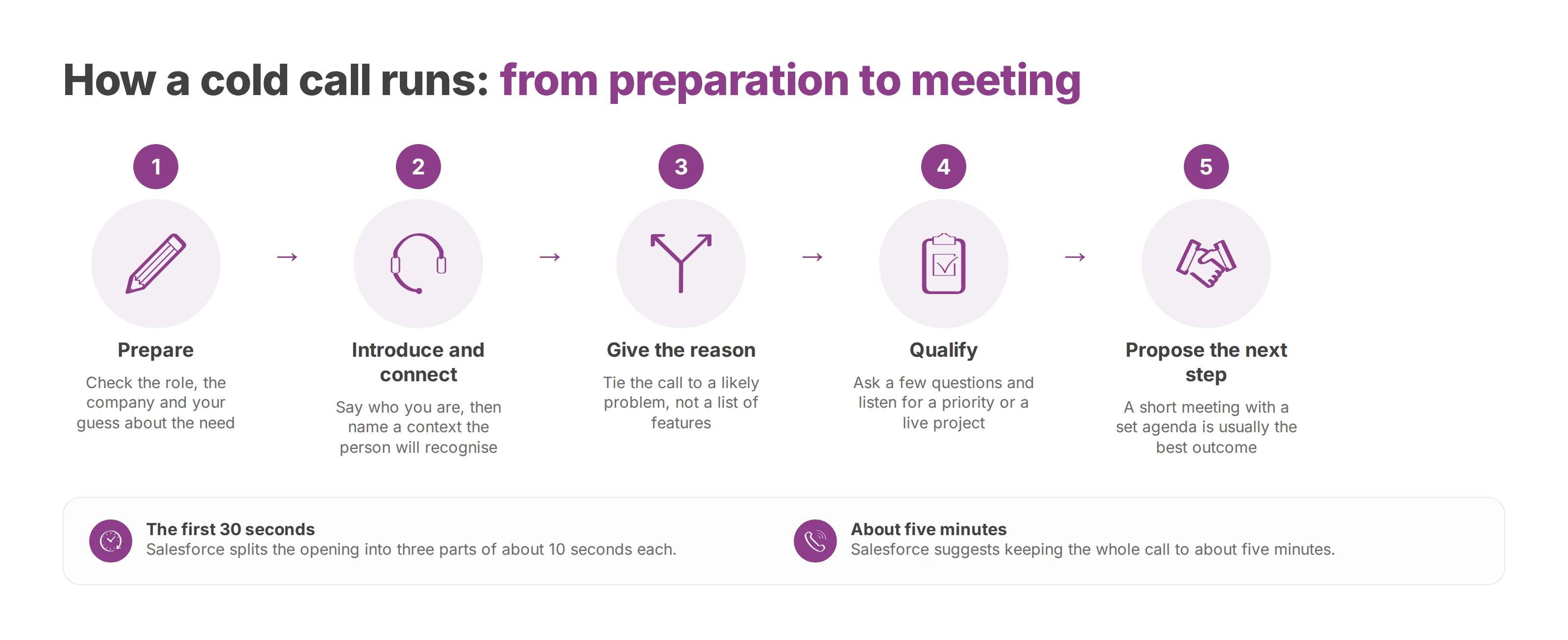
Salesforce's cold calling guide splits the opening into three parts of about 10 seconds each: who you are and what your company does, a point of connection, and why you're calling. It calls the first 30 seconds the most important part, and suggests keeping the whole call to about five minutes. Within that frame, a cold call follows a fixed order:
Prepare. Check the person's role, the company, its situation and your guess about the need. Without that, the opening sounds generic, and a poor list hurts results before anyone dials.
Introduce yourself fast. Say who you are and where you're calling from in one breath.
Make a connection. Mention a business context, a sector issue or a day-to-day problem the person will recognise.
Give the reason for the call. Tie it to a likely problem. A list of features gives the prospect nothing to respond to.
Qualify with a few questions. Listen for a priority, a frustration or a live project.
Propose the next step. A short meeting with a set agenda is usually the best outcome.
You'll reach voicemail on a good share of calls. The advice on professional voice messages applies to a prospecting voicemail as well: keep it short and in your company's voice.
Take an integrator who sells telephony or software to companies with several sites. The opening could run like this:
"Good morning, Ms Carter, it's Paul Hughes from Northline. I work with multi-site companies that want to manage their phones from one place instead of changing settings by hand at each site. A quick question: is your call routing managed centrally today, or does each site run its own?"
Paul gets his introduction done in one sentence, names a problem Ms Carter may well have, and asks his question while she is still listening.
Most objections ask for clarity, context or better timing, and a short, useful answer keeps the call open. When someone says they haven't got time, accept it and ask one closed question that shows whether the topic matters to them at all. "Send me an email" deserves a yes, followed by a question about which angle the email should take, so it doesn't land as one more generic message. If they already have a supplier, don't argue. Ask what works well today and what still frustrates them.
A cloud PBX turns each call into a tracked event in your sales process. Without it, reps dial by hand and keep notes wherever they can. With the phone system and the CRM connected, both share one record of the call:
Reps start calls from the contact record with click to call.
Each call logs against the right account and the right opportunity.
Managers see real activity on live dashboards instead of self-reported numbers.
Calls become material for coaching, within your internal rules and the GDPR.
Your prospecting calls share the phone system with your incoming lines. The guide to inbound vs outbound calls explains how to run both on one setup. On Voxbi One, live call dashboards and the Odoo, Microsoft 365 and API integrations start with the Voxbi Plus plan. Voxbi Plus AI also transcribes and summarises every call.
The tool you pick also settles who can reach call data and who answers for it: your company, your integrator or the vendor. Ask concrete questions before you sign. Who can play back a recording? How long is call history kept, and can you shorten it? Where are the servers? On Voxbi Managed, for example, call history is kept for 60 days on the Essential plan and up to 730 days on Enterprise, and recordings stay on our server for 3 to 120 days depending on the plan.
A cold calling campaign needs a few key performance indicators (KPIs), tracked the same way every week. The most useful is how often a conversation ends in a booked meeting. Cognism's State of Cold Calling 2025 report recalls a figure Cognism first published in 2024, based on data from We Have A Meeting (WHAM): 4.82% of cold call conversations ended in a booked meeting. The same report puts the industry standard at around 2%. Use figures like these to set expectations, not to promise results. A team well below them usually has a blockage somewhere in the call, and more dialling just repeats it.
A working dashboard tracks four numbers:
Calls made. Activity matters, but on its own this number says nothing about quality.
Connect rate, the share of calls that reach a person. A low rate points to weak contact data or targeting.
Conversation-to-meeting conversion: the central test of whether your calls work.
Conversation length, which separates calls cut off early from calls that open a real qualification.
A low conversion rate can come from poor targeting, a weak opening, an unclear value proposition or a vague next step. The pattern in the data shows which one you're facing:
Many calls but few conversations point to the contact data or the targeting.
Conversations that rarely turn into meetings mean the script and the questions leading to the ask need work.
Meetings that turn out unqualified mean reps are accepting next steps that are too weak.
Go through these ratios together in the weekly sales meeting, and pick one to work on until the next review.
Yes, when you use it to qualify accounts and book meetings rather than to force a sale. It pays off when the list is accurate, the opening is short, the calling rules of each country are respected and someone reads the numbers every week. The phone does its best work inside a multichannel sequence, on telephony and CRM tools that keep call data traceable.
Voxbi is a cloud PBX built and hosted in the European Union. From the Voxbi Plus plan, it connects your outbound calls to Odoo, Microsoft 365 or your own tools through the API.
How to choose music on hold, license it for each country, prepare a seamless loop and give every call queue its own audio file.
What an AI voice agent does on a business phone system, which calls to give it first, how to test handover and languages, and what to ask about data.
The transport, security and voice components behind a hosted PBX, who runs each one, and what to test before you switch off the old service.
Start a free trial, or work with a certified Voxbi partner.