A wireless VoIP phone keeps a receptionist, a nurse or a hotel housekeeper reachable while they move around the building. It uses the same extension and the same phone system as every desk. If you run IT for a small or mid-sized organisation that still sits on an ageing on-site PBX, the question usually comes up now. Copper lines are being retired across Europe, and staff want to take calls away from their desks. Voice also has to sit alongside Teams, Zoom or a CRM. So choosing a handset means choosing a radio architecture and deciding how those handsets will be governed on your SIP platform.
What a wireless VoIP phone is
A wireless VoIP phone is a radio handset that carries voice over IP and registers as a SIP endpoint on an IP PBX or a cloud PBX. The radio handles transport, and the call logic is ordinary SIP. That sets it apart from a wired SIP desk phone, which the guide to choosing a SIP phone covers. It also differs from the closed, proprietary DECT systems that older PBXs shipped with.
Inside the handset, the radio module manages the DECT or Wi-Fi connection, or both on a hybrid model. The SIP stack takes care of registration, calls, transfers and signalling. The codec adapts the voice to the network and to the quality the site expects. The lithium-ion battery decides how long the handset really lasts on a shift, and a colour screen makes it quicker to use while walking. A push-to-talk or alarm button becomes essential in healthcare and security work. A ruggedised casing earns its cost in workshops and hotel maintenance teams.
The handset's value comes from the way it's registered in the system. Once most of your telephony already runs over VoIP, a cordless handset is simply one more SIP endpoint. WebRTC tools and central monitoring sometimes sit on top of it.
Each layer depends on the others. Radio, signalling, audio and remote management get decided together. A cloud PBX with provisioning profiles helps most at that stage, especially when indoor mobility has to work the same way on several European sites.
Why move to cordless VoIP handsets now
The switch usually happens before the old PBX breaks down. Three pressures bring it forward.
Copper retirement. A setup that still depends on copper lines or an old PBX ends up costing more in workarounds than modernisation would. The guide to what PSTN is explains the network being switched off.
Indoor mobility. Receptionists, carers, multi-role staff and hotel teams need a handset that stays reachable while they move.
Centralised voice. Wireless IP handsets slot into a cloud PBX, monitoring and collaboration tools more easily than legacy kit.
The cost model changes too. A monthly per-seat charge is easier to read than a large up-front replacement budget, and the rollout stays reversible. Once the handset has to follow the person around the building, you're deciding on a radio architecture and on the way SIP accounts are governed. The result is a handset fleet you can manage, with defined zones, user profiles and mobility rules.
DECT or Wi-Fi: choosing by indoor mobility
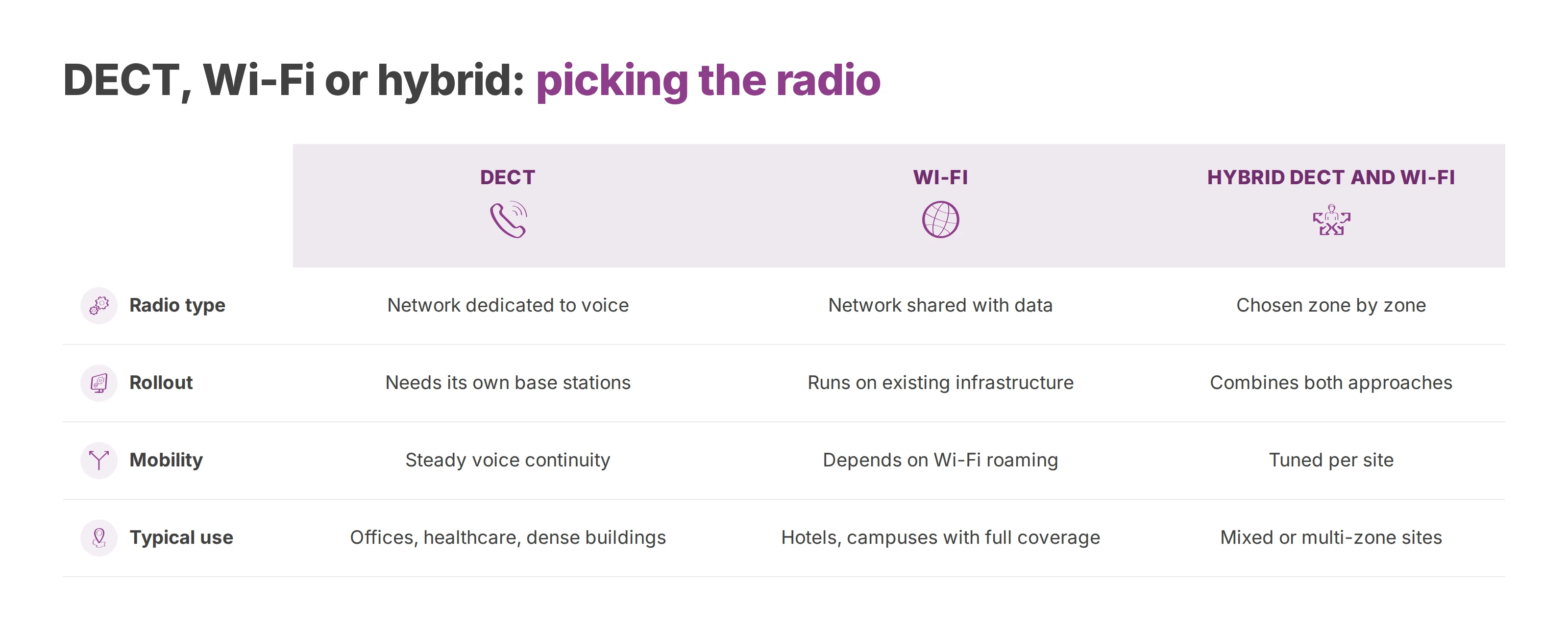
Indoor mobility decides between DECT and Wi-Fi. The factors are wall density, partition materials, how much roaming users need, call continuity and battery life. All five come from walking the site, so the survey happens before anyone picks a handset model.
When a DECT IP phone is the better fit
A DECT IP phone suits dense, heavily partitioned sites where voice is the priority. In a hospital with many concrete-walled rooms, call continuity and dependable voice roaming matter most. DECT runs on its own spectrum (1,880 to 1,900 MHz in Europe) with cells that are independent of the LAN. That's why it's usually seen as the steadier, longer-lasting option for covering large buildings, and voice holds up even when the structure fights the signal.
When a Wi-Fi handset makes sense
Wi-Fi takes the lead on sites that already have dense coverage, particularly Wi-Fi 6, where the business wants to avoid running two radio networks. A hotel campus or a well-equipped office can cut hardware spend by reusing the existing network, provided roaming and radio quality are under control. When coverage is even and the access points are already sized for the load, a Wi-Fi handset is the logical choice.
A quick decision guide
Heavy walls and many rooms: go with DECT.
Even Wi-Fi coverage already in place: evaluate Wi-Fi handsets.
Mixed zones: choose a hybrid setup.
Critical mobility with voice as the priority: keep calls off a Wi-Fi network that's already busy with data.
Sizing by fleet size
For 50 handsets, a simple network with one or a few well-tuned radio zones can be enough. At 200, you'll need to segment the zones and treat roaming as an acceptance-test item. At 500, a hybrid design often works better than a single technology, especially across several buildings or floors.
Codecs, QoS and security on wireless calls
Four settings shape a wireless call: codec, QoS, roaming and transport security. If any one of them is misconfigured, users hear dropouts, delay or echo, even with a decent handset and a good PBX. The VoIP call quality guide covers how to measure each of those symptoms.
Choosing a codec
G.711 is the easiest option for compatibility. G.722 makes voices sound fuller. Opus copes well with changing network conditions, and G.729 still has a place where bandwidth is tight. The right one depends on your network, the radio load and the quality the site actually needs.
Wi-Fi is a shared resource. Size it for voice traffic, allow for the security overhead and keep voice from competing with data. DECT has a different constraint. Commonly quoted deployment figures put a cell at about four simultaneous calls, and the real number depends on the base station and codec.
QoS and encryption
QoS has to follow the traffic end to end, with marking, priority and logical separation. On the LAN, voice goes in a priority queue and the voice VLAN stays apart from the data VLAN. Media runs over SRTP and SIP signalling over TLS 1.2 or later, with X.509 certificates managed by your company PKI. Unencrypted SIP over UDP has no place in a serious deployment.
A cloud PBX such as Voxbi provides that execution layer, with SIP, WebRTC, TLS, SRTP and central provisioning built for day-to-day operations. What you're delivering is an audio policy the operations team can administer and defend.
Good QoS can't make up for poor radio roaming. If the handset drops its cell, the priority queue won't save the call.
Registering handsets on a SIP cloud PBX
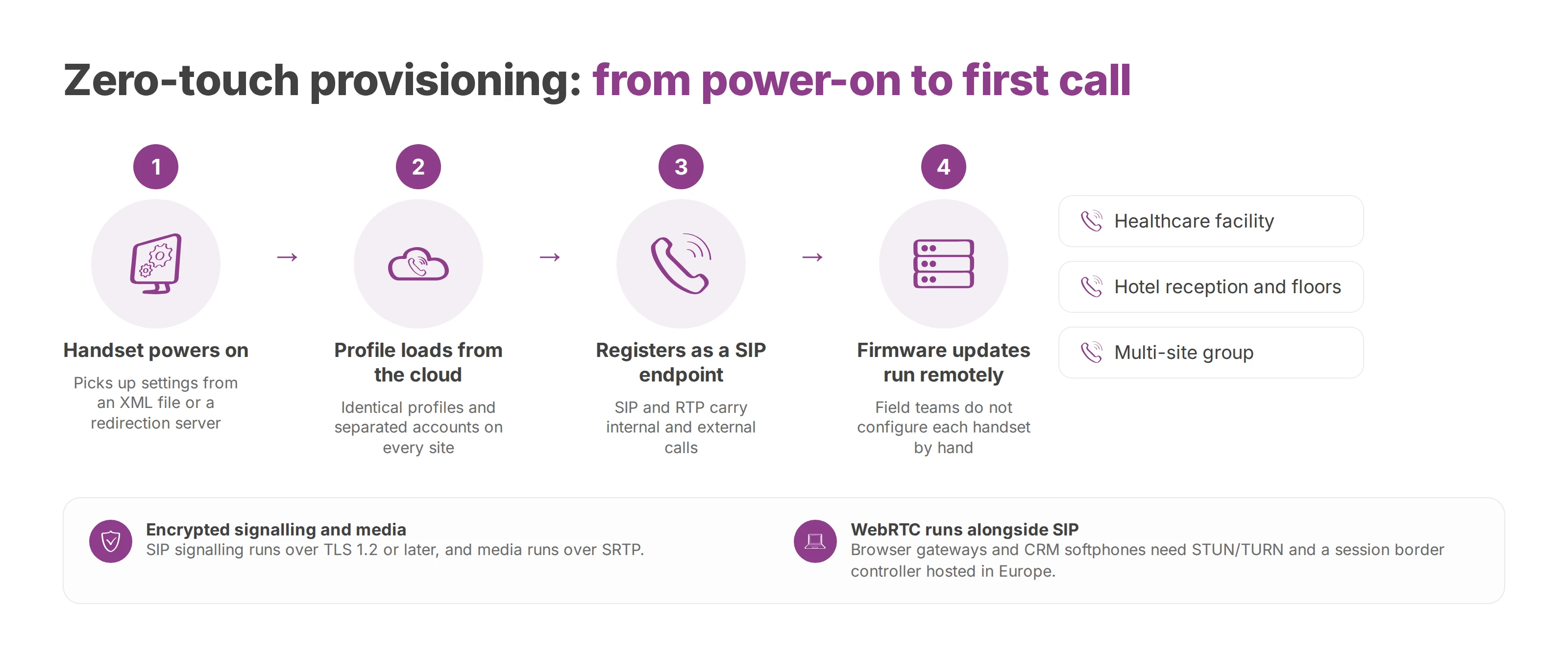
A wireless handset earns its place once it registers correctly on the cloud PBX. Provisioning should be automated, profiles should live in the cloud and firmware updates should run remotely. Without that, every site turns into a special case and your team spends more time fixing than running the service.
Healthcare, hotel and multi-site scenarios
A healthcare facility wants handsets registered fast, with identical profiles, separated accounts and an up-to-date view of any handset that can't be reached. In a hotel, the handset has to fit the rhythm of reception, the floors and internal requests, and it has to be quick to swap. For a multi-site group, governance matters most, which means shared rules, repeatable rollouts and tightly held admin rights.
The call flow runs on two tracks. SIP and RTP carry internal and external calls. WebRTC serves browser gateways, softphones inside the CRM and video calls. Running both means checking DNS resolution for the SIP domain, opening an outbound proxy and using STUN/TURN for outgoing WebRTC. It also means confirming there's a session border controller (SBC) hosted in Europe.
Zero-touch provisioning pays off across several sites. Handsets pick up their settings from an XML file or a redirection server, depending on the architecture. Field teams don't have to configure each handset by hand, and manual setup is one of the surest ways to derail a large rollout.
Sector use cases: healthcare, hospitality and multi-site
Each sector needs a different kind of indoor mobility, and that's where the DECT or Wi-Fi choice gets settled. Healthcare needs traceable emergency calls, constant availability and handsets that last the whole shift. DECT is the stronger fit where solid coverage and indoor location matter more than network convergence. Indoor location itself depends on the vendor's multicell system. Wi-Fi shouldn't carry calls on a site with sensitive equipment, or where call continuity can't depend on data traffic.
Hospitality tips the other way. A Wi-Fi SIP handset can tie into check-in, minibar and room-service systems, provided the property management system and the PBX support that integration. The hotel also needs even Wi-Fi already in place. Roaming has to cover rooms and service areas with very fast handover, otherwise staff lose time and calls drop at the worst moment. The model suits a property that's already built around Wi-Fi.
Multi-site groups often do best with a mixed fleet. Headquarters keeps DECT for its most mobile staff, while other profiles move to a WebRTC softphone. You avoid duplicating radio networks everywhere and keep governance central. Under GDPR, a cloud migration starts with an accurate map of the personal data and processing involved. European data-protection guidance also points towards a provider whose security and data-location commitments match the context. That review covers the provider's cloud security and the risk of access by authorities outside the European Union.
Deployment, GDPR and handover checklist
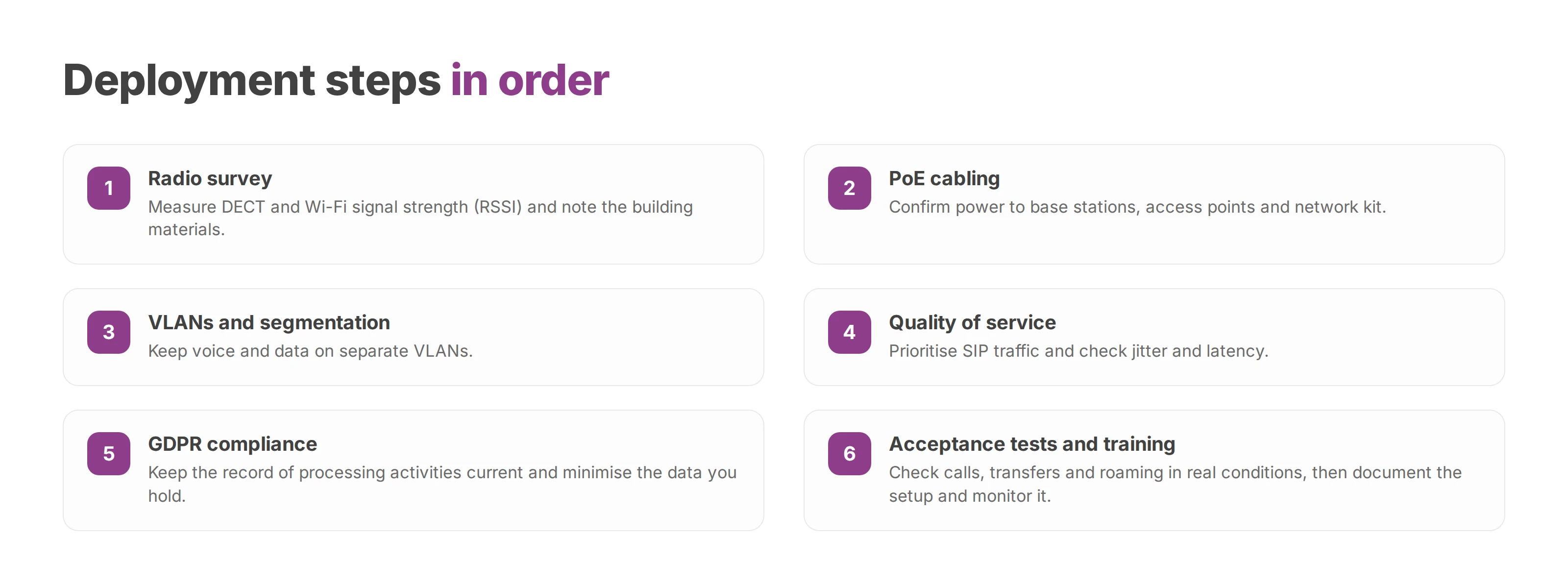
A clean rollout starts on site, before any handset arrives, with a radio survey, cabling tests, network segmentation and a compliance review. Teams that skip this step nearly always end up redoing the work in person.
Deployment steps in order
Radio survey. Measure DECT and Wi-Fi signal strength (RSSI) and note the building materials.
PoE cabling. Confirm power to base stations, access points and network kit.
VLANs and segmentation. Keep voice and data apart.
Quality of service. Prioritise SIP traffic and check jitter and latency.
GDPR compliance. Keep the record of processing activities current and minimise the data you hold.
Acceptance tests. Check calls, transfers and roaming in real conditions.
Training and operations. Document the setup and monitor it after migration.
Compliance belongs in the architecture from the start. Before a cloud migration, the data gets mapped by type, with personal, sensitive, strategic and business data kept distinct. A provider's security level covers backup, redundancy, encryption and physical security, and it has to hold for the whole length of the contract.
What to agree before go-live
On-call and monitoring. Who gets the alerts, and how often.
Firmware policy. Who approves updates and when they reach production.
WAN failure fallback. Which services stay available locally.
Exit and reversibility. How SIP accounts are closed and data returned.
Data sovereignty needs a firm answer. If the project demands strong protection against access by foreign authorities, vague arrangements are out and the provider has to be bound by European Union law and the controls expected there. The question gets settled before go-live, while changing provider is still cheap.
Radio, security, cloud and operations work best as one package. Voxbi is a cloud PBX that keeps calls, profiles and data in the European Union and runs administration centrally. That suits sites leaving an on-site PBX that don't want to build a ticket factory in its place. The cloud PBX migration guide covers bringing your teams across. If your site is leaving copper and needs secure calls with indoor mobility, write to hello@voxbi.com to check how the users, extensions and voice flows fit your building.