
Cloud telephony architecture: how a call travels from carrier to desk
The transport, security and voice components behind a hosted PBX, who runs each one, and what to test before you switch off the old service.
Oct 31, 2026
What an AI voice agent does on a business phone system, which calls to give it first, how to test handover and languages, and what to ask about data.

An AI voice agent is software that answers a business phone call, works out what the caller wants and either replies, takes an action it is allowed to take, or transfers the call to a person. A common piece of advice is to put one on every call and let it learn in real conditions. That is a bad place to start, because your reception then depends on a system whose limits, transfers and languages nobody has checked. A convincing demo is not enough reason to do it.
The AI is a function of your phone system, not the product. For a small or mid-sized company, or the telecom integrator who runs its phones, the work is to connect that function to the published number, the teams and the business data. Then you decide which calls it can take without creating a problem that costs more than the missed call it was meant to save.
On a web page, an agent can answer a question about opening hours correctly. On your business number the same exchange asks for more: the agent has to work out which site the caller means, look up that site's hours and know where to send the call when the question turns specific. The difference lies less in the voice than in the data the agent can reach and the rules it follows.
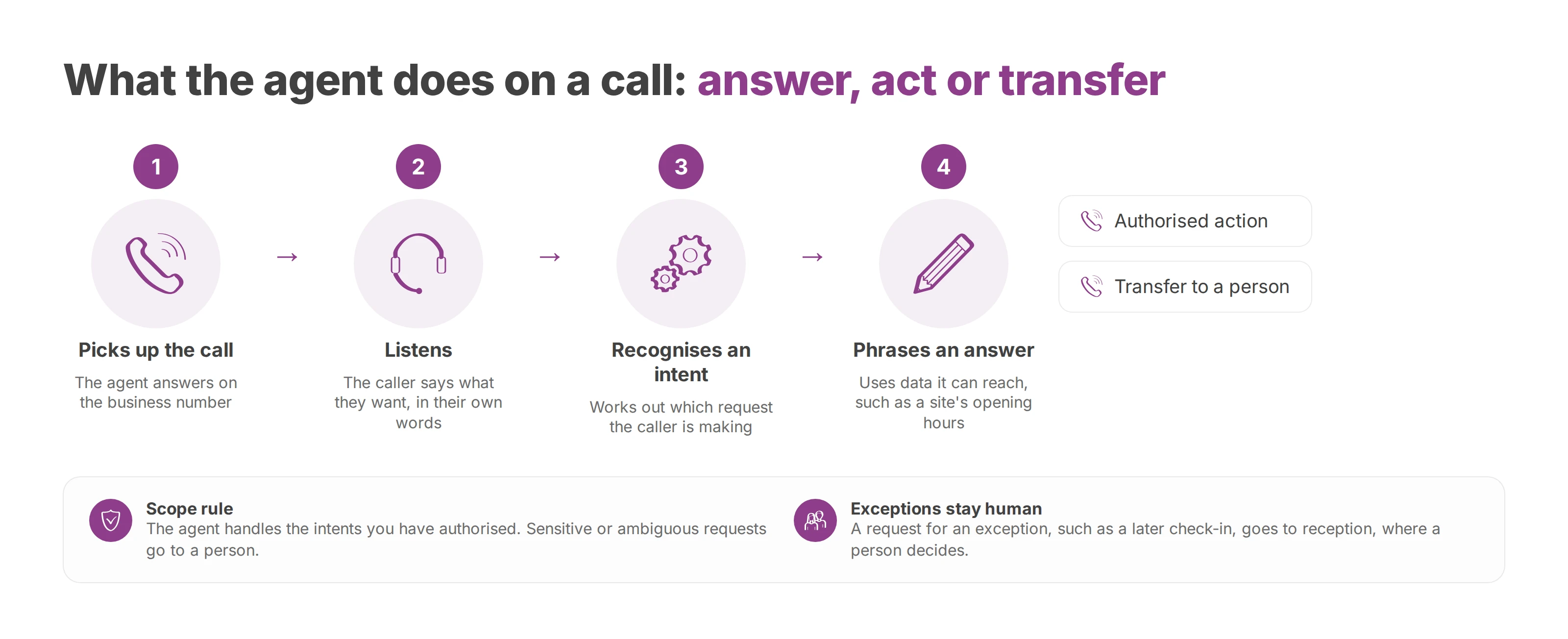
On a call, the agent picks up, listens, recognises an intent, phrases an answer and then either carries out an authorised action or transfers. Take a call to a hotel. The agent can give the check-in time written in the hotel's documentation. A request for an exception to that time goes to reception, where a person decides.
Think of a new receptionist on their first morning. With an accurate directory and an up-to-date rota they can greet callers, answer questions and put each call through to the right person. Without them, a confident tone makes their answers no more reliable.
Plenty of tools already talk on the phone, and most of them do a narrower job.
A keypad menu (interactive voice response, IVR) acts on an explicit choice, such as "press 2 for accounts". It may already be wired to your numbers, opening hours and queues.
An out-of-office message plays recorded information and understands nothing the caller says.
A browser demo shows a conversation, but it tells you nothing about the phone path or the transfer to your team.
An agent understands requests more flexibly than a keypad menu does. You still need the routing, the directory and a person at reception around it.
According to Insee, 18% of companies in France with ten or more staff used an AI technology in 2025, eight points more than in 2024. Among those users, 43% used tools that generate text or speech and 34% used automatic speech recognition, and adoption reached 58% in firms with 250 or more staff.
Those uses rely on different building blocks. An accurate transcript doesn't mean the call went to the right person, and a fluent reply can sit on top of a booking that never saved.
Scope rule: the agent handles the intents you have authorised. Sensitive, ambiguous or off-procedure requests go to a person.
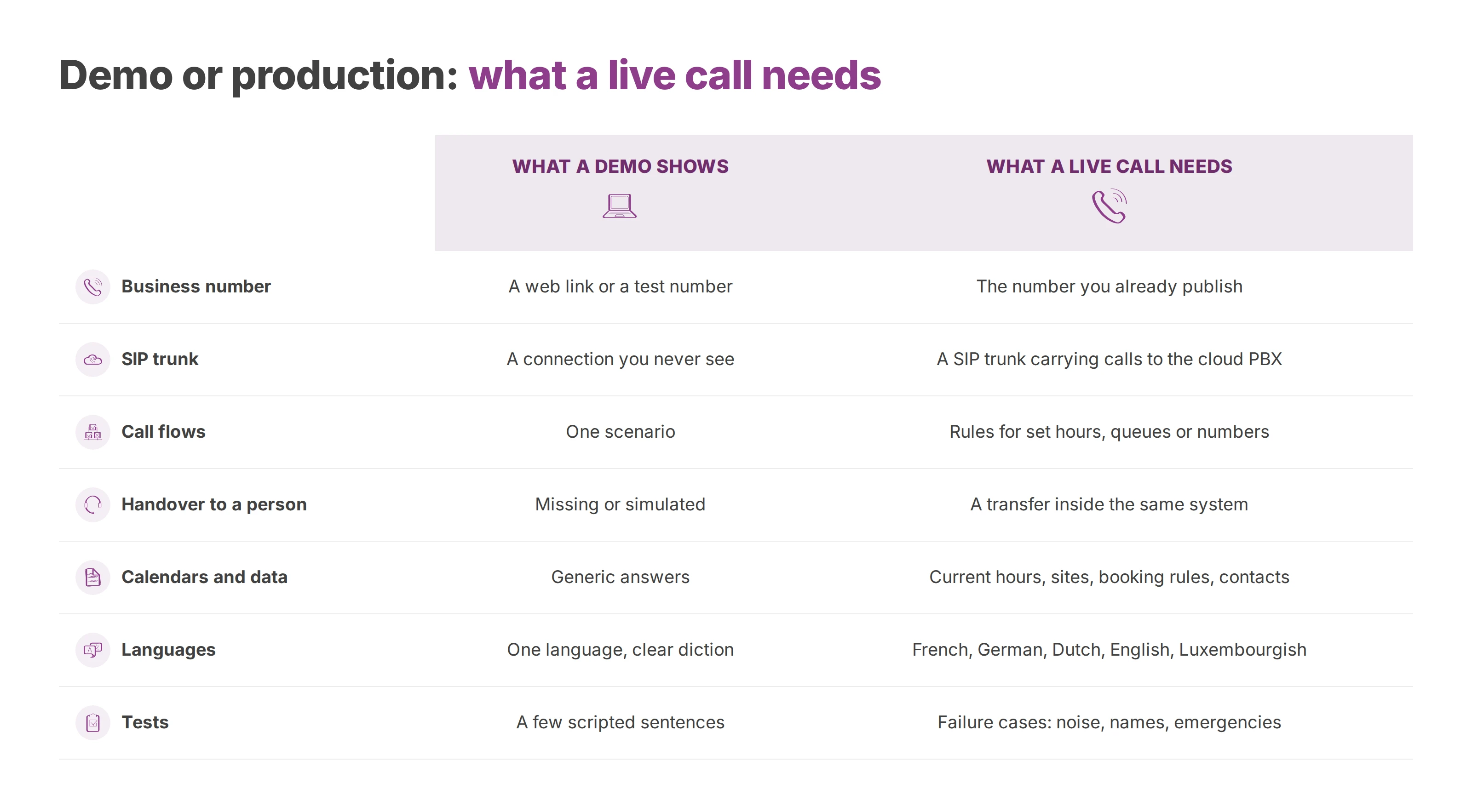
Demo and production for an AI voice agent
| Element | What a demo shows | What a live call needs |
|---|---|---|
| Business number | A web link or a test number | The number you already publish, ported in or assigned to you |
| SIP trunk | A connection you never see | A SIP trunk that carries the call to the cloud PBX |
| Call flows | One scenario | Rules that send the agent only certain hours, queues or numbers |
| Handover to a person | Missing or simulated | A transfer inside the same system, so the caller doesn't repeat the reason |
| Calendars and data | Generic answers | Current hours, sites, booking rules and contacts |
| Languages | One language, clear diction | French, German, Dutch, English and Luxembourgish, depending on who calls |
| Tests | A few scripted sentences | Failure cases: noise, a proper name, an absent colleague, an emergency, a language the agent can't follow |
| Risk level | Every call treated alike | A scope limited to what an error really costs |
Getting an agent to talk takes little time. Connecting it to the phone system means signing off every row of that table before the final quote, and if one row is still open, the setup stays in trial.
The entry point is your business number, not the one from the demo. The integrator checks that it's available, whether it needs porting and that it's assigned to the right site. Then someone calls it from an ordinary outside phone, because a test from the admin interface skips the path your callers actually take.
A SIP trunk carries the call to the cloud PBX. It may come bundled with the phone system rather than as a separate contract. Either way, one named party owns the connection, or an audio fault turns into an endless email thread between the carrier, the integrator and the AI supplier.
Call flows decide which calls the agent receives. The administrator sets a time window, a queue overflow or a dedicated number, each with a fallback destination, and keeps a way to take the agent out of the call path without rebuilding the whole phone system.
Human handover gets tested until a colleague actually picks up. A transfer counts once someone answers, whatever the agent announced. The person who answers should receive the reason for the call, and the system needs a plan for when nobody answers at all.
Calendars and business data come after the connection. A booking needs real availability, duration rules and a confirmation that the entry was written, so if the calendar doesn't respond, the agent must not announce a confirmed appointment.
Languages are another operational dependency. In Belgium and Luxembourg the test plan may need French, German, Dutch, English and Luxembourgish, depending on who calls, including a switch partway through the conversation. A language listed in a brochure still has to be tested on your own calls.
Finally, the tests cover resources that are down and requests the agent can't complete. The business owner decides which consequences are acceptable before any traffic flows. Go-live covers the whole call path, from the number to the person who picks up.
Putting the AI on general reception from day one gives it too wide a scope. It immediately receives sales enquiries, complaints and calls for people who are on holiday, and if nobody has tested transfers and language switches, your team discovers the exceptions at the callers' expense.
After-hours calls are an easier first scope to control. The office is closed, so the agent says so, gives the reopening time and answers the practical questions you have documented. If a request needs someone to act, it follows the agreed procedure, and it never lets the caller believe a colleague is about to pick up when nobody is on call.
Frequent questions make a good scope when one person owns the official answer. Opening hours, directions, the address and the documents to bring fit into a short knowledge base. Special prices, sales commitments and undocumented exceptions stay out of this first scope.
Overflow comes next. The agent steps in when the call queue can't take more calls, but it keeps the destinations of the team the caller wanted. Sending someone to another department just because a phone is free there doesn't solve their request.
Appointment booking needs more care. The connected calendar has the final word, and a rule covers the case where no slot is free or the booking fails. Without that rule, arranging a call-back is safer than giving a confirmation nobody can stand behind.
The France Num 2025 barometer, a survey of French small and medium-sized businesses, found that 26% of them used an AI tool in 2025, against 13% in 2024. Only 5% used it to automate tasks. That gap suggests where the effort belongs, which is in written procedures rather than more demo conversations.
Before activation, the business owner writes down three things for each intent.
The authorised answer, with its internal source and the person who keeps it current.
The handling limit, such as a change request nobody planned for.
The expected exit: a transfer, a message or a call-back, depending on which service is actually staffed.
A call can be answered and still leave the caller without what they needed, so judge the agent by the outcome the caller got.
The handover phrase is written down and tested too. It should name an action the system can really carry out, such as a call-back at a set time.
How much error a business can afford depends on its trade. A missed restaurant booking can be fixed with a call-back. A wrong medical or financial routing can delay help, expose personal information or send the caller into the wrong procedure.
So the scope follows the consequences, however polished the conversation sounds. The table below gives a starting point for that decision in four trades. No trade is ruled out.
Starting scope by the cost of an error
| Trade | Typical cost of an error | Starting scope | What stays human |
|---|---|---|---|
| Restaurant | A missed booking, often fixed with a call-back | Opening hours, simple bookings, after-hours calls | Groups, complex allergies, complaints |
| Practice or clinic | Wrong timing or wrong routing | Hours and non-urgent admin routing | Symptoms, emergencies, health data |
| Bank or financial service | Wrong path, with commercial and compliance stakes | General questions and routing to the right department | Transactions, identity checks, disputes |
| Chain of about 40 shops (rollout scenario) | A call path that breaks between sites | Hours and the nearest shop, then a transfer | Complaints, uncertain stock, local exceptions |
The France Num report also shows how uneven adoption is: 56% of IT and telecom firms used AI, against 9% in agriculture and 26% across all sectors. Those gaps are no reason to hurry. Each trade has its own constraints to look at first.
In a restaurant, being able to take a simple booking doesn't mean the agent can commit the kitchen on a complex allergy. It has to tell a table request apart from a question the kitchen must approve, and a group booking can carry conditions the calendar doesn't show.
In a practice or clinic, admin reception stays separate from medical assessment. A caller who mentions a symptom shouldn't be pushed into detail just to fill a qualification tree. Setting up a healthcare phone system with an agent means giving it an instruction the clinic has approved and a route to the right person, with no automated diagnosis.
In a bank, opening hours and routing to a department are one thing, a transaction or an identity check another. For a chain of shops, the hard part is local exceptions: a temporary closure, stock that is out of sync, a service one site doesn't offer. General information stays general, and nobody on the line makes a promise on behalf of one shop.
Callers hear at the start that they are talking to an AI, and the agent lets them ask for a person at any point. A caller who refuses to talk to a machine, has trouble speaking or keeps being misunderstood gets another route, and if nobody is available, the announcement says so plainly.
Sign off the list of excluded requests before launch. After launch, the team uses the same list to audit errors and human takeovers.
A pleasant voice can hide poor understanding. Even after mixing up a site, a name or a negation, an agent can answer with complete confidence, so the test checks the intent it understood and the action it took as well as the transcript on screen.
Speech itself varies a lot. LeBenchmark, a research corpus of French speech, gathers 2,933 hours: 1,626 hours of broadcast speech, 1,115 hours of read speech, 124 hours of spontaneous speech, 38 hours of acted telephone dialogue and 29 hours of acted emotional speech. Telephone dialogue is a thin slice of that research corpus, and each kind of speech comes with its own acoustic conditions.
A model that handles clean read speech well still has to cope with hesitation, background noise and interruptions. Test calls go through the public number and the same path your callers will use. A headset test from a laptop leaves part of the phone chain out.
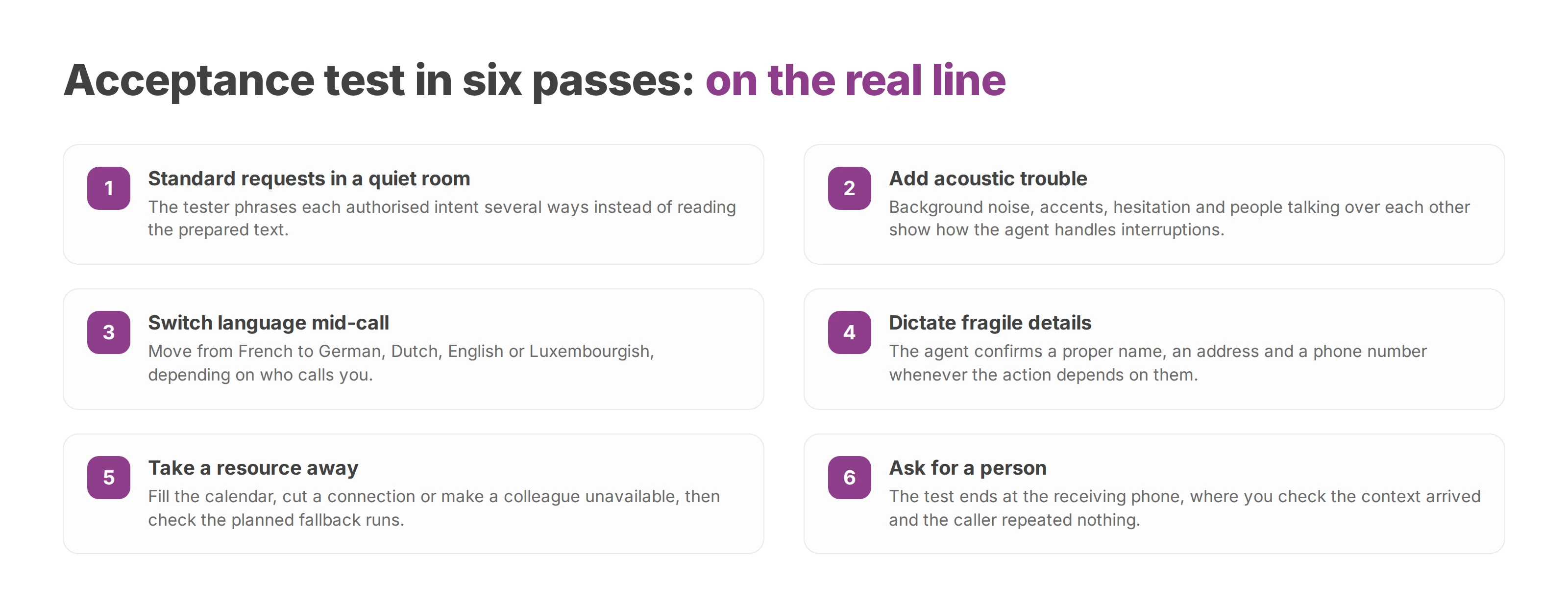
The acceptance test can run in six passes.
Check the standard requests in a quiet room. The tester phrases each authorised intent several ways instead of reading the prepared text word for word.
Add acoustic trouble. Background noise, accents, hesitation and people talking over each other show how the agent rephrases and handles interruptions.
Switch language mid-call. Move, for example, from French to German, Dutch, English or Luxembourgish, depending on who calls you.
Dictate fragile details. The agent confirms a proper name, an address and a phone number whenever the action depends on them.
Take a resource away. Fill the calendar, cut a connection or make a colleague unavailable, then check that the agent runs the planned fallback.
Ask for a person. The test ends at the receiving phone, where you check the context that came with the call and that the caller didn't have to repeat anything.
The test report keeps a misheard word separate from a wrong decision. Mishearing a small word such as "a" or "the" costs far less than sending the call to the wrong site. Each intent gets its expected result: correct information, a booking that's really saved or a transfer that someone answers.
If the service offers a confidence threshold, it can trigger a rephrase or a transfer, but it doesn't replace your business rules. An ID or an address still needs explicit confirmation before any binding action.
Planning a multilingual call centre also means a human destination for every language. Understanding a German request helps little if the transfer lands with a team that can't continue in German.
Exit criterion for the trial: an intent goes into production only after you have heard its normal path and its fallback end to end.
Every call can collect personal data. In a piece on voice assistants, France's data protection authority, the CNIL, points out that people who talk to a voice assistant may volunteer information about their health, religion or sexual orientation, and about their family, friends or work. The script you planned doesn't limit what a caller says.
Running the service and reusing conversations to train a system are separate purposes. Review each one on its own, with its recipients and its conditions. Permission to read a calendar gives you no right to keep what callers said.
Collect as little as you can, and design around that. Where the service allows it, the transcript lasts only for the session, contact details are masked and technical logs are kept apart from what was said. Retention should be something you configure, with deletion you can check.
The colleague who takes over the call needs only the context that bears on it. Forwarding the whole exchange by default can show them details unrelated to their job, which is why your call recording policy under the GDPR needs a review of its own before the agent goes live.
Storage and retention. Where are the audio, the transcripts and the summaries stored, and for how long is each kept?
Training. Do calls help improve or train a system, and how can you refuse that reuse?
Human takeover. Who can take over a call, and when? Which command removes the agent from the call path when you're in doubt?
Transferred context. What information travels with the call, who receives it, and what record remains?
Logs and access. Which events are logged, who can read the content, and how is that access tracked?
Subprocessors and GDPR. Which companies are involved, from which countries, under what contract and with which deletion procedures?
European Union AI Act. How is the supplier preparing for the requirements that apply to it, without presenting its compliance as already settled?
Acceptance testing. Which languages and failure scenarios were tested, by whom, and who signs off the launch?
For the phone system itself, ask for written documentation of European Union hosting, data location and GDPR compliance. Check where calls, recordings and metadata are stored, separately from the processing that subcontractors handle.
European sovereignty is more than the address of a data centre. It also means knowing who has access, which contracts you depend on and how you would take back control. Make sure the written answers describe the service you actually order, rather than the supplier's general brochure.
An AI voice agent has proved nothing until it has taken a real call, on a ported number, with a fallback that works. So keep the first scope narrow: after-hours calls. The business owner prepares a short set of authorised answers covering the closure, the reopening time, the address and the call-back procedure. Anything outside that set goes to a planned destination, with no promise that someone is available.
After-hours call routing has to allow for public holidays and for differences between sites. You run the acceptance test by ear: the announcements, the language switches, the transfer to a phone or a queue, and the message that plays when nobody answers. Each failure gets a named outcome before launch.
Voxbi AI Receptionist is an add-on to the Voxbi cloud phone system. It answers on the company's existing numbers and transfers to a colleague or a queue in the same system. Trying a voice agent is easy. Production still needs the number, the SIP trunk, the call flows, a human fallback, business data, tested languages and a risk the business accepts. If you would rather hand over the day-to-day running, Voxbi Managed is the service where our team sets up and runs the phone system, with a person you can reach by phone.
The project lead widens the scope only on explicit conditions: accurate answers, every fallback completed and no critical failure left open. For an IT integrator or a telecom reseller, this acceptance test is part of the job, on the same footing as the connection itself. General reception becomes an option only once the narrow scope has passed.
To plan an after-hours start, talk to us with the number you want to keep, the opening hours of each site and your transfer destinations, so the call path is mapped before it goes live.
The transport, security and voice components behind a hosted PBX, who runs each one, and what to test before you switch off the old service.
How to choose, secure and migrate a healthcare phone system: queues, on-call routing, GDPR health-data rules, resilience and the contract terms that matter.
How a law firm phone system routes every call, keeps professional secrecy intact under the GDPR, and what to check before you migrate or pick a provider.
Start a free trial, or work with a certified Voxbi partner.