Ask what is PSTN and the short answer is the public switched telephone network: the circuit-switched system that has carried fixed-line calls for decades. The longer answer is the one that actually helps an IT manager, a small business owner or a telecoms integrator make a decision. This guide defines the PSTN, shows how circuit switching works, sets it against VoIP, SIP and WebRTC, and covers the equipment in your building that still leans on an analogue line.
PSTN defined: the public switched telephone network
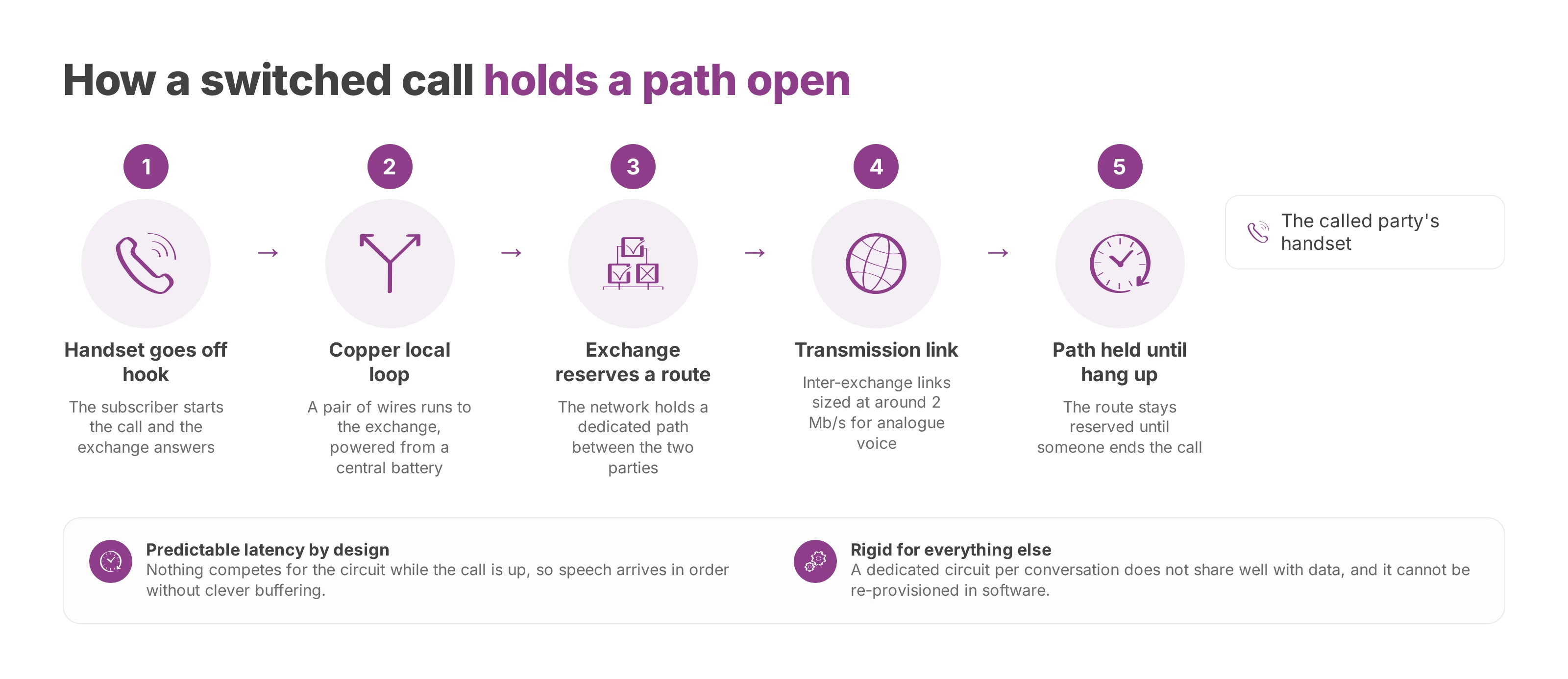
The PSTN holds a dedicated path open for the length of a call. When the call connects, the network reserves a route between the two parties and keeps it until someone hangs up. Circuit switching is the mechanism. The copper local loop is the access side of it: a pair of wires runs from the subscriber's handset to the exchange, powered from a central battery.
Exchanges connect to one another over transmission links. Technical descriptions of classic switched architectures put those inter-exchange links at around 2 Mb/s, a figure sized for analogue voice and well below what bulk data traffic needs.
That's why the term still turns up in building surveys, alarm contracts and telephony quotes long after the desk phones have gone. The network is a physical estate, and parts of it are still wired into your site.
Why circuit switching dominated fixed-line voice
A reserved path gives predictable latency. Nothing competes for the circuit while the call is up, so speech arrives in order and on time without clever buffering at either end. For a world where the phone call was the main event, that design was hard to beat.
The same design struggles once you add anything else. A dedicated circuit per conversation doesn't share well with data, applications or video, and it can't be re-provisioned in software. Moving away from it changes the architecture, not the supplier.
The switched network is steady for voice and rigid for everything else.
PSTN, VoIP, SIP and WebRTC compared
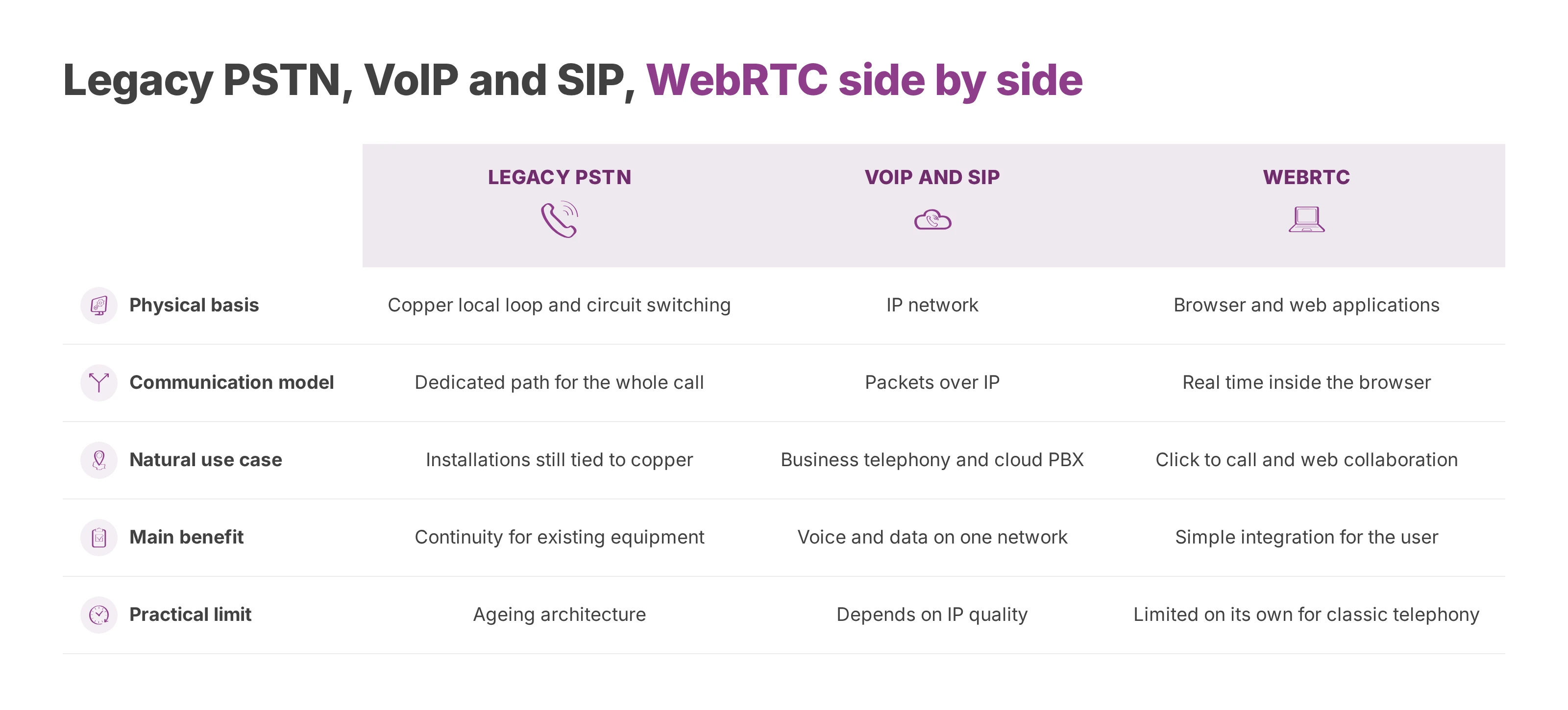
Each of these has a natural home. The legacy switched network carries installations still tied to copper, VoIP over SIP carries standardised business telephony, and WebRTC carries browser integrations and click to call.
Where SIP fits
SIP is the signalling protocol of an IP telephony estate. It sets up, modifies and tears down calls without reserving a circuit, and that difference is what a migration project has to plan around. For the wider picture of packet voice before you compare suppliers, our guide to VoIP covers the ground.
A company keeping copper equipment has a different job from one specifying a cloud switchboard. The first job is securing legacy dependencies. The second is integration, administration and adding users without a site visit.
Non-voice equipment that still depends on a phone line
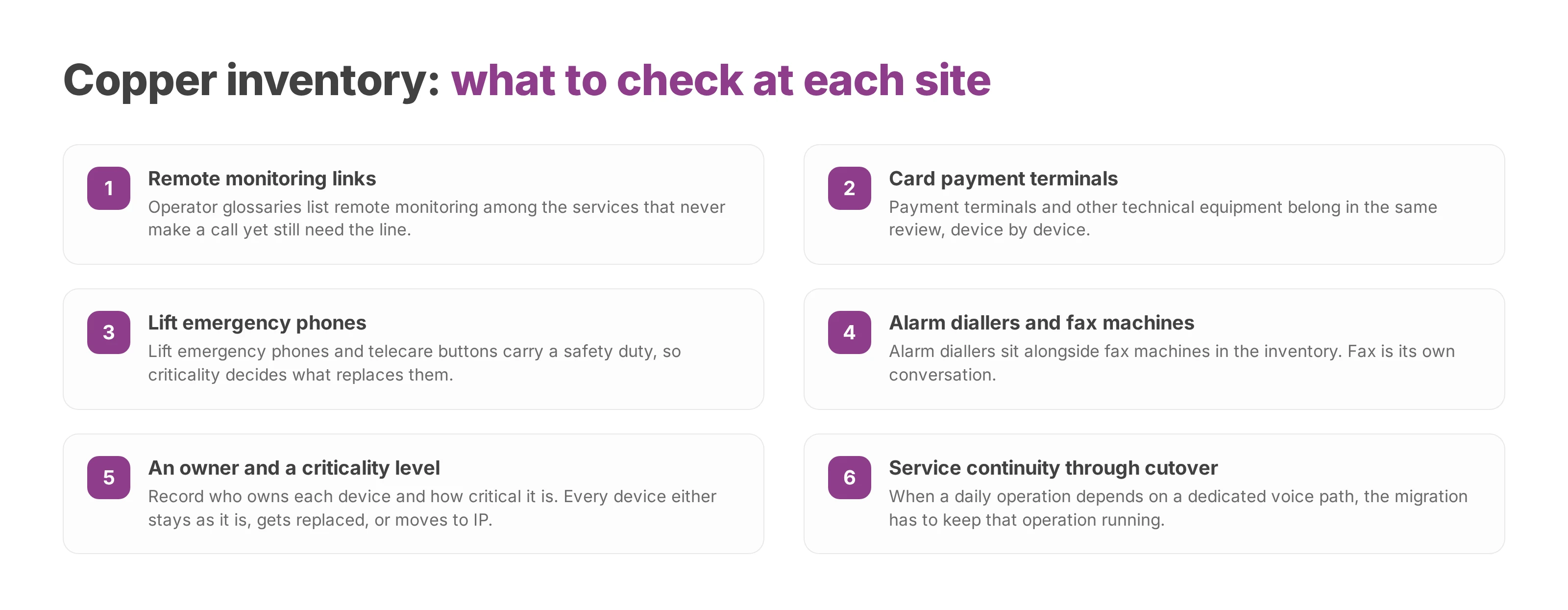
Start the inventory with the services that never make a call yet still need the line. Operator glossaries list several: remote monitoring, card payment terminals and technical equipment. Lift emergency phones, telecare buttons, alarm diallers and fax machines belong in the same review, and each one needs a decision of its own.
For a multi-site IT team, a hospital, a council or a hotel, the exercise runs site by site. Every device either stays as it is, gets replaced, or moves to IP, and the criticality of the service decides which. Fax is its own conversation, and we've looked at whether fax still has a job separately.
Service continuity is the sensitive part. When a daily operation depends on a dedicated voice path, the migration has to keep that operation running through the cutover.
What changes when lines move to a cloud PBX
Moving to a cloud PBX moves the risk. You leave a physical estate wired into one building and arrive on a shared platform where hosting, encryption and integration decide the outcome. If the model is new to you, start with what a cloud PBX actually is. Voxbi is a cloud switchboard for European companies, hosted in the European Union, with Mixvoip supplying the numbers and the carrier side.
Hosting is the first criterion. When calls, recordings and metadata stay on European soil, data governance is easier to describe to an auditor or a customer. Encryption is the second, and SIP TLS is the piece that matters: it keeps signalling private and works with the rest of your security posture.
Interoperability follows the same logic. Integrations with Microsoft Teams, Odoo, REST APIs and TAPI CTI links connect telephony to the tools people already work in. Quality becomes measurable too, because jitter, packet loss and latency decide whether a call is usable, and dashboards report them per site. When audio breaks up on an IP call, what packet loss does to voice explains the mechanism.
Guidance by profile
For a multi-site IT team, the copper inventory comes first. Without that map, hidden dependencies stay in production and surface on the day a line goes quiet. The technical choice that follows is a cloud PBX hosted in the European Union, with SIP TLS and open APIs.
IT teams and larger companies: map every copper use, then plan the migration site by site and by criticality.
Small businesses: favour simple administration, a clean cutover and a support path you can name.
Integrators and resellers: pick a platform that fits the existing systems without custom glue and deploys the same way every time.
A small business usually wants administration it can handle in-house and number portability that doesn't interrupt trading. An integrator wants one deployment method that works at ten users and at several thousand. Hospitals, councils and hotels want all of that plus a cutover window that respects their operating hours.
A three-step plan
Confirm which lines and services at each site still terminate on the switched network.
Map the equipment behind them, device by device, with an owner and a criticality level.
Choose an IP or cloud alternative that meets your European compliance requirements and the way your teams actually work.
Voxbi runs a cloud switchboard hosted in the European Union, built to replace an on-site PBX without adding work for the IT team. If you're planning a move off copper lines, a VoIP migration or browser integration, it's a workable starting point. Send the inventory you've built to hello@voxbi.com and we'll tell you what maps across cleanly and what needs a design decision.