
Hotel phone system: the complete 2026 guide
How a hotel phone system routes reservation, room and maintenance calls, connects to your PMS, and helps you stay secure and meet the GDPR across one site or many.
Oct 24, 2026
Call queuing holds callers in an ordered line inside your cloud PBX. How it works, which options to switch on, which metrics to watch and how to configure a queue.

Every phone line eventually gets more calls than there are people free to answer. Callers who hear nothing but ringing hang up, and the agents who do pick up spend the first minute apologising. Call queuing is the cloud PBX feature built for that moment. The system holds each caller in an ordered line, tells them where they stand and connects them when an agent frees up.
This guide is for IT integrators and telecom managers who set up queues for clinics, hotels, support desks and switchboards. For them, the subject is bigger than caller comfort. A queue decides who gets served first and what happens when the team is full, and it stores data about every caller who waits.
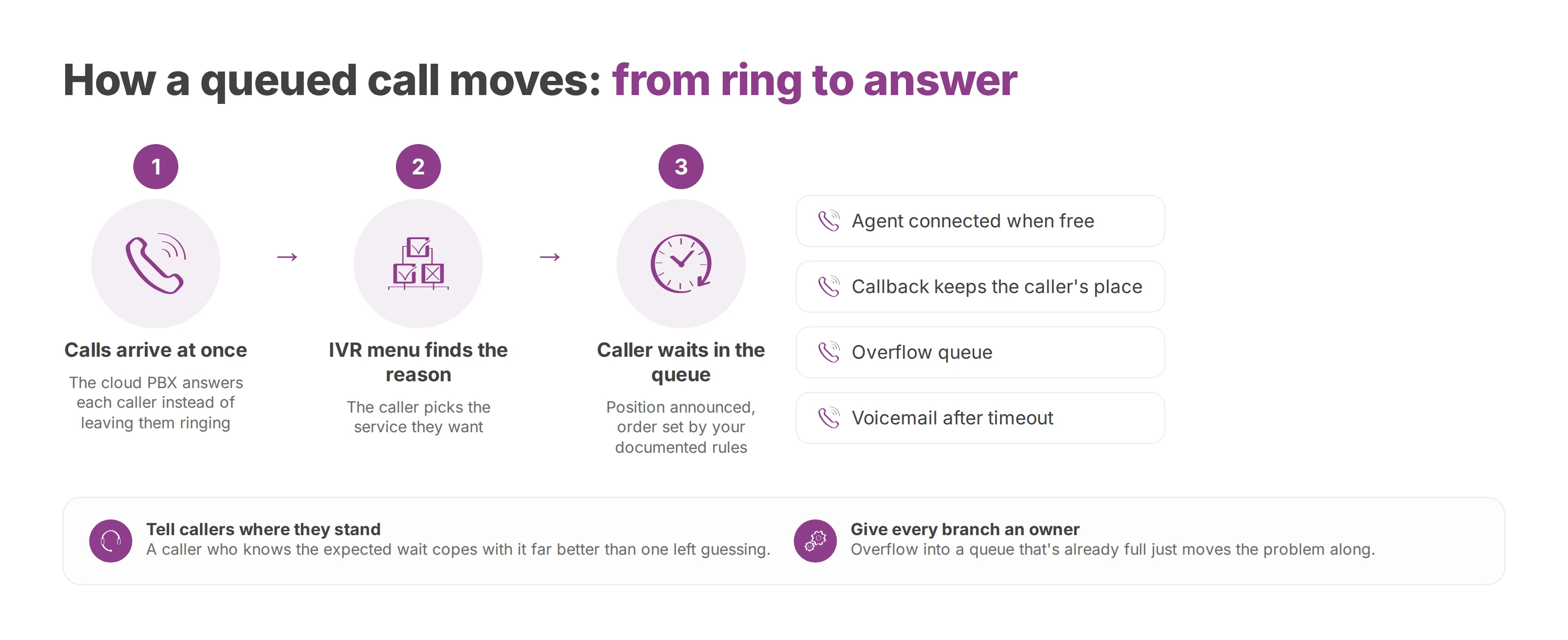
Call queuing places inbound callers in a line that the business controls. When several calls arrive at once, the cloud PBX answers each one and works out which service the caller wants, often through a cloud IVR menu. It then puts the call in the matching queue. The order of service can follow arrival time, the reason for the call, the skills on shift or documented priority rules.
Without a queue, a caller stays on the line with a tone or a loop of music until their patience runs out. With one, the PBX knows who's waiting, how long they've waited and what happens to them next.
Take a patient calling a clinic to move an appointment. Every agent is busy. The system can announce the caller's approximate position, offer to keep holding or record a callback request. A caller who picks the callback keeps their place in the queue without tying up a phone line.
The wait doesn't disappear. It moves off the handset and becomes a job the system schedules. An agent returns the call when capacity frees up, following the rules the organisation has set.
A good call queue never promises an agent who isn't there. It makes the wait easy to follow and lets the system keep the order you've defined.
How long people will tolerate matters too. In a Harris Interactive study for StrongPoint, cited by France Num (the French government's small-business digital programme), 47% of respondents said a wait becomes uncomfortable after three to four minutes. The same France Num guide to managing waits (in French) adds that a customer who knows the expected wait copes with it far better than one left guessing. A queue helps by keeping lines free and callers informed. It can't make the demand go away.
A basic queue puts one caller behind the others. A better queue also tells the caller something, gives them a choice and offers a way out when the wait drags on. Some options cost you setup work. Others cost the caller attention, because every extra choice is one more thing to listen for.
A position announcement answers the caller's first question. They learn where they stand and can decide whether to hold. An estimated wait time adds more, but be careful with it when handling times vary a lot from one case to the next.
Hold music helps when someone has set it up with care. A short loop on repeat makes the caller notice every minute that passes. Varied content that suits the business makes the wait less monotonous, though it doesn't replace a clear spoken update. Before go-live, check the volume and the audio quality, and make sure you hold the rights to the track. Voxbi's music on hold page shows how that part is configured.
Callback changes a cloud queue more than any other option. When every agent is busy, the caller chooses between holding and asking for an automatic callback. The PBX then has to keep their rank, check the number, manage retries and avoid ringing back someone who's no longer available.
France's public-sector modernisation office describes this choice in its guide to automatic callback (in French). In its words, callback turns an incoming call into an outgoing one and reduces the frustration of not knowing how long the wait will be.
Plan for the callbacks that fail. Ring back only during permitted hours and log each attempt. Decide in advance what happens when the callback reaches voicemail or a number that doesn't answer. An overflow queue catches whatever the callback scheme can't absorb.
| Option | Main benefit | Design risk |
|---|---|---|
| Position in queue | Makes the order visible | A position doesn't always predict the real wait |
| Announced wait time | Gives the caller a time reference | A wrong estimate can add frustration |
| Varied hold music | Makes the wait feel less monotonous | Badly chosen content can irritate callers |
| Callback | Frees the line and cuts active waiting | The system must manage rank, retries and hours |
| Skills-based routing | Sends the call to the right agent | A rule that's too strict can overload a sub-queue |
In a clinic, a call queue can sort reception calls, test-result requests and appointment changes. At a town hall, it can separate callers asking for a birth or marriage certificate from those asking about a building permit. In a hotel phone system, it keeps the front desk reachable when several calls land during a busy spell.
Each setting asks something different of the queue. A booking line can put speed first. A health service has to protect confidentiality and treat every patient the same way. A public service has to explain its priorities so that callers understand how the line moves.
Priority belongs in a written service rule. A call tied to an appointment, an accessibility need or an emergency can move ahead, provided the rule says so. If an algorithm reorders callers in ways nobody wrote down, staff can't answer a caller who asks why they waited.
Selling priority is where this gets sensitive. In France, some teleconsultation platforms offer a paid "skip the line" option to see a doctor sooner, and France 3 reported (in French) the backlash it drew. Patients were offered priority for a few euros once their wait had been estimated, and several people objected online that faster access now depended on paying. A tool meant to make access smoother had started to treat people who can pay differently from people who can't.
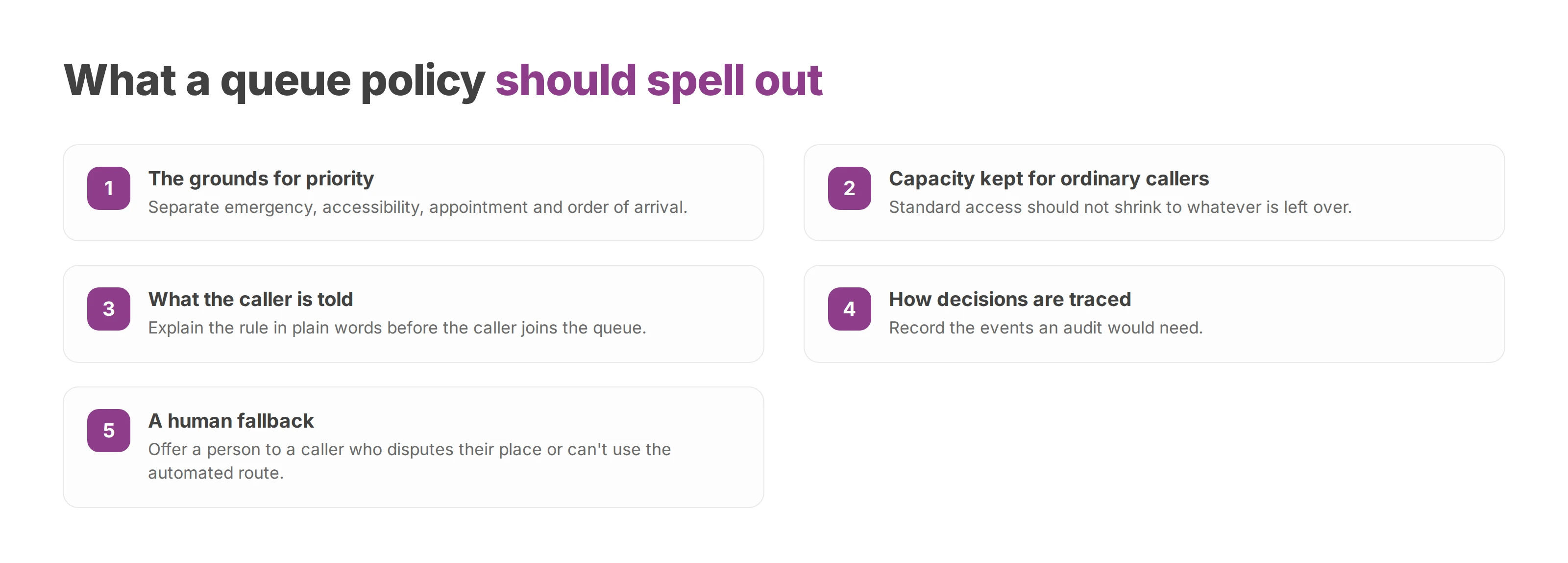
For regulated sectors, the queue policy should spell out:
The grounds for priority, separating emergency, accessibility, appointment and order of arrival.
The share of capacity kept for ordinary callers, so standard access doesn't shrink to whatever's left over.
What the caller is told, in plain words, before they join the queue.
How decisions are traced, with the events an audit would need.
A human fallback, for a caller who disputes their place or can't use the automated route.
A queue is fair only when the organisation can explain who goes first, why, and under which rule.
Some callers can't comfortably use a keypad menu or a callback scheme. Keep a staffed alternative line, or let an agent register the caller by hand. The queue should cut congestion without putting a new barrier in front of anyone.
Gut feeling won't tell you whether a queue works. The dashboard should set what callers experience against what the team can actually handle. IT watches the technical health, while the team lead reads the changes by time of day, reason for calling and the skills on shift.
Start with the abandon rate: the share of callers who hang up before anyone serves them. A rise can point to a wait that's too long or an announcement that confuses people. It can also mean poor audio, or a queue routed to the wrong group. Average wait time gives an overall marker, though it can hide the gap between quick calls and complex cases.
Answer rate measures the share of calls the team actually takes. Callback volume shows whether callbacks absorb the peaks or pile up a backlog the team can't clear later.
Check abandons by time slot. A cluster at opening time may call for extra staff early in the day, a callback offer or new published hours.
Compare waiting time with capacity. If the wait climbs while some agents stay free, look at the routing rule or the skill filter.
Track completed callbacks. A high callback count means little on its own. Check that those calls are made, answered and closed.
Review overflow. A secondary queue, a voicemail box or a shared team should only get the volume it can handle.
Live dashboards put the current volume next to historical trends. Each chart should point to an action, such as opening an extra skill group or changing the callback window.
| Metric | Corrective action |
|---|---|
| Abandon rate | Check the announcement, routing, callback and capacity |
| Average wait time | Adjust hours, staffing or overflow rules |
| Answer rate | Check agent availability and distribution rules |
| Callback volume | Check time windows, retries and later capacity |
| Calls waiting per queue | Reassign skills or open a backup queue |
Split the metrics by queue, reason, site and channel where your data governance allows it. An overall average can look healthy while one specialist queue collects most of the abandons.
A queue collects personal data as it works: callback numbers, call metadata, routing history, and sometimes recordings and transcripts. Before you deploy, find out where that data is stored, who can reach it, and whether any of it leaves the European Union. Look past the data centre address: backups and subprocessors count too. Encryption in transit and at rest lowers exposure, but it doesn't decide who can open a recording. Limit that by role. Settle how long you keep call logs at the same time, and treat recordings separately: our guide to call recording and the GDPR covers notice and retention.
The European Commission's cloud sovereignty framework asks for storage and processing confined to European jurisdictions, auditable AI use and data deletion backed by verifiable evidence. A vendor's claim of European hosting should come with documents you can check.
Two newer laws apply. The EU Data Act has applied since 12 September 2025 and includes rules that let customers switch between cloud providers. The AI Act entered into force on 1 August 2024 and has applied since 2 August 2026, with some rules phased in later. Article 99 sets fines of up to €35 million or 7% of total worldwide annual turnover for prohibited practices. A PBX may use AI to route or transcribe calls, but the AI is a feature, not what the product is. Keep a list of each AI use and the queue data it touches.
Start with the service the queue supports, not the hold music. A support queue, a booking queue and a switchboard queue need different skills and keep different hours, and each overflows in its own way.
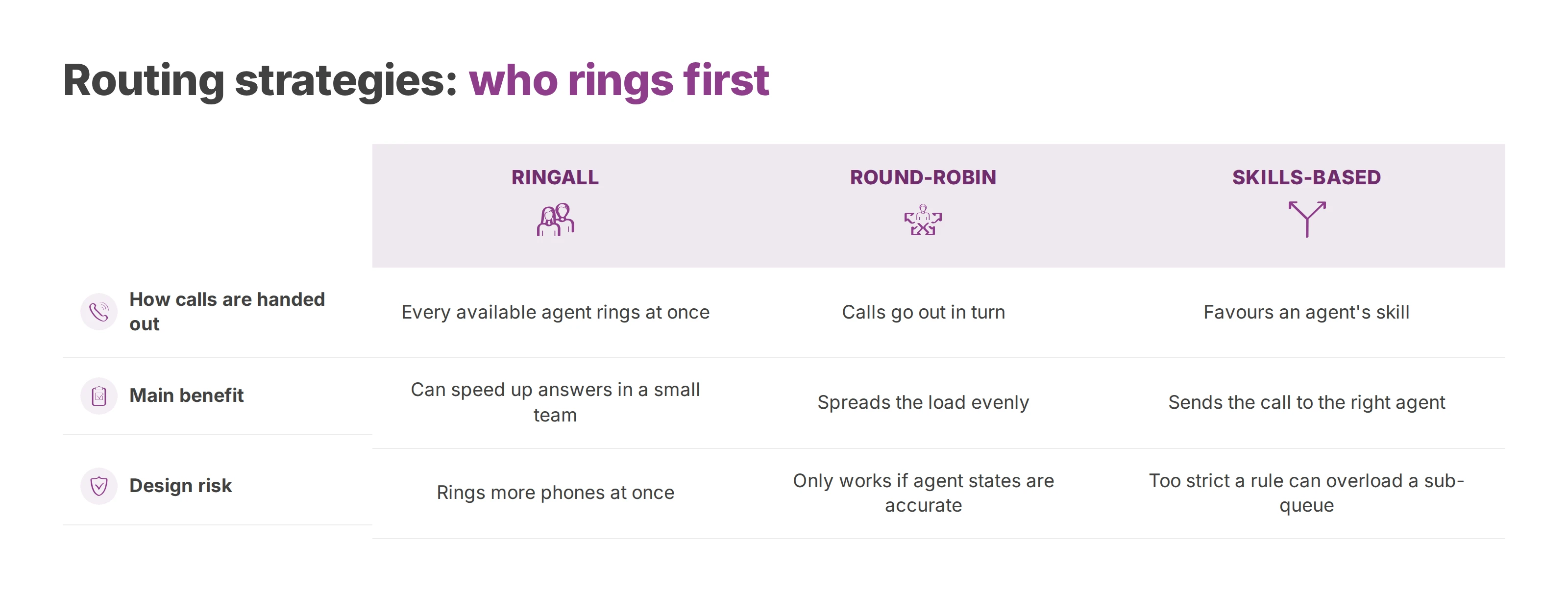
In the admin interface, you create the queue, assign agents and define how calls enter it. Ringall rings every available agent at once. Round-robin hands calls out in turn so the load spreads evenly. Other strategies favour a skill or an availability level.
Ringall can speed up answers in a small team, but it rings more phones at once. Round-robin spreads the load better. It only works if agent states are accurate, though. Any routing rule fails when people forget to go on pause or leave a phone logged in at an empty desk.
The timeout sets how long a call rings before the next action. When it expires, the call can move to another queue, trigger a callback, go to voicemail or hear an announcement. Give every branch an owner. Overflow into a queue that's already full just moves the problem along.
Schedules cover opening and closing times, public holidays and any on-call cover. The out-of-hours message should tell callers something useful without exposing personal data. Place a test call after closing time and listen to what the caller hears.
Map each branch of the call flow before it goes into production. Then authorised staff can change the rules from the web interface themselves, without a support ticket for every edit.
SIP over TLS protects signalling between compatible components. WebRTC secures calls from a browser or app when configuration and certificates are handled properly. Both need tight control of admin accounts, separate roles and a log of every change.
Before go-live, test routing, callback and announcements. Then check schedules, permissions and what happens when an agent drops out mid-shift. A simple interface lets you put a decision into effect quickly. You still have to test it.
A well-designed call queue protects your phone lines and shows the team where its time goes. It won't make up for too few staff, poor routing or nobody at reception. In health and public services, it also has to keep access fair and transparent for every caller.
For a small or mid-sized company, or an integrator, the selection criteria are concrete. Treat a vendor's AI Act compliance as documented, ongoing work you can inspect, not a badge. Ask for European hosting you can verify and subprocessor clauses you can read. Then check that you control the data, manage callbacks and run the setup yourself, with dashboards your team will actually open.
Voxbi is a cloud PBX hosted in the European Union, and you configure its call queues in Voxbi Cockpit: ring policy, announcements and overflow. On the self-service line, live call dashboards come with Voxbi Plus and above. On Voxbi Managed, Voxbi Professional adds call reports and Voxbi Business adds in-depth analytics. To see how a queue design would fit your setup, write to hello@voxbi.com and ask for a walkthrough.
How a hotel phone system routes reservation, room and maintenance calls, connects to your PMS, and helps you stay secure and meet the GDPR across one site or many.
An inbound call reaches your organisation and an outbound call leaves it. Here's how to route, measure and govern each one, and keep your numbers when you migrate.
How a cloud voicemail system takes a message from the dialled number to the person who calls back, and the routing, security and GDPR settings behind it.
Start a free trial, or work with a certified Voxbi partner.