The 10 cheapest cloud PBX providers in 2026
Entry prices compared with numbers, calls and support added back in, because the headline seat price is never the total. Ten providers priced.
Sep 14, 2026
Which cloud PBX providers actually integrate with Odoo, how each one connects, what the integration costs and where call recordings are stored.

📌 Short answer. If you run Odoo and you want your phone system to work inside it, a cloud PBX is the right shape of product. We scored eighteen providers on six things any buyer can check without a sales call: who maintains the Odoo integration, whether a price is published, whether it works with Odoo Community, whether the supported Odoo versions are stated, whether EU data residency is published, and whether there is a published SLA. Voxbi scores 7 out of 7 at €2.90 per user per month. JustCall and DIDWW score 5. VoIPstudio, sipgate, OnSIP and Ringover score 4. Odoo itself verifies only three providers, Axivox, DIDWW and OnSIP, and Axivox is still the one Odoo documents in most depth. The full method and the full table are below.
A PBX is the system that decides what happens to a call. Who it rings, in what order, what the caller hears, and what gets recorded. There are three shapes on the market, and they behave very differently when you ask them to talk to Odoo.
<column>

</column>

<column>

</column>

<column>

</column>
💡 Why cloud wins for Odoo specifically. Odoo is updated on a yearly cycle and a new major version lands every September. A cloud PBX provider can ship a module update for the new version and push it to you. An on-premise PBX with a hand-built connector needs someone to rewrite that connector every year. The maintenance cost is not in the first install. It is in year three.
This is the part most articles get wrong, so it is worth being precise.
Odoo ships a telephony app. In Odoo 19 it is called Phone and sits under Productivity. In Odoo 18 and earlier the same app is called VoIP.
What it is not is a phone system. The Phone app is a softphone panel and a set of hooks into Odoo records. It has no call routing, no IVR, no queues, no numbers and no carrier. It needs a real PBX or SIP provider behind it.
There is a second limit that catches people out. On Odoo's own editions comparison, VoIP sits in the Enterprise column. If you run Odoo Community, the built-in telephony app is not yours to use. That is precisely why the community voip_oca module exists, and why a provider that ships its own module, such as Voxbi, can serve Community users when Odoo's own app cannot.
<column>

</column>

<column>

</column>
Odoo names three providers for the Phone app, and it is worth quoting exactly. The Odoo 19 documentation says: "Odoo supports three verified providers by default: Axivox, DIDWW, and OnSIP." That is a short list, it is not a ranking, and it is not the whole market. Plenty of providers integrate with Odoo through their own module or their own API instead. The section on the ranking below explains how to tell those apart.
🟣 Odoo, odoo.com
Founded. 2005, by Fabien Pinckaers, founder and chief visionary.
Headquarters. Grand-Rosière, Belgium.
Users. 28 million.
Employees. More than 8,000.
Partners. More than 21,000.
Applications. 50 main apps, plus more than 50,000 community apps.
Developers. More than 200 in house, around 2,000 in the community.
New implementations. About 600 a year.
Editions. Community, open source. Enterprise, licensed.
Hosting. Odoo Online, Odoo.sh, self-hosted.
Current version. Odoo 19. Odoo 20 is released at Odoo Experience, 24 to 26 September 2026, Brussels Expo.
Pricing tiers. One App Free, Standard, Custom.
All figures published by Odoo on its own about and event pages, checked on 10 September 2026.

Who actually uses it. Odoo's spread is unusual. The One App Free tier and the open-source Community edition put it inside very small companies, often with one or two users and one app. The Standard and Custom tiers, sold through a partner network of more than 21,000 firms, put it inside mid-market manufacturers, distributors, retailers and service companies. It is heavily used in Belgium, France, the Netherlands, Luxembourg and Germany, which is the same footprint as most European cloud PBX providers. That overlap is why Odoo telephony integration is a competitive battleground in the Greater Region and not a niche request.
📊 Market position. Third-party technology tracking puts Odoo at 6.72 percent of the ERP market with 22,427 tracked customer domains, ranking it fourth behind three SAP product lines. Treat that as directional. Web-technology trackers systematically undercount self-hosted and open-source installs, which is exactly where a large share of Odoo lives.
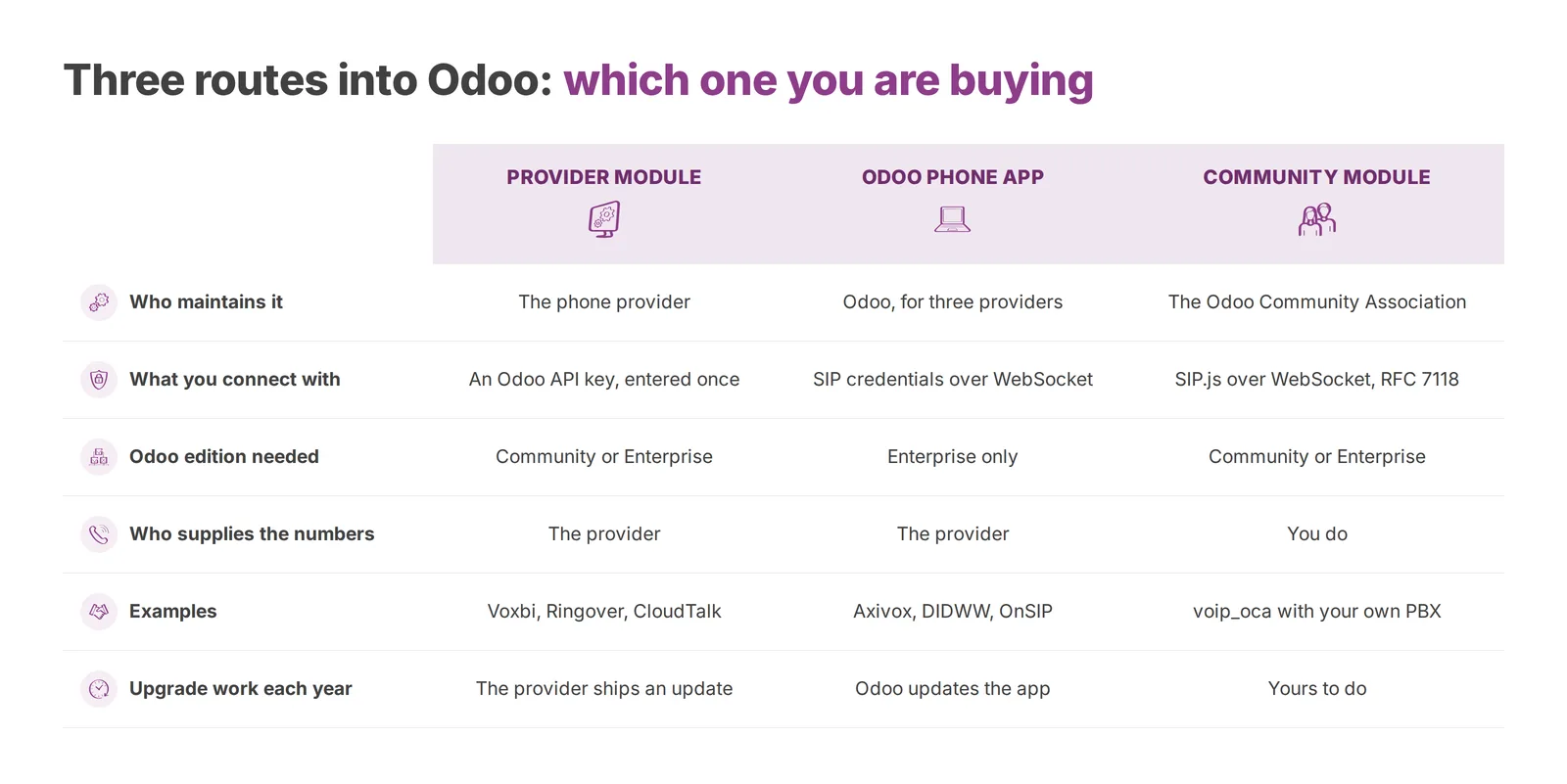
There are three ways this is done, and knowing which one a provider uses tells you most of what you need to know about it.
1️⃣ Provider module installed into Odoo. The provider publishes and maintains an Odoo module. You connect the two systems once with an API key and the module handles calls, logging and lookups. This is the deepest option and the one that survives Odoo upgrades best, because the provider maintains the module. Voxbi works this way and installs its module for you.
2️⃣ Odoo's Phone app pointed at a SIP provider. You use Odoo's built-in Phone or VoIP app and give it SIP credentials from your provider. This is what Odoo documents for Axivox, DIDWW and OnSIP. It requires the provider's PBX to accept SIP over WebSocket, because the call runs in the browser. Not every PBX does. This route needs Odoo Enterprise, because the built-in app is an Enterprise feature.
3️⃣ Community module plus any PBX. The OCA module
voip_ocauses SIP.js to connect the browser to a PBX over WebSocket. It is free, AGPL-3 licensed and maintained by dixmit and Tecnativa for Odoo 17, 18 and 19. It has been tested with Zerovoz and Ringover. You supply the PBX and the numbers.
⚠️ The hosting question decides a lot. On Odoo Online, you cannot freely install third-party modules, and custom code carries a monthly maintenance fee. On Odoo.sh and self-hosted, you can install what you like and there is no such fee. Ask any provider which of the three hosting options they support before you go further. Several support only self-hosted.
<column>

</column>

<column>

</column>
Odoo has around 50 main applications. Only some of them care about the telephone. These are the ones where a connected phone system changes daily work.
<column>

</column>

<column>

</column>
🟢 The case for Odoo, in plain terms. One database instead of six. A CRM that already knows your stock, your invoices and your tickets means fewer integrations to buy and fewer to break. Pricing is per user for all apps rather than per app, so adding a department does not trigger a new contract. It is open source at the core, so you can read the code, host it yourself and leave with your data. There is a partner in almost every country, which matters when you need someone on site. And the module ecosystem is large enough that most gaps have already been filled by someone.
The honest counterweight. Odoo moves fast. A major version every year means upgrade work every year, and heavily customised installs feel that. Depth in specialist areas such as complex manufacturing or regulated finance is thinner than in the large incumbents. And "one platform" only pays off if you actually consolidate onto it.
Odoo competes in a crowded market. This is the short version, for context rather than as a buying guide.
SAP. Business One for smaller companies, S/4HANA above it. The deepest functionality in manufacturing and finance, the highest cost and the longest implementations.
Microsoft Dynamics 365 Business Central. Strong where a company already runs Microsoft 365, sold through a large partner channel.
Oracle NetSuite. Cloud-only, popular with fast-growing and multi-entity companies, priced well above Odoo.
Zoho One. The closest thing to Odoo's "everything for one per-user price" model, lighter on manufacturing and inventory.
Sage and ERPNext. Sage holds a large installed base in accounting-led deployments. ERPNext is the other serious open-source option.
Odoo's position between them is consistent: broader than the small-business tools, cheaper and faster to deploy than the large incumbents, and the only one of the group with a genuinely open-source core.
Odoo does not run a telephony partner programme. There is no "approved cloud PBX" directory, and the partner finder on odoo.com filters by industry, grade and country only. So the phrase "works with Odoo" is unpoliced, and a lot of vendors use it loosely.
There are only three ways a provider can genuinely claim it, and telling them apart is most of the work of choosing.
🥇 Verified by Odoo. The Odoo 19 documentation states it plainly: "Odoo supports three verified providers by default: Axivox, DIDWW, and OnSIP." That is the closest thing to an official list, and it is three names long.
🛠️ Built by the provider. The vendor writes and maintains the integration itself, either as a module on the Odoo apps store or from the PBX side through Odoo's API. Voxbi, 3CX, Yeastar, JustCall, sipgate, Zadarma, Ringover, CloudTalk and VoIPstudio are in this group.
🧩 Built by somebody else. An Odoo consultancy publishes a connector for a provider that had no hand in it. This is the largest group by far, and it is the one that catches buyers out.
⚠️ Two names that look official and are not. Aircall's own marketplace lists an Odoo integration, but it says it was made by Caret IT Solutions, a certified partner, and support goes to Caret IT rather than Aircall. Placetel's Odoo page sells a connector built by Phonemondo at €7.90 per user per month on top of your plan. Wildix points at a connector from Sozias with a yearly fee it does not publish. None of that makes them bad phone systems. It does mean the integration's price, its version support and its lifespan are a third party's decision, not the carrier's. The cautionary tale is Telavox: its Odoo module on the apps store now reads "This module has been unpublished from Odoo Apps and cannot be purchased anymore."
That is also the answer to the question of why the shortlist looks the way it does. We started from the three providers Odoo verifies, added every provider that builds its own integration, and included the partner-built ones so you can see where they land.
A "best of" list on a vendor's own blog is worth exactly as much as its method, so here is ours in full.
We score each provider on six things a buyer can check without talking to a salesperson. Every cell comes from the provider's own published pages, checked on 10 September 2026. Nothing is estimated, and where a provider does not publish something we score it as not published rather than guessing.
📋 The six checks
- Who maintains the Odoo integration. Verified by Odoo or built by the provider scores 2. A partner or consultancy scores 1. Community or do-it-yourself scores 0.
- Is a price published that you can read without a sales call. Any pricing model counts.
- Does it work with Odoo Community, or only Enterprise.
- Are the supported Odoo versions stated anywhere public.
- Is EU data residency published.
- Is an SLA or an uptime figure published.
Maximum score is seven. Ties are broken by the published entry price, cheapest first, and providers with no published price sort last.
⚖️ What this score is and is not. It measures what you can verify before you buy, not how good a phone system is. A vendor can run an excellent platform and still publish very little, and several here do. Voxbi publishes this page and Voxbi scores well on it, so read the criteria first and decide whether they are the ones you care about. If your only criterion is how deeply Odoo itself documents a provider, the ranking below is the wrong tool and Axivox is your answer. We say so again further down.
Prices are as published and are not converted between currencies. A dollar figure is what that vendor publishes in dollars. Converting would turn a fact into an estimate.
| Rank | Provider | Score | Entry price as published |
| 1 | Voxbi | 7/7 | €2.90 per user per month |
| 2 | JustCall | 5/7 | \$29 per user per month |
| 3 | DIDWW | 5/7 | Usage rate cards |
| 4 | VoIPstudio | 4/7 | \$6 per user per month |
| 5 | sipgate | 4/7 | €12.95 per user per month |
| 6 | OnSIP | 4/7 | \$18.95 per user per month |
| 7 | Ringover | 4/7 | €47 per user per month |
| 8 | Zadarma | 3/7 | Integration free, calls per minute |
| 9 | voip_oca and your own PBX | 3/7 | Free module |
| 10 | Placetel | 3/7 | €7.90 per user for the connector, plus a plan |
| 11 | CloudTalk | 3/7 | €29 per user per month |
| 12 | 3CX | 3/7 | €760 per system per year at 16 calls |
| 13 | Aircall | 3/7 | Not published |
| 14 | Axivox | 3/7 | Not published |
| 15 | Wildix | 1/7 | Not published |
| 16 | Telavox | 1/7 | Not published |
| 17 | Dstny | 1/7 | Not published |
| 18 | NFON | 1/7 | Not published |
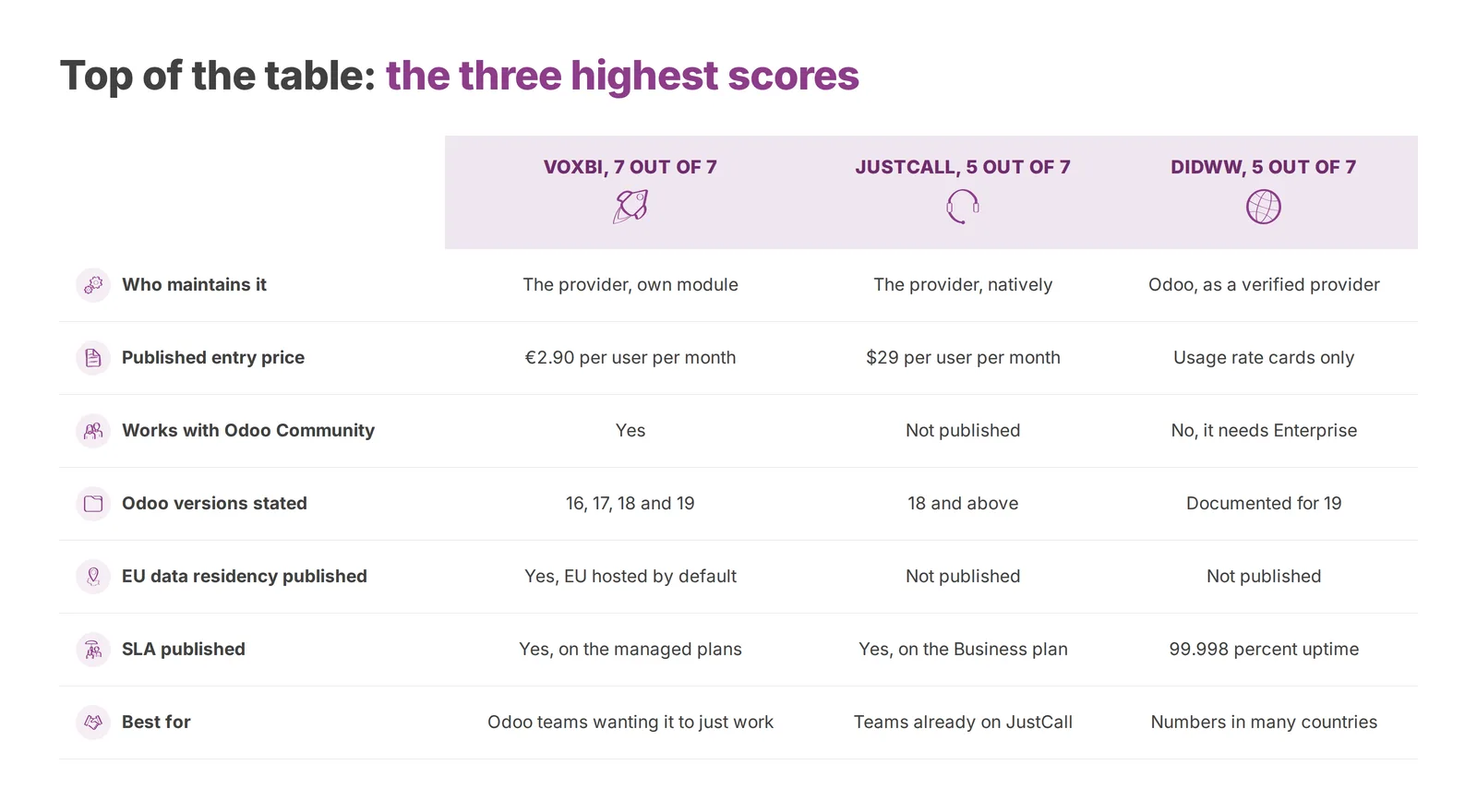
🇱🇺 Luxembourg. The only provider on this list that publishes all six things. Its own module, installed automatically from the Voxbi Cockpit, on Odoo 16 to 19, on Odoo Online, Odoo.sh and self-hosted, and on Odoo Community too. €2.90 per user per month on Voxbi Plus, numbers €1.60, EU hosting by default, and named SLAs on the managed tiers.
Watch for: on Odoo Online the module counts as custom code, which adds about €32 a month. That is not a Voxbi charge, it is Odoo's, and it does not apply on Odoo.sh or self-hosted.
Best for: companies that want the integration to work on day one and want to check the terms before a sales call.
🇺🇸 United States and India. Built by JustCall, no third-party module, and it is the only provider besides Voxbi that publishes both a version requirement and an SLA. Its help pages state "Your Odoo CRM account must be on Odoo version 18 or above" and the integration is included from the Team plan at $29 per user per month.
Watch for: no EU data residency statement. The module sold under JustCall's name on the Odoo apps store is actually Serpent Consulting's at €400, which is not the official path.
Best for: teams already on JustCall.
🇮🇪 DIDWW Ireland Limited, Dublin. One of Odoo's three verified providers, with published rate cards and a claimed 99.998 percent network uptime.
Watch for: this is a carrier, not a phone system. You get numbers and SIP trunking. Routing, queues, recording and a helpdesk are not part of it, and it needs Odoo's Phone app, which means Odoo Enterprise.
Best for: buyers who need numbers in a lot of countries and already have a PBX.
🇬🇧 United Kingdom. The cheapest published per-user price on this page at $6 per user per month pay as you go, and a published 99.99 percent uptime guarantee.
Watch for: the documented setup points Odoo's own VoIP app at a VoIPstudio WebSocket address, so it needs Odoo Enterprise in practice. VoIPstudio does not say so, and it publishes no Odoo version support at all.
Best for: price-led buyers on Odoo Enterprise who are willing to test the setup themselves.
🇩🇪 Germany. Built in house, runs inside the sipgate app, and German data location. €12.95 per user per month on business S.
Watch for: sipgate publishes no Odoo version support and no edition statement. Its own help article notes the API key route needs Odoo's Custom subscription, which is Odoo's most expensive tier.
Best for: German companies that want a German provider.
🇺🇸 United States. An Odoo verified provider with a clear $18.95 per user per month price.
Watch for: the Odoo 19 documentation is explicit that "OnSIP VoIP services are available in the United States (US) only. A US billing address and US credit card are required to use the service." For a European buyer that is not a caveat, it is a full stop.
Best for: United States companies only.
🇫🇷 France. One of only two providers that publish their own module on the Odoo apps store, ringover_dialer, covering Odoo 14 to 19.
Watch for: €47 per user per month on Business, three users minimum on a twelve month commitment, which is the highest published per-user price here. Ringover's pricing page never actually names Odoo. And if you are in a regulated sector, read Ringover's general terms first, because they disclaim suitability for critical functions, which is a live question under DORA in the Luxembourg financial sector.
Best for: French sales teams that want a dialler and are not price sensitive.
☎️ Zadarma builds its own integration, states it "works without additional modules and intermediaries" and is "completely free", but publishes no version support, no edition, no residency and no SLA. CloudTalk publishes its own module and names the tier on its Odoo page, a CloudTalk Essential plan at €29 per user per month, but nothing else. 3CX has been natively integrated with Odoo CRM since Version 20 Update 10, which is a genuinely good route if you already run 3CX, though it needs the AI or Pro edition and is priced per system rather than per user, at €760 a year for Pro at sixteen simultaneous calls. voip_oca is free and open source, works on Community, and covers Odoo 17 to 19, but you bring the PBX, the numbers and the maintenance. Placetel and Aircall are partner-built, as described above. Axivox is the interesting case and gets its own note below.
📉 Wildix, Telavox, Dstny and NFON publish no price, no Odoo version support and no residency or SLA statement, and none of them builds the integration itself. NFON's CRM Connect page still lists Odoo Enterprise versions 8 to 14, which are all out of support. Telavox's integration is contact lookup only, and its Odoo module has been unpublished. A low score here is a statement about what these vendors publish, not about how their platforms perform.
🔍 Four places Voxbi is not the answer.
Axivox, on documentation. Odoo has documented Axivox since version 14, and in Odoo 19 it has a whole section under the Phone app covering configuration, users, voicemail, dynamic caller ID, conference calls, dial plans and call queues. Nobody else comes close, and if you want the route Odoo itself writes about, that is Axivox. It scores 3 out of 7 here only because it publishes no prices and no SLA, and quotes come from its sales team. Axivox does publish support channels and a knowledge base.
VoIPstudio, on headline price. $6 per user per month is less than half of Voxbi Plus. If the deciding factor is the lowest published per-seat figure and you are on Odoo Enterprise, VoIPstudio wins that comparison outright.
3CX, if you already own it. Since Version 20 Update 10 the Odoo CRM integration is native, with no module to maintain. Replacing a working 3CX system to gain an Odoo integration you can already have makes no sense. Mixvoip, which operates Voxbi, sells certified SIP trunks into 3CX installations for exactly this reason.
DIDWW, on number coverage. If what you actually need is numbers in a long list of countries and you have a PBX already, a wholesale carrier is the more direct purchase.
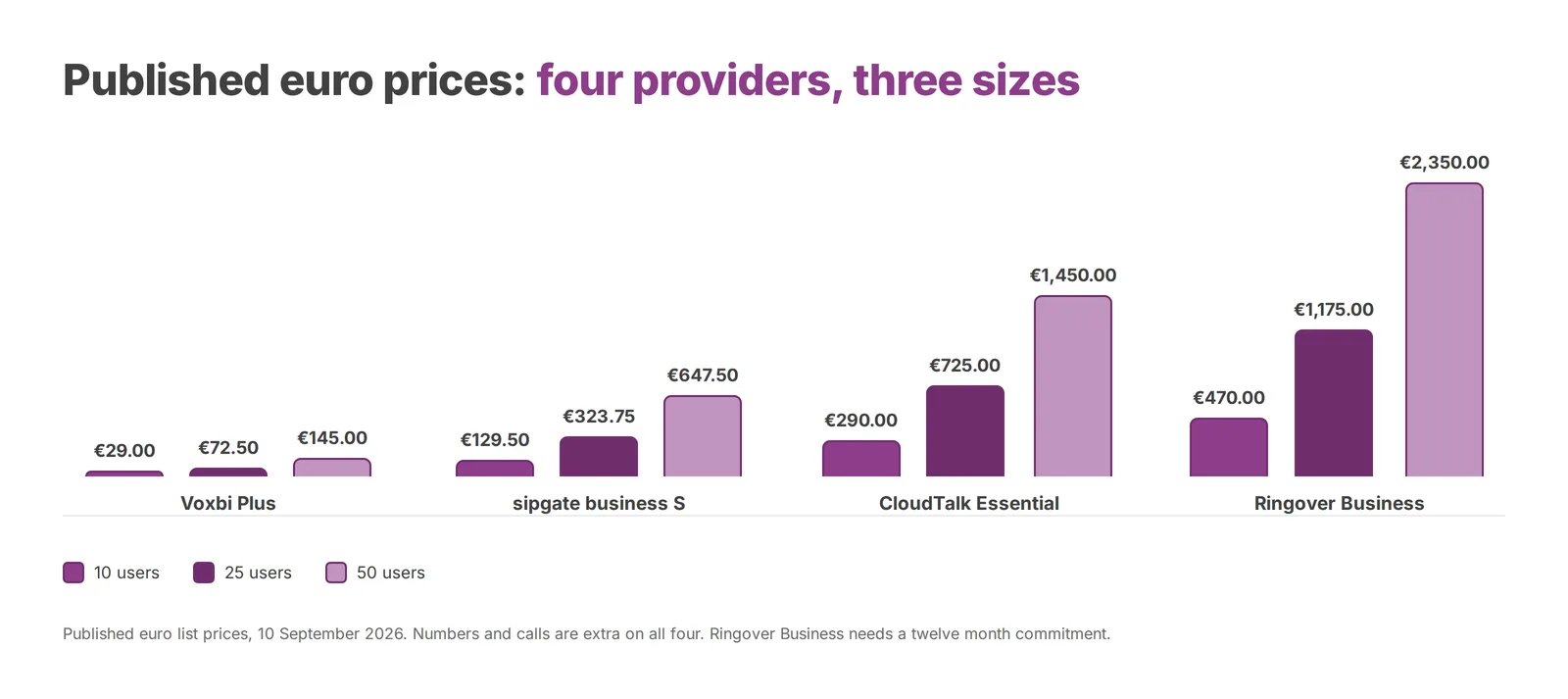
Most Odoo telephony articles quote a per-user price and stop. That number is never the bill. Here is the full stack, using published rates checked on 10 September 2026.
🧮 The four things you pay for
- Odoo itself. One App Free at zero, Standard, or Custom. Odoo's public pricing page served prices in US dollars at $24.90 per user per month on the Standard tier billed yearly, and $49.00 on Custom.
- The phone system, per user. Voxbi Plus is €2.90 per user per month and is the entry tier that lists the Odoo integration. Voxbi Plus AI is €3.10 and adds transcription and unlimited AI summaries. On the managed side, Voxbi Business is €11.20 per user per month on per-minute calling.
- Phone numbers, billed separately. This is the line that is missing from almost every comparison you will read. On Voxbi One plans a number is €1.60 a month. On Voxbi Managed the number is €5.70 a month on Business per-minute, or €8.90 on the flat plan. Most companies need one number for the company, not one per user, because cloud PBX extensions sit behind the main number. Anyone who multiplies a number fee by your headcount is quoting you wrong.
- The calls themselves. Billed per minute on Voxbi One and on the per-minute managed tiers, or included on the unlimited tiers.
⚠️ The Odoo Online custom-code fee. If you host on Odoo Online, third-party modules count as custom code and Odoo charges a monthly maintenance fee based on how many lines there are. The Voxbi module is around 180 lines, which works out at roughly €32 a month. It does not apply on Odoo.sh or self-hosted. For a ten-user company this fee is larger than the phone system subscription. It is not a reason to avoid the integration, but it is a reason to know which hosting you are on before you compare quotes.
Prices exclude VAT.
🟢 Five specific reasons, not adjectives.
It installs itself. You supply four things: the Odoo URL, the database name, an administrator username and an API key generated in Odoo. The Cockpit connects, installs the module and configures call synchronisation, with a live log so you can watch it happen. Setup is about fifteen minutes and the first full sync completes within about an hour.
It covers the versions people actually run, including Community. Odoo 16, 17, 18 and 19, on Odoo Online, Odoo.sh and self-hosted. Community Edition is supported on self-hosted, using the same module and the same setup. That matters more than it sounds: Odoo's own VoIP app is an Enterprise feature, so Community users otherwise have only the free
voip_ocamodule and their own time.
The data stays in the EU. Voxbi is operated from Luxembourg by VOXBI S.A. and is EU-hosted by default, with GDPR and EU AI Act readiness stated on the product. For a Belgian, French, German, Dutch or Luxembourg company running an ERP full of customer data, that is a shorter conversation with your DPO than a US-hosted alternative.
The AI runs in Europe too. Transcripts and summaries are generated by EU-hosted AI and attach to the Odoo record, so the summary is where the next person will look rather than in a separate tool.
The parent company funds the ecosystem. Mixvoip, which operates Voxbi, joined the Odoo Community Association as a Gold Sponsor. The OCA is the nonprofit that maintains the open-source module ecosystem Odoo Community users depend on, including the telephony connectors.
📘 At a glance
Odoo versions. 16, 17, 18, 19.
Editions. Enterprise and Community.
Hosting. Odoo Online, Odoo.sh, self-hosted. Community on self-hosted.
Install method. Automatic from the Voxbi Cockpit.
Setup time. About 15 minutes. First sync within about one hour.
User matching. By email address.
Entry plan. Voxbi Plus, €2.90 per user per month.
Odoo Online surcharge. About €32 per month in Odoo custom-code fees.
What it does inside Odoo
Logs inbound and outbound calls automatically with time, duration, direction and handler
Turns any phone number in Odoo into a click-to-call link
Shows caller name, company, recent calls, tickets and activities while the phone is ringing
Attaches AI transcripts and summaries to the record
Adds an AI sentiment reading to each logged call
Shows caller information on supported desk phones
Read the documentation
Setup guide: Connect Odoo to Voxbi
Integration overview: Odoo VoIP integration
Odoo Community: Odoo Community Edition VoIP integration
API reference: docs.voxbi.com
Odoo 20 is released during Odoo Experience 2026, which runs from 24 to 26 September 2026 at Brussels Expo. If you are choosing a phone system this month, ask every provider one question: when will you support Odoo 20?
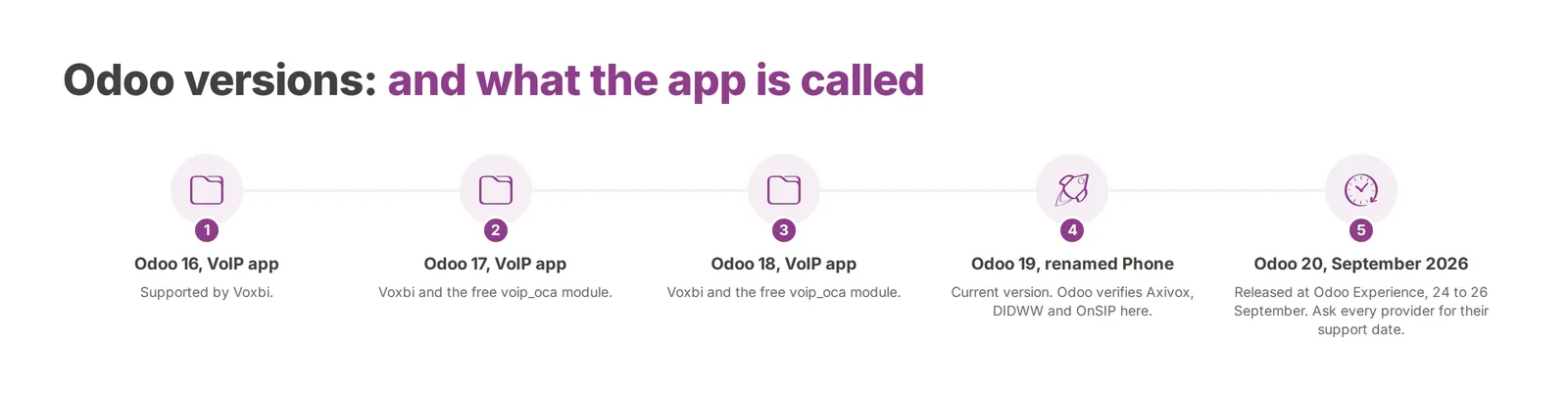
| Odoo version | Telephony app name | Notes |
| 16 | VoIP | Supported by Voxbi |
| 17 | VoIP | Supported by Voxbi and voip_oca |
| 18 | VoIP | Supported by Voxbi and voip_oca |
| 19 | Phone | Current version. Voxbi and voip_oca. Axivox documented in depth by Odoo |
| 20 | To be confirmed | Releasing 24 to 26 September 2026. Confirm provider support before you commit |
🆕 The rename matters when you search for help. In Odoo 19 the VoIP app became Phone. Older guides, forum answers and screenshots still say VoIP. They are describing the same app. If a provider's documentation still only says VoIP, that is a small signal about how recently they updated it.
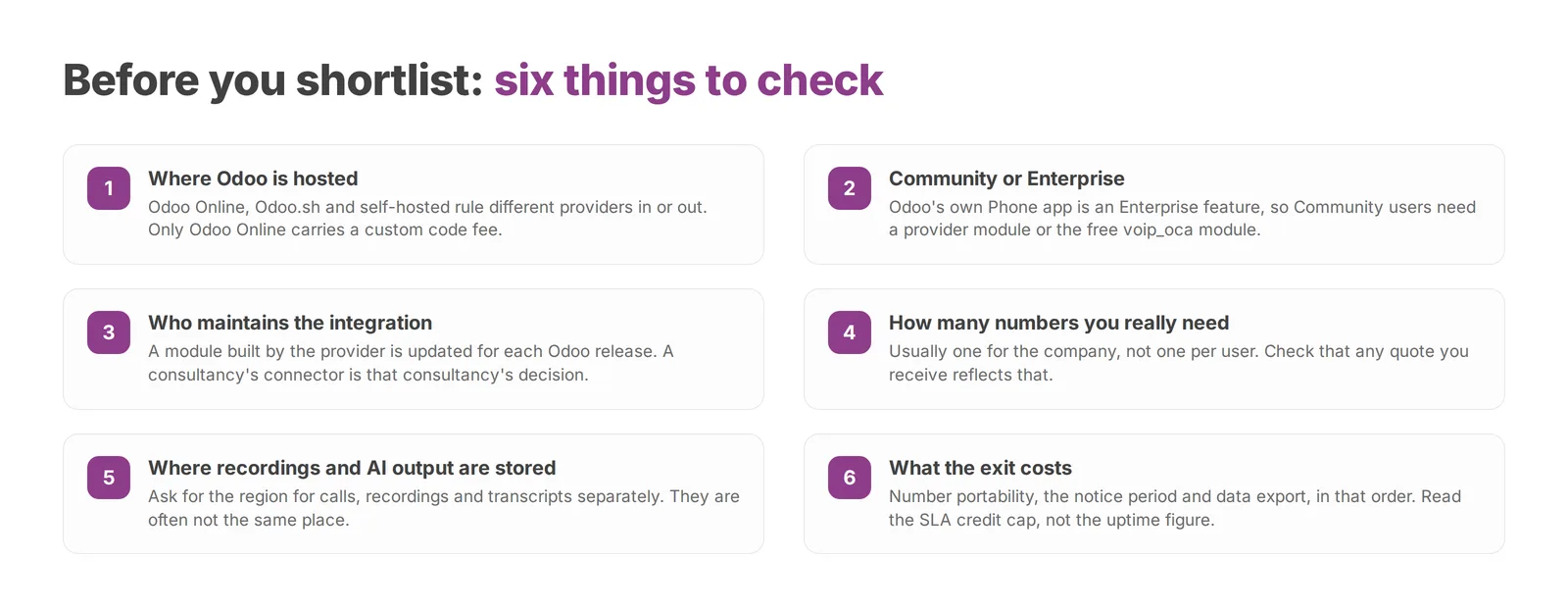
Where is Odoo hosted? Odoo Online, Odoo.sh or self-hosted changes which providers are even possible and whether a custom-code fee applies.
Which Odoo version are you on, and when will you move to 20? Ask for the provider's Odoo 20 date in writing.
Enterprise or Community? Some providers support Community only on self-hosted. Some not at all.
How many numbers do you actually need? Usually one per company, not one per user. Check that any quote reflects this.
Which countries do you need numbers in? Coverage varies a lot and it is the most common reason a shortlist collapses.
Where will call recordings, transcripts and AI output be stored? Ask for the region for each of the three separately, because they are often different.
Who maintains the Odoo module? If it is you, price your own time. If it is a third party on the apps store, ask who patches it when Odoo 20 breaks it.
Is there a support contract and an SLA, and what does the SLA actually pay out? Read the credit cap, not the uptime percentage.
What does it cost to leave? Number portability, contract notice period and data export, in that order.
Does Odoo have its own phone system?
No. Odoo has a Phone app, called VoIP before version 19, which is a softphone and a set of links into Odoo records. It has no numbers, no routing, no queues and no carrier. You still need a cloud PBX or a SIP provider behind it.
Is the Odoo VoIP or Phone app available in Community edition?
No. On Odoo's editions comparison, VoIP sits in the Enterprise column. Community users have two routes instead: the free voip_oca module from the OCA, or a provider that ships its own module. Voxbi supports Community on self-hosted installs, using the same module and the same setup as Enterprise.
Which cloud PBX does Odoo officially recommend?
Odoo does not run a telephony partner programme and publishes no approved list. The Odoo 19 documentation does say "Odoo supports three verified providers by default: Axivox, DIDWW, and OnSIP." Axivox is documented in the most depth, across versions 14 to 19. Everything else on the market is either built by the provider or built by a consultancy.
Is a provider's module on the Odoo apps store an official integration?
Not necessarily, and this is the most common mistake. Most telephony connectors on the apps store are published by Odoo consultancies, not by the phone provider. Check the author field. Ringover and CloudTalk publish their own. The Aircall and Wildix integrations are partner-built, and Telavox's has been unpublished entirely.
Can I use a cloud PBX with Odoo Online?
Yes, but check two things. The provider must support Odoo Online, and any module they install counts as custom code, which Odoo charges a monthly maintenance fee for. For the Voxbi module that is around €32 a month.
How long does it take to connect a cloud PBX to Odoo?
With a provider that installs its own module, about fifteen minutes of configuration and roughly an hour for the first sync to complete. Building your own connector against a PBX is a project, not a task.
Will the integration survive an Odoo upgrade?
It depends who maintains the module. A provider-maintained module is updated for each Odoo release. A module you built or a community module you adopted is your responsibility every September.
Do I need a phone number for every user?
Usually not. Cloud PBX extensions sit behind a main company number, so one number per company is the normal starting point. Direct dial numbers per user are an option you add deliberately, not a requirement.
What is the free option?
The OCA module voip_oca is free and AGPL-3 licensed, for Odoo 17, 18 and 19. It is only free in licence terms. You still need a PBX that accepts SIP over WebSocket, numbers, minutes and your own time to run it.
We already have a 3CX or Asterisk system. Do we have to replace it?
No. You can keep it and buy a certified SIP trunk. The trade-off is that the Odoo link is then yours to build and maintain through Odoo's yearly releases.
📖 Terms used on this page
PBX. The system that decides what happens to a call: who it rings, in what order and what the caller hears.
Cloud PBX. A PBX run by a provider and configured in a browser, with no hardware on your site.
UCaaS. Unified Communications as a Service. A cloud PBX plus chat, video and presence in one subscription.
SIP. The signalling protocol that sets up and ends calls between systems.
SIP trunk. The connection that carries calls between your PBX and a carrier.
SIP over WebSocket. SIP carried inside a browser connection, defined in RFC 7118. It is what lets a phone run inside an Odoo tab.
DID. Direct inward dialling. A phone number that reaches a specific person or team.
IVR. The recorded menu that asks the caller to press a number.
Chatter. The message and activity log attached to every Odoo record. It is where a logged call appears.
BYOC. Bring your own carrier. Keeping your existing minutes contract while changing phone system.
OCA. The Odoo Community Association. The nonprofit that maintains open-source Odoo modules.
All figures on this page were checked on 10 September 2026 against the sources below.
Odoo company figures: odoo.com about page
Odoo pricing tiers: odoo.com/pricing
Odoo editions comparison: odoo.com/page/editions
Odoo 19 Phone app, verified providers and the OnSIP United States restriction: Odoo 19 documentation
Odoo Experience 2026 and Odoo 20 release: Odoo Experience 2026
3CX native Odoo CRM integration from Version 20 Update 10: 3CX documentation
Ringover module and pricing: apps.odoo.com ringover_dialer and ringover.com/pricing
CloudTalk plan requirement: cloudtalk.io/odoo and cloudtalk.io/pricing
JustCall version requirement: JustCall help centre
Other provider prices: VoIPstudio, sipgate, OnSIP, 3CX
voip_oca module: OCA apps store
Mixvoip OCA Gold Sponsorship: Odoo Community Association
Voxbi Odoo integration and setup: voxbi.com/integrations/odoo and the setup guide
Voxbi pricing: voxbi.com/pricing
ERP market share estimate: 6sense ERP market share
Prices exclude VAT.
Entry prices compared with numbers, calls and support added back in, because the headline seat price is never the total. Ten providers priced.
The ten cloud PBX providers worth shortlisting in Europe in 2026, compared on price, hosting country, support and what the entry plan includes.
A 90-day cloud PBX migration guide for European companies. Diagnose the ground, train by user profile, deploy in waves with written go/no-go criteria, and measure adoption once the system is live.
Talk to us or to a certified Voxbi partner.