A salesperson answers a call on a station platform while the handset shows 4G. The call connects quickly, the voice stays crisp, the calendar app keeps syncing in the background, and the conversation survives the walk out of the building. To the user it all feels unremarkable.
VoLTE stands for Voice over LTE. The technology carries speech as IP packets across the 4G LTE network instead of dropping the call down onto a 2G or 3G radio. For a consumer, the answer is mostly about audio quality. For a business it covers handset compatibility, call continuity, technical equipment on remote sites, and the interconnection with a cloud PBX.
For IT integrators, telecom resellers and the IT managers of small and mid-sized companies, the working question is how to get through the migration without a break in service.
What is VoLTE?
VoLTE is mobile IP telephony run by the operator. The handset registers with the operator's IP Multimedia Subsystem, or IMS, and sets up the voice session with controlled SIP signalling over the LTE attachment that's already carrying data. That's why the internet connection stays alive during a call, and why call setup is often quicker than it was on a legacy radio.
Calls can carry wideband audio, usually sold as HD voice, when the codec and both ends of the call allow it. Mobility follows the same logic. The network can hold the session on LTE as someone walks out of a station or an office, provided coverage, handset and operator profile all support the service.
Practical rule: the handset, the SIM, the firmware and the operator's provisioning all have to accept VoLTE. A 4G icon on the screen reports on none of them.
Business voice over IP works on close principles, with different architecture and a different split of responsibility. The groundwork sits in our explainer on voice over IP and what it covers.
What it changes for an IT team
A company's audit covers work phones, BYOD handsets, the SIM cards sitting inside alarms, lifts and other machine-to-machine kit, and the call paths that terminate on a cloud switchboard.
Four threads run through the rest of this article. IMS architecture shows where the voice travels. The comparison with VoWiFi and CSFB shows what's available when LTE voice isn't. The 2G and 3G shutdowns expose the continuity risk. The interconnection with a cloud PBX hosted in the European Union sets out the checks worth running before a multi-site rollout.
How voice over LTE works
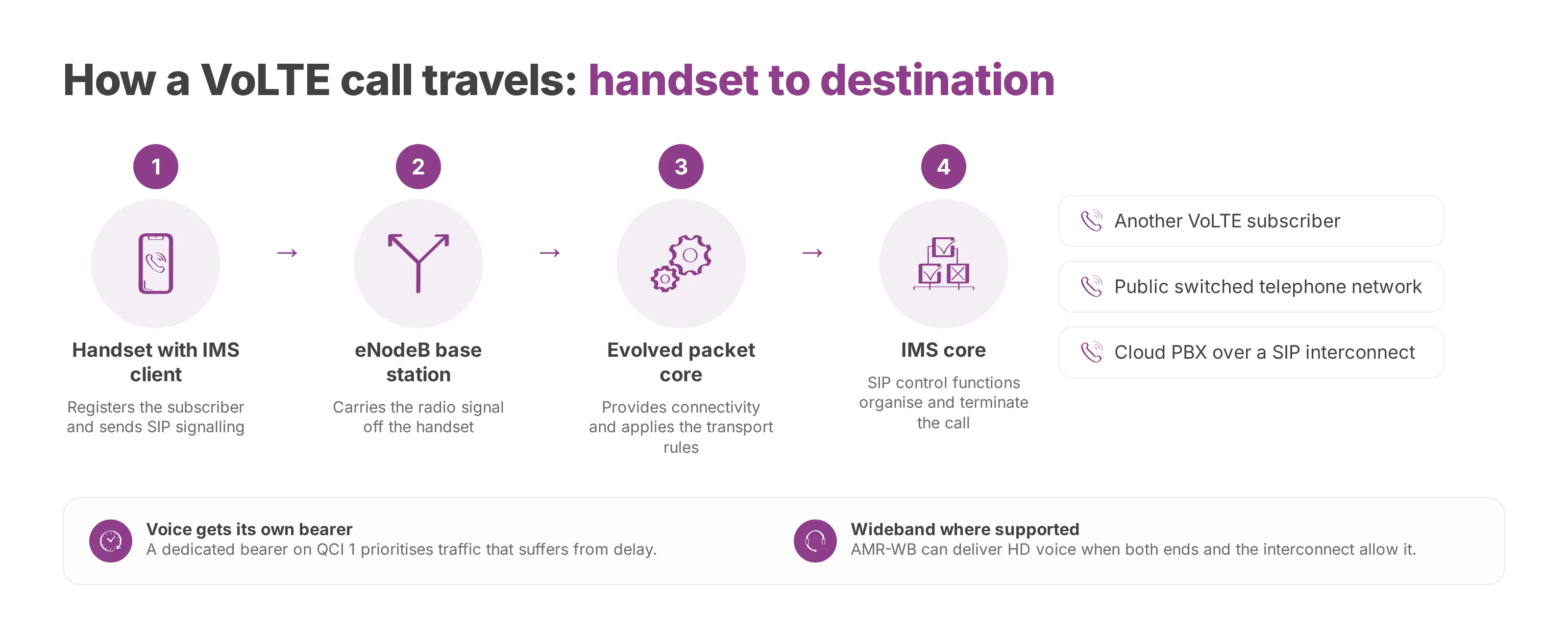
The 4G network carries data, video and signalling across one shared radio infrastructure. VoLTE gives the voice session priority handling inside that infrastructure, with parameters tuned for a stream that suffers from delay and from variation in delay.
The handset does the first job. Its operating system runs an IMS client that registers the subscriber and emits SIP signalling. When someone dials a number, the phone announces a multimedia session that the network then has to authenticate, establish, hold and release.
The call path
The radio signal leaves the handset for the eNodeB, the LTE base station. The eNodeB passes the traffic to the packet core, the EPC, which provides connectivity and applies the transport rules. The session then arrives at the IMS, where SIP control functions organise the call and work out where it terminates.
From there the route depends on the destination. A call to another VoLTE subscriber can stay inside the operator's IMS. A call to an ordinary landline number crosses into the public switched telephone network, and our piece on what the PSTN is covers what that network still handles. In a business context the call can instead land on a telephony platform over a SIP interconnect, depending on the agreements between the operator, the integrator and the PBX provider.
The building blocks
A telecom administrator doesn't need the whole IMS architecture in their head. A handful of elements explain the technical trade-offs.
Dedicated EPS bearer. The network gives voice its own logical channel with its own transport rules, separate from ordinary data traffic.
QCI 1. This quality-of-service profile is the one traditionally attached to conversational voice, and it prioritises latency-sensitive traffic.
AMR-WB. This codec can deliver wideband voice, often called HD voice, when both ends and the interconnect support it.
ROHC. Header compression cuts packet overhead, which counts on a radio interface where every byte is paid for.
PCRF. This function applies the policy and quality-of-service rules the operator has defined.
No circuit switch carries the LTE call anywhere in that chain. The session is handled as an IP service under IMS control, which puts mobile voice close to the mechanics of business telephony and to the way a SIP trunk hands calls between networks.
VoLTE, VoWiFi and CSFB compared
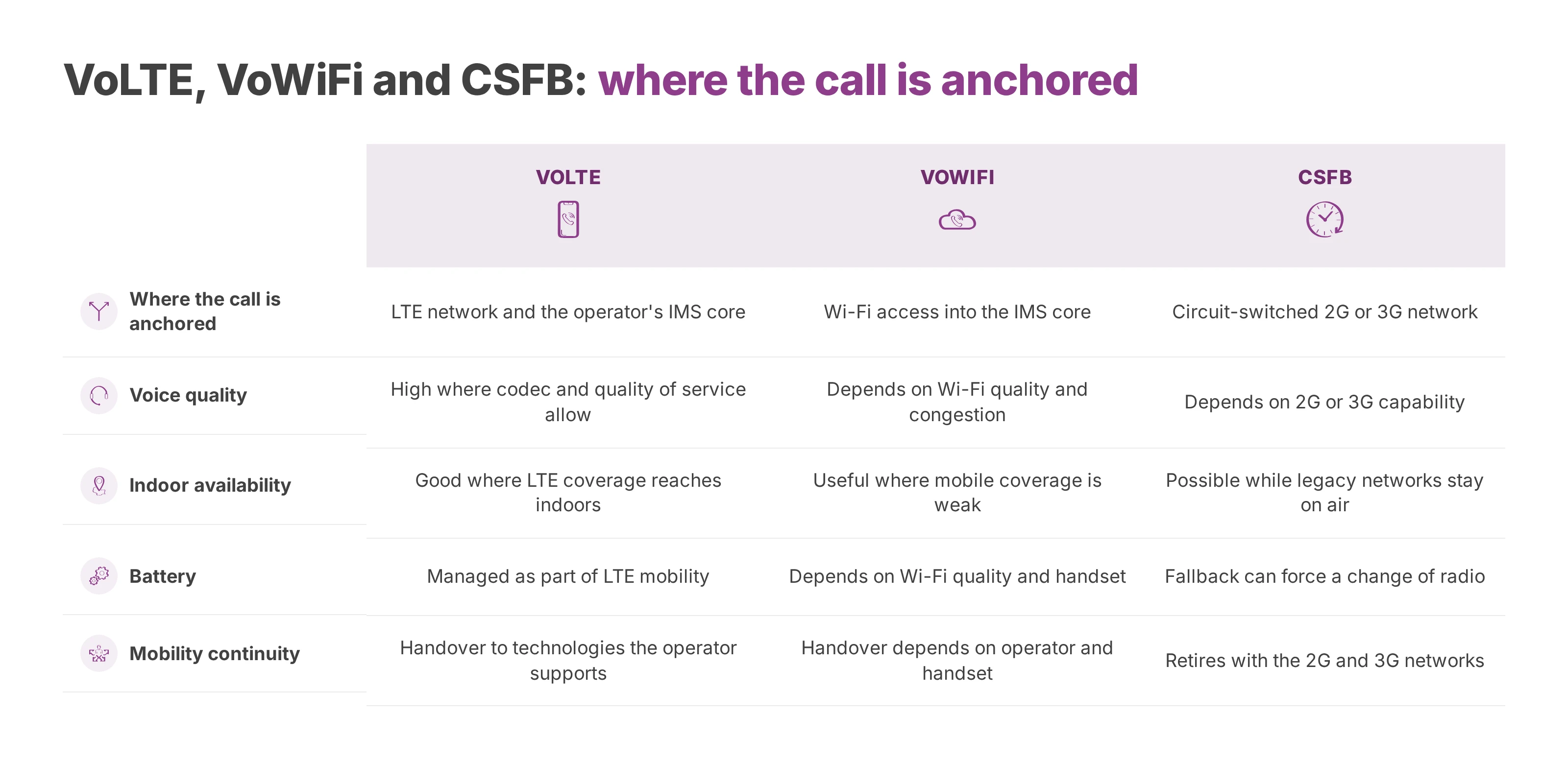
Where the call has to stay available decides which of the three you lean on. VoLTE anchors on the operator's LTE network. VoWiFi uses Wi-Fi as the radio access and then joins the same IMS core. CSFB, or Circuit-Switched FallBack, takes the handset off 4G and carries the voice over 2G or 3G.
That difference shows up in indoor coverage, in quality of service, and in continuity while someone is moving. An office building can have weak 4G and a well-built business Wi-Fi. A salesperson on the road depends instead on LTE coverage and on the handset staying attached to the VoLTE service.
Quality of service on each path
VoLTE runs on a network the operator controls, but it still fails in ordinary ways. A congested cell, a badly provisioned handset or an incomplete operator policy can stop a call from setting up at all. VoWiFi adds the local network as a second dependency, and a LAN can under-prioritise real-time traffic or filter the exchanges the service needs.
CSFB made sense as a transition mechanism. It let a 4G handset keep telephony where VoLTE wasn't yet available by leaning directly on 2G or 3G. Once those networks go, the safety net goes with them. In day-to-day operation, VoLTE is the primary mode outdoors, VoWiFi extends coverage inside buildings and on isolated sites, and CSFB has no place in a plan meant to hold for years.
The 2G and 3G shutdowns set your deadline
A handset can show 4G and browse the web while failing to place a call, because VoLTE isn't active on the line. Once the legacy radios go, handset compatibility becomes a condition of service.
Operators are retiring 2G and 3G on their own schedules, network by network and country by country. Each operator publishes its own dates, and the technology it retires first varies between them. The date that governs your fleet is the one published by each operator whose SIMs you actually carry.
Alarms, lifts and M2M kit share the risk
Before VoLTE became standard, a phone used 4G for data and switched to 3G or 2G for the duration of a call. After a shutdown, a 4G handset without VoLTE can hold a data connection with no working voice path behind it. The signal bars stay up, so the user has little chance of diagnosing what broke.
The audit therefore covers four categories.
Older handsets. Models limited to 2G or 3G need finding before the operator pulls the network.
Alarms and lifts. A GSM module can depend on 2G without appearing anywhere in the IT inventory.
IoT and M2M. Every card has to be matched to a modem and a profile that work on the networks being kept.
Emergency calls. Calls to 112 need testing wherever LTE coverage is patchy.
Site-by-site preparation
Map the sites, the routes people drive, the technical equipment, and the areas where voice used to rely on a 2G or 3G fallback. For a multi-site organisation, one test per operator and per handset type surfaces the gaps well before the cutover.
Radio coverage is one part of it. VoLTE activation on the tariff, SIM provisioning, software updates and emergency-service behaviour all need checking too. Paperwork only proves so much. A live call placed from each sensitive site validates the whole path.
Fixed installations went through the same exercise as the copper network started closing. Inventory the dependencies first, then change the infrastructure. Our cloud PBX migration guide walks that sequence for fixed lines.
VoLTE and a cloud PBX hosted in the European Union
A VoLTE call to a cloud switchboard crosses several environments. The handset registers with the operator's IMS. The voice session runs over LTE. The operator hands the signalling to a SIP trunk or a gateway. The cloud PBX then applies the company's own rules for numbering, queues, transfers and the greeting.
The exact route follows the interconnect contract. Mobile to mobile can stay inside the operator's IMS. A call to a company's main number usually crosses a SIP trunk or a gateway into the PBX, which distributes it to a user, a queue, an auto attendant or another site.
So the interfaces between mobile network, operator and hosted platform are what an integrator has to examine. VoLTE provides the radio transport for voice; the behaviour of the business switchboard is defined in the PBX, not in the mobile network.
Interoperability points
Codecs don't necessarily survive end to end. The mobile leg may use EVS or AMR-WB while the SIP interconnect and the PBX negotiate something different. A session border controller, or SBC, can translate between them, which shifts perceived quality and adds processing load.
Quality has to be verified segment by segment. The mobile network applies its own mechanisms, including the voice bearer on QCI 1. The IP network can class real-time traffic with DSCP EF. Neither setting replaces a test, because a misconfigured Wi-Fi, a saturated WAN or a failing trunk degrades the call while VoLTE itself is working correctly.
Ask the operator and the platform provider about five things.
SIP interoperability. Registration, calling-line presentation, transfer and overflow scenarios should all be described.
SBC. Session policies should govern which connections are accepted, which codecs are allowed and how signalling is adapted.
Encryption. TLS for signalling and SRTP for media should be specified on each segment that carries them.
Mobility. Transitions between LTE and Wi-Fi, including VoWiFi and ePDG, need testing rather than assuming.
Data. Logging, recording retention and call metadata belong under a documented policy.
Data residency and compliance
The General Data Protection Regulation has applied since 25 May 2018 to the personal data of people in the European Union, including where the processing happens outside it. The scope sits in the regulation's own text. Hosting inside the European Union simplifies the residency analysis, but an IT team still has to check sub-processors, administrator access, backups and retention periods.
Voxbi is a cloud PBX hosted in European Union data centres, which makes it one option to weigh against your own residency requirements.
EU AI Act compliance depends on which functions you use, what processing they perform, and how the contracts allocate responsibility. For a migration driven by legacy-network shutdowns, those checks come before you generalise the interconnection between VoLTE mobiles and a cloud PBX.
Migrating a business mobile fleet to VoLTE
A migration starts with an inventory. Separate corporate handsets, BYOD devices and technical equipment, because each category can carry a different manufacturer, firmware, SIM and operator profile.
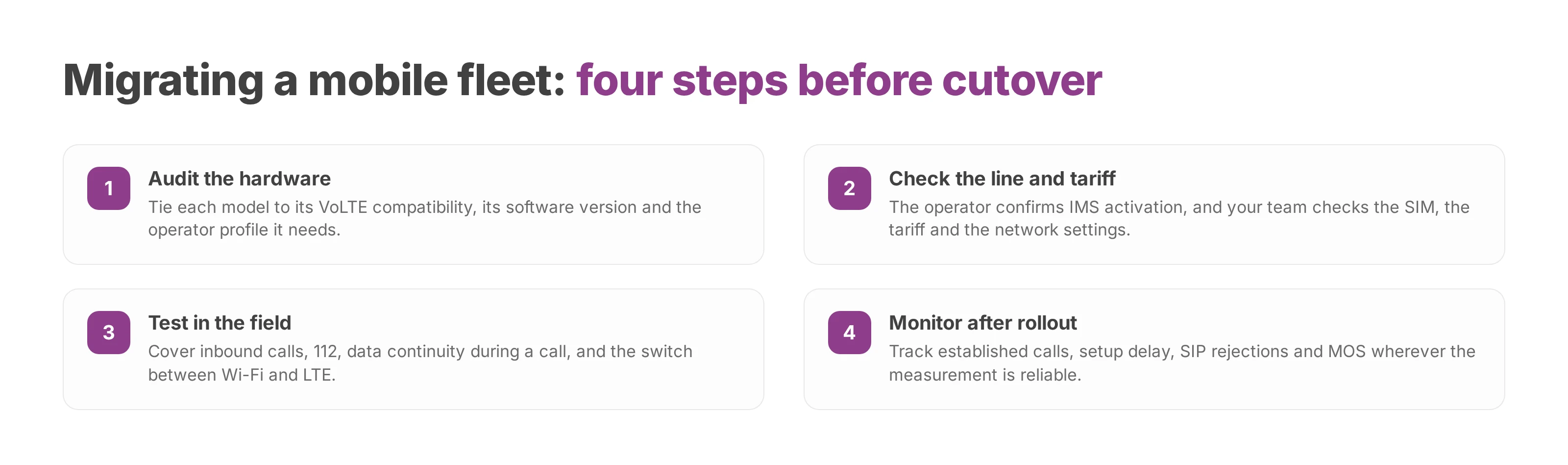
A four-step checklist
Audit the hardware. The list should tie each model to its VoLTE compatibility, its installed software version and the operator profile it needs. A 4G smartphone isn't automatically VoLTE-capable on every network. Check your operator's published compatibility list against the fleet you actually own, model by model.
Check the line and the tariff. The operator confirms IMS activation and service availability on the line itself. Your team checks the SIM or eSIM, the tariff, the network settings, the APN where it applies, and the operator's own diagnostic procedures, including any documented USSD codes.
Test in the field. Cover on-network and off-network calls, inbound calls, 112, data continuity during a call, movement between LTE areas, the planned drops to 3G during the coexistence phase, and the switch between Wi-Fi and LTE. Record every result by site, model and operator.
Monitor after rollout. Track the rate of established calls, setup delay, observed SIP rejections, and MOS wherever the measurement is reliable. Know the Android and iOS diagnostics, particularly IMS status, network logs and operator profile settings.
Mixed fleets
BYOD adds a governance constraint. A company doesn't always control the model, the firmware or the settings on a personal phone, so a written policy has to name the accepted handsets, the minimum versions, and the replacement route when a device won't work on the chosen operator.
M2M equipment needs its own track. An alarm or a payment terminal can't be signed off by making a voice call from a smartphone. The equipment vendor confirms radio compatibility, the SIM migration, and how the device behaves when LTE coverage drops for a while.
Decisions to settle before the cutover
VoLTE becomes a continuity question the moment a company still depends on an old handset, an M2M device or a CSFB fallback. The work is verifying that every link, from the cell site to the cloud PBX, supports the path you're counting on.
Network coverage. Map each operator's LTE voice coverage across your sites, your regular routes and your service areas.
Operator dependency. A fleet on a single mobile network is simpler to administer, while a multi-operator strategy cuts your exposure to thin local coverage and to a shutdown schedule that lands badly for you.
Hardware compatibility. Validate models, firmware, SIMs, eSIMs and IMS profiles, BYOD handsets and technical devices included.
Security and quality of service. Test the cloud PBX on codecs, the SBC, end-to-end quality of service, VoLTE to VoWiFi handover, SRTP and TLS encryption, and data residency.
A staged cutover should keep VoWiFi as the fallback where LTE voice coverage stays weak, without treating it as a universal guarantee. The final decision takes one of three shapes. Migrate now, defer under documented conditions, or run a hybrid for a fixed window with an exit date and a named owner.
Voxbi administers users, extensions, call scenarios and queues from Voxbi Cockpit, on a platform hosted in European Union data centres, so a mobile migration doesn't have to wait on a local PBX. Write down your per-operator shutdown dates, your incompatible models and your emergency-call test results, then send the gaps you can't close yourself to hello@voxbi.com.