It's 9.15 on a Tuesday morning. The reception phone rings while two urgent files sit open on screen, and someone picks up mid-sentence with a rushed "Hello?". On the other end, a supplier hesitates and asks whether they've reached the right company. Then they cut their explanation short.
A clear greeting would most likely have saved that call in its first three seconds. The phone is still the channel people reach for first. In France, 77% of people use the phone to contact a customer service, against 31% who use a chatbot, and 72% of phone users are satisfied, against 50% for chatbots. Those are Ipsos bva figures from its 2025 customer service observatory, quoted in a Businesscoot study of the French chatbot and customer service market.
This telephone etiquette guide is for anyone who answers the phone at a small or mid-sized business or a service firm, at reception or on a shared team line. It follows a call in the order it happens, from the greeting to the goodbye, with lines you can say word for word and a checklist to pin by the phone.
What telephone etiquette means in a business
Telephone etiquette is the set of habits that make a business call easy for the person ringing in. It covers how you greet, listen, hold, transfer and close, and it applies to every line in the company, from reception to the sales desk.
Picture a common scene in a shared office. A number rings four times, then a voice answers without a first name or a company name. The caller pauses and asks who they're speaking to. Their request comes out half-finished, and they hang up before anyone has pointed them anywhere.
No technical fault caused that. The person who picks up sets the frame in the first three seconds: either the caller knows they've reached the right place, or they start to wonder whether they dialled the wrong number, whether they're interrupting, and whether anyone will follow up.
Identification comes before the answer. Until callers know exactly who they're talking to, they hold back part of what you need to help them.
This guide covers the call itself, from pick-up to hang-up. How you set up queues, opening hours and call distribution for the whole company is a separate question.
The six steps of a business call
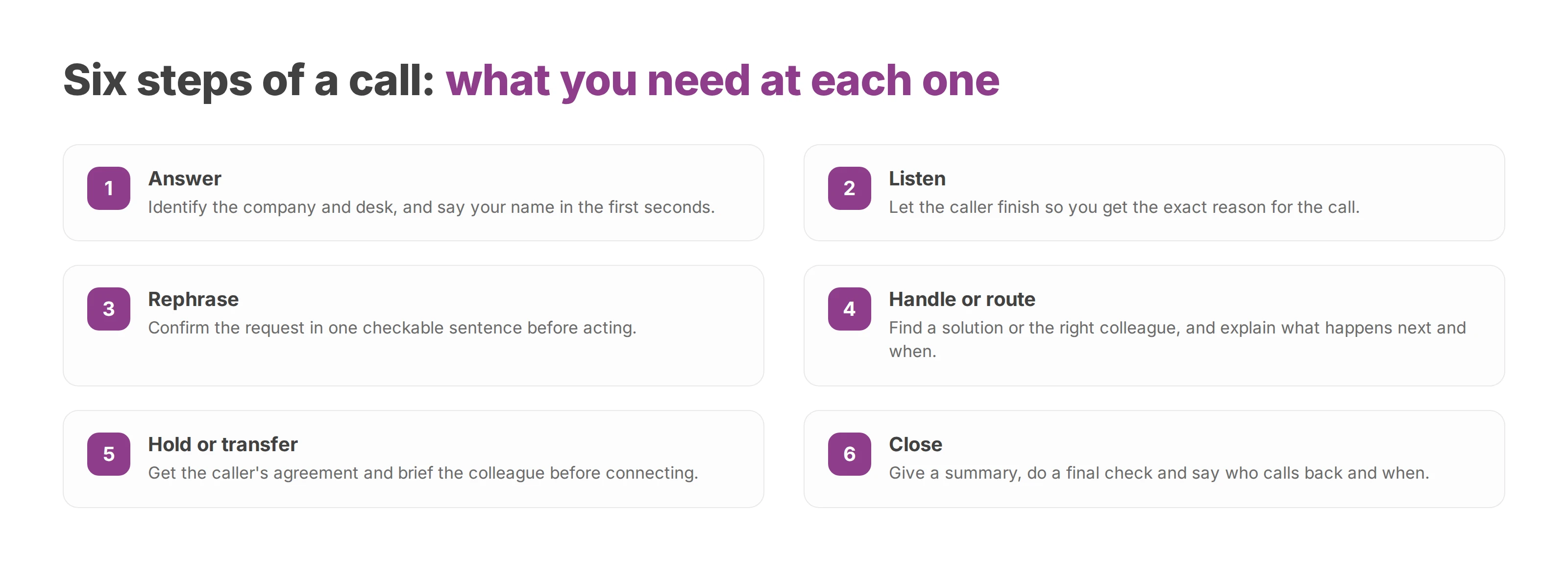
Every professional call moves through checkpoints. At each one, you need a specific piece of information before you move on. The table below works as a quick reference for the whole team.
Skip a row and the next step runs blind. A transfer made before you've confirmed the exact reason lands the caller with an unprepared colleague, who asks them to repeat everything. The call gets longer, and the company sounds less competent.
Answering within a few rings matters. Resolving or routing the request on the first contact matters more, because a failed first call comes back as a second one.
The table isn't a script to recite. It sets an order and leaves the tone to you, so each person keeps their natural voice and no critical detail gets lost between steps.
How to answer the phone professionally
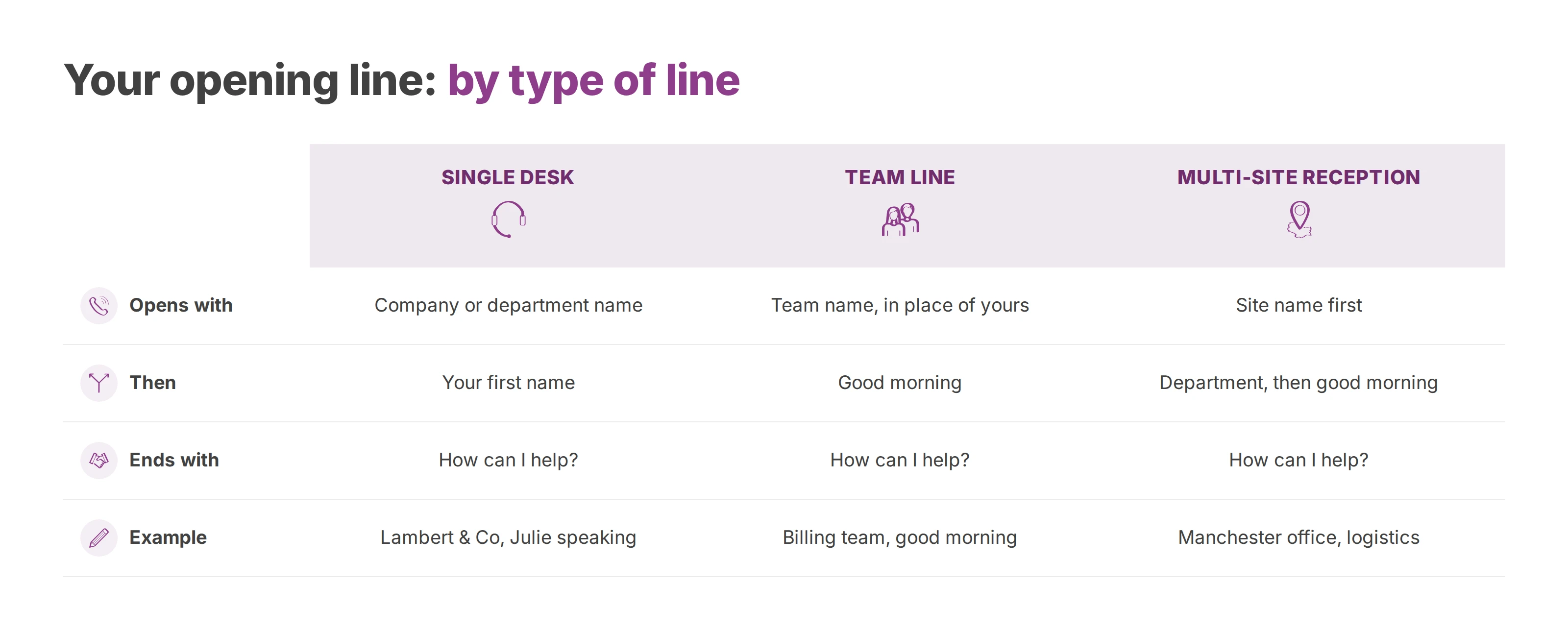
Your opening line should remove every doubt in one unhurried sentence. It works best in a fixed order: the company or department name, your first name, then an open offer of help.
"Lambert & Co, Julie speaking. How can I help?"
Say it without rushing. A bare "Hello?" followed by silence leaves the caller doing the work. If a recorded welcome message already announces the company, you still give the department and your first name, so the caller hears that a person has taken over.
Greetings for team lines and multi-site reception
On a rotating team line where several people pick up in turn, the team name takes the place of yours: "Billing team, good morning, how can I help?"
A reception desk that covers several sites names the site first. "Manchester office, logistics, good morning, how can I help?" Naming the site before the department stops you from handling a request that was meant for another branch.
Edge cases when you pick up
When a caller rings your direct line and already sees your name on their screen, your first name and a crisp "good morning" confirm they've reached you and not a colleague covering for you.
If you answer in a meeting or on the move and it's noisy, step away for two seconds before you speak, or say straight away that you'll call back at a set time. A company name lost in background noise gets the call off to a confused start.
After a late pick-up, a brief "Thanks for holding" at the start of your greeting is enough. Long apologies before you know who's calling only delay the caller.
Two last habits: quieten the desk before you press answer, and keep a steady pace so the company name stays easy to catch.
Active listening and taking a phone message
Many callers keep the real subject for their last sentence, so interrupting at the first familiar word sends you down the wrong path. Active listening means letting them finish and writing down names, dates, references and numbers as they come. Then you rephrase the goal in one sentence the caller can confirm.
"So if I've understood, you're calling about your last invoice and you'd like a payment plan."
A rephrase that misses isn't a failure. It gives the caller a chance to correct you before a transfer or a ticket goes to the wrong place. That check matters most with callers who find procedures hard: a May 2022 study by Insee, the French national statistics institute, found that people under 30, older people and the most disadvantaged struggle most with administrative procedures, online or not (Service-Public.fr summary).
Clarifying a vague request
When the caller stays vague, don't fire four closed questions in a row. Ask one precise question that points towards an action. "Is this about an order that's already been delivered, or a quote that's still open?" That single either-or gets the conversation moving without rushing the person.
When the colleague the caller wants isn't available, your note has to be usable straight away. Ideally you type it into the contact's record with call commenting, or into the call log. With the nine fields below, a colleague can pick up the case at a glance.
Access limits and confidentiality
Whoever answers the phone promises only what they control and comments only on files they can see. A status you can't verify stays unsaid. The General Data Protection Regulation (GDPR) adds two duties: record no personal data the message doesn't need, and pass the message only to the person it concerns.
The practical target is a note complete enough for your colleague to call back with the answer. The caller then never has to tell their story twice.
Putting callers on hold and transferring them
Starting hold music without warning breaks the caller's trust at once. Before any hold, give the reason, ask permission and offer a cautious estimate of the wait.
"I'll check that with Ms Patel. May I put you on hold for a moment?"
If the check takes longer, come back on the line and let the caller choose between waiting and a callback. Clear hours help here too: a caller told that billing answers from 2pm can plan the afternoon around it, which beats waiting with no idea when anyone will pick up.
The seven steps of a warm transfer
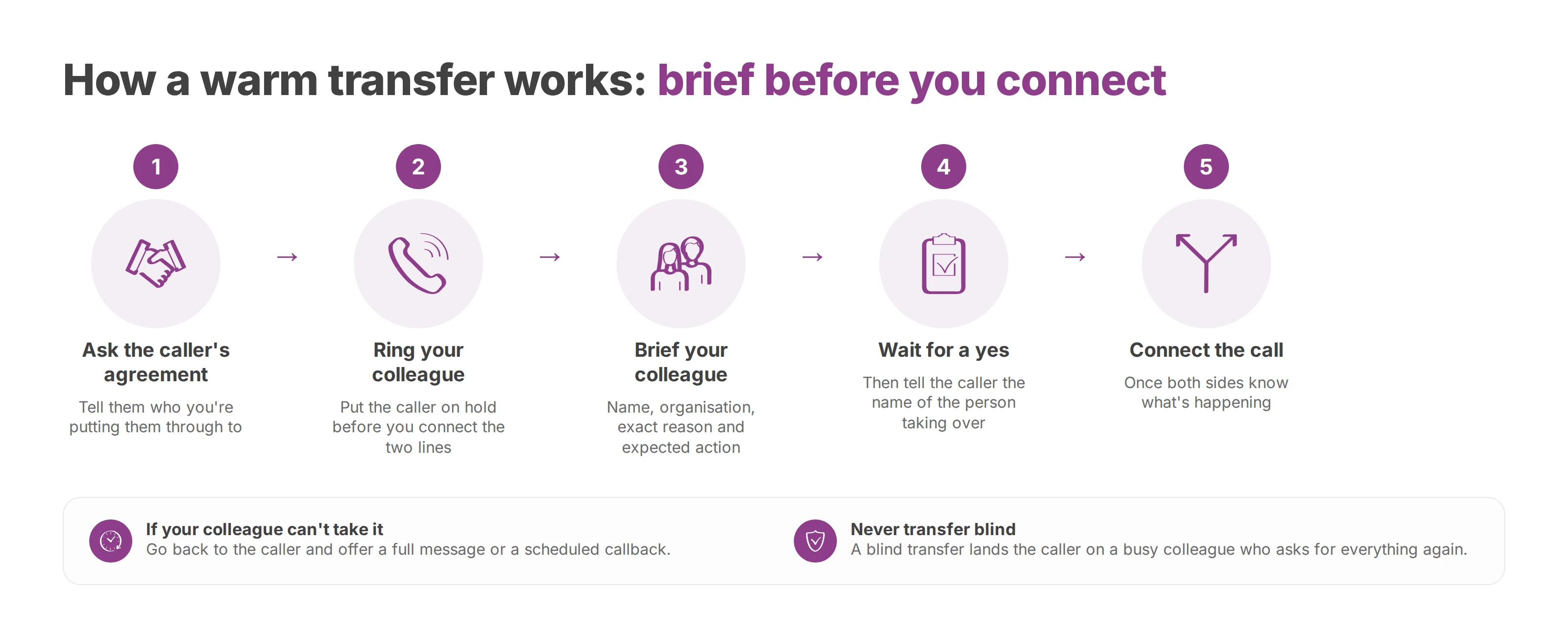
A blind transfer is still the most common trap at reception. The call lands on a busy colleague, who has to ask for the name, the company and the reason all over again. An attended transfer, also called a warm transfer, avoids that in seven moves:
Ask the caller's agreement and tell them who you're putting them through to.
Put the caller on hold and ring your colleague before you connect the two lines.
Give your colleague four things: the caller's name, their organisation, the exact reason and the action they expect.
Wait for your colleague to say yes before you let the call go.
Go back to the caller briefly and tell them the name of the person taking over.
Connect the call once both sides know what's happening.
If your colleague doesn't answer or can't take it, go back to the caller and offer a full message or a scheduled callback. Never fall back on a blind transfer.
For a longer absence, give a real time. "Ms Patel is back tomorrow at 9am" reassures the caller far more than a vague promise of a callback soon. Our guide to the call handling process goes further into hold timing and queues.
Handling an angry caller
Irritation usually shows before anyone names it. The voice gets louder, sentences get shorter or break off, the same request comes back twice, and the caller mentions an earlier call that went nowhere.
Your own tone weighs heavily here. Nearly one in two French people has felt that a phone adviser was rushed or stressed, and for 84% of them it made the conversation worse, according to the 2025 customer service observatory quoted by Yelda. A quick, clipped reply feeds the conflict.
Acknowledge the frustration first
The first mistake is to justify yourself with the team's workload or to explain internal procedures. The caller doesn't want to hear how your team is organised. They want to hear that their problem has been taken on board, and one sentence does that without conceding anything on the substance:
"I understand you've called before. Let's go through exactly what's holding this up."
Three things to avoid while they talk: don't interrupt their account, don't defend the company with a general explanation, and don't match their pace when they're wound up. Once you've found the concrete fact, offer an action the caller can check: look up a status, open the right file, or book a callback in a time slot you'll keep.
Difficult situations and what to say
The caller demands a manager. Check first whether the manager can actually take the call. If they can't, don't put the manager on the spot with a transfer that may fail. Offer a named callback instead, and say who will ring and whether it'll be this morning or this afternoon.
The caller drifts or piles on complaints. Let the current sentence finish, then steer back to something you can act on: "So I can sort out today's delivery, I need the order number."
The caller stays aggressive after that. Set a short, calm limit with no threat in it. "I want to help you, and I need us to stay calm so I can log your case." Then write the objective facts in the note for your colleague.
A broken promise makes a tense dispute worse. A realistic deadline, even one slightly longer than the caller hoped, protects the relationship better than an instant fix nobody can deliver.
How to end a business call
The last ten seconds leave the final impression. A good close sums up the agreed action and its timing, names who will call back, and leaves room for one last question.
"I'm passing your request to the right team today, and they'll call you back this morning. Is there anything else I can do for you?"
Never promise a deadline that depends on someone you haven't asked. If information is still missing, say what you'll check and when you'll come back to the caller. Right after you hang up, a few seconds of after-call work are enough to finish the note and assign the follow-up before the phone rings again.
Telephone etiquette checklist for your desk
The same standard applies whatever device you answer on. With a cloud phone system such as Voxbi, you make and take calls in the browser, in the desktop app or on your mobile, always on the same number. Print these eight points and pin them by the desk phone or in the shared workspace:
Answer with the company name, your first name and an offer of help.
Let the caller finish without interrupting.
Rephrase the request in one checkable sentence before acting.
Ask for the caller's agreement before any hold.
Before a transfer, brief your colleague on who's calling, why, and what they expect.
Note the name, the callback number (read back), the exact subject and the expected action.
Promise only a deadline or status you can verify.
Sum up the next step, say who'll call back and check for a last question before hanging up.
Voxbi is a cloud phone system for small and mid-sized companies, IT integrators and telecom resellers. It's built and hosted in the European Union and run in line with the GDPR. Call routing, attended transfers, call comments and one number across browser, desktop and mobile support every step above. Start with the free trial, or write to hello@voxbi.com to talk it through.