
How to send a fax online from your computer or phone
Send a fax without a machine or an analogue line. Five steps, three ways to send, and the records to keep in case anyone disputes the fax later.
Nov 23, 2026
Choosing a business phone system in Belgium or Luxembourg comes down to caller languages, the number of sites and the line you're replacing. Three customer cases and Voxbi's prices.

When a customer calls your business, the phone system decides which phone rings, which language greets them, and what happens at 6 p.m. and on a Saturday. For a small or mid-sized business in Belgium or Luxembourg, choosing a business phone system mostly means settling three questions: the languages your callers speak, the sites you need to connect, and the old line you're replacing.
If your current system works well and everyone sits in the same office, there's no rush. For everyone else, caller languages and the number of sites count for more than any feature list. The three examples in this guide are Voxbi customers: two Luxembourg companies and a municipality in Hainaut. How a cloud phone system works under the hood, from the route a call takes to hosting and compliance, is covered in our cloud PBX guide.
An old analogue PBX or an early IP system runs in the comms room. The landline has been with Proximus for years. You want to move to IP telephony without changing your number.
The nasty surprise can come from devices still plugged into the old line. Proximus points this out itself on its Bizz Call Connect page. When Bizz Call Connect is added to a Business Flex+ pack, the traditional phone line is replaced by an IP line, and Proximus warns that "some alarms are not compatible with the IP line" (page checked on 24 November 2026). The same check applies with any provider once your line moves to IP. Before you sign, walk round the building and list everything that still depends on that line. Start with the alarm, then the lift phone and the door intercom, and don't forget the fax or the old card terminal sitting in a corner.
The municipality of Quaregnon, about 18,000 residents, also had an old system. Its analogue PBX could keep up with neither home working nor the planned move to new offices. With no automatic routing, residents were passed from one department to the next. Today a Voxbi voice menu sends each call to the right department before any phone rings. Staff no longer depend on their desk phone, because the same lines work from home and in a new building, with no rewiring. The details are in the Quaregnon case study.
The Ernster bookshop chain has ten stores, a logistics centre and 115 employees in Luxembourg. It wanted phones that work the same way everywhere, rather than store by store. Every site now runs on Voxbi with the same configuration, so a new store joins the existing system instead of starting from scratch.
A Liège business that opens a subsidiary in the Grand Duchy, or a Luxembourg firm with an office in Arlon or Trier, soon ends up with two operators and two contracts. Calls between its own offices can then be billed at international rates.
The Luxembourg haulier LGL Transport put its teams in Luxembourg, Germany, Cameroon and Benin on one Voxbi system. A call from one country to another stays an internal call, extension to extension. Drivers answer on the mobile app like any other colleague.
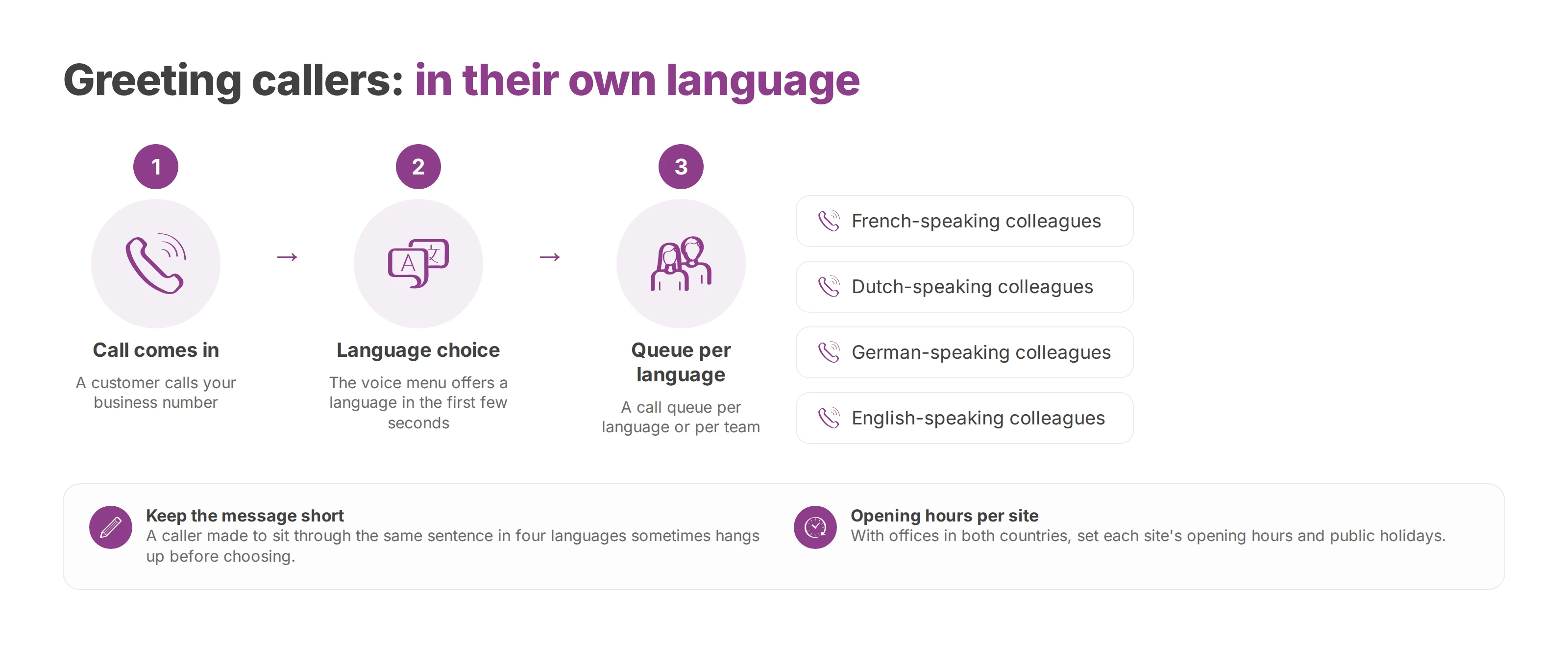
In Brussels, some of your calls come in Dutch. In Luxembourg, a single morning can bring French, German, Luxembourgish and English. And the caller who opens in German always seems to land on the colleague whose German is weakest. The simplest fix is to offer a language choice in the first few seconds, then send the caller to colleagues who speak it. Keep that message short. A caller made to sit through the same sentence in four languages sometimes hangs up before choosing.
In Voxbi, you set the language choice in the IVR (interactive voice response), which sends callers to a call queue per language or per team. With offices in both countries, also set each site's opening hours and public holidays. Belgium's national day is 21 July, Luxembourg's is 23 June.
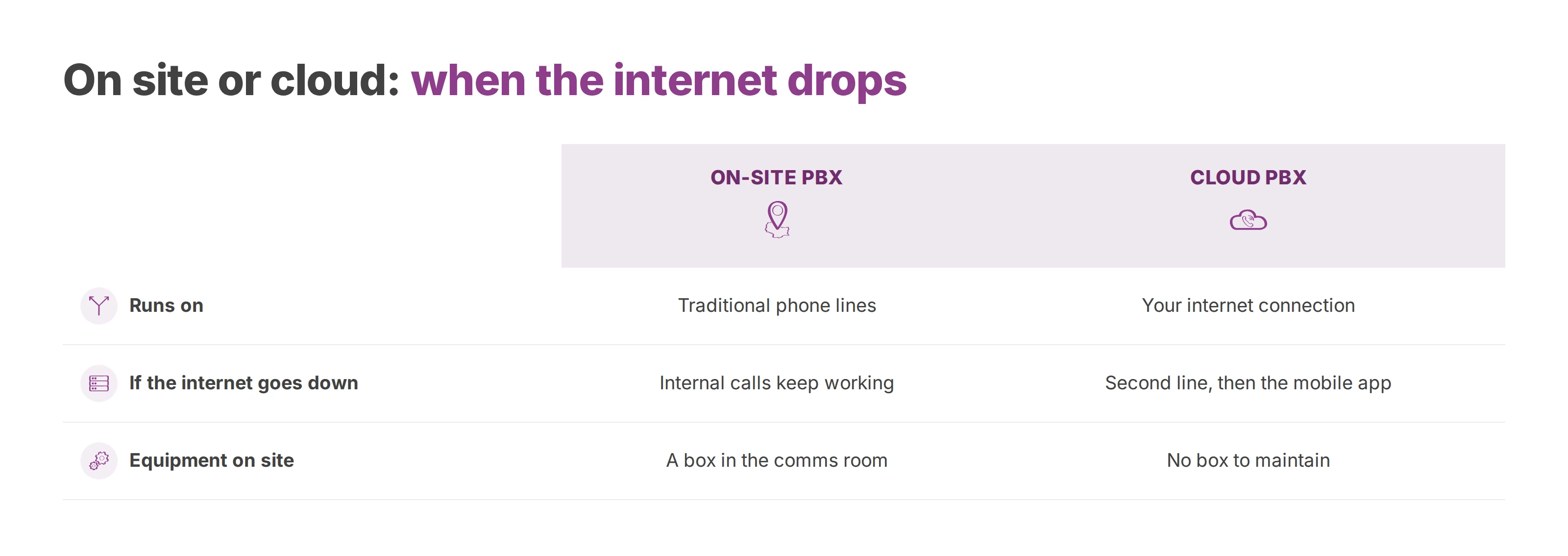
A PBX installed on your premises and wired to traditional lines keeps running when the internet drops, at least for internal calls. In Belgium, Proximus makes this a selling point for the on-site version of Call Connect, which "runs on traditional phone lines, so you can still call internally if the internet goes down". On its Call Connect page, Proximus calls it ideal for care homes and single-site offices.
In the cloud, everything runs over your connection. With a second internet line, the office stays reachable. If both go down anyway, the team answers on their mobiles through the app. On the plus side, there's no box left to maintain in the comms room, and an office move needs no rewiring, as Quaregnon found. Our guide to PBX high availability explains how to organise that continuity.
One quote charges per user and bills calls separately. Another charges per line and includes unlimited calls to Belgian landlines. You can't compare their totals as they stand, so compare the quotes row by row. Look at the price per user or per line, calls, numbers, handsets, installation, and integrations such as Microsoft Teams or Odoo. Check the commitment period too, and whether each amount includes VAT.
The incumbent operators differ on each side of the border. In Belgium, on 24 November 2026, Proximus listed Bizz Call Connect "as from €30/month + free installation". It requires a Proximus VDSL2 internet line, and Proximus has announced a price change from 1 January 2027. The page doesn't say whether that amount is per line or whether it includes VAT. Call Connect is sold on request for an offer. Both are Belgian products and aren't sold in Luxembourg.
In Luxembourg, the incumbent is POST Luxembourg. Under its DEEP brand it sells businesses CloudPBX with Cisco Webex, a cloud PBX with no published price. Proximus NXT, a company separate from Proximus in Belgium, offers U-call there, a cloud PBX hosted in its Luxembourg data centres, also sold on request. We checked these pages on 24 November 2026.
Voxbi is a cloud PBX built and hosted in the European Union. In both countries you can try it free for two weeks, with no card, and you get 2 local Belgian or Luxembourg numbers to test your greeting. Emergency calls don't go through during the trial, because it's a test environment.
If the trial suits you, you can stay on Voxbi Free at no cost and with no time limit. It covers up to 3 users, 2 local numbers and 2 calls at a time. Emergency calling works, you get €0.70 of call credit a month, and support is by email. To activate it, we check your card and your ID.
To keep your current numbers, or to hand the whole setup to someone else, you need Voxbi Managed, the only paid offer in these two countries. The team at Mixvoip, Voxbi's parent company, installs the system, runs it and ports your Belgian or Luxembourg numbers. Phone support comes with every plan, Essential included, even when your internet comes from another provider. Monthly prices, excluding VAT:
| Plan | Per user, calls billed per minute | Per user, unlimited calls |
|---|---|---|
| Essential | €5.20 | €11.60 |
| Professional | €7.70 | €14.10 |
| Business | €11.20 | €17.60 |
| Enterprise | €17.10 | €23.50 |
Twelve people on Professional with calls billed per minute pay 12 × €7.70, or €92.40 a month, plus calls and numbers. Voxbi Managed publishes no price for a phone number, so talk to us for the price of yours. From Professional up, the Odoo integration costs €29.50 a month and Microsoft Teams €72.50 a month, billed per phone system, not per user.
Your SLA (service level agreement) depends on the plan and on your internet provider. With internet from a provider other than Mixvoip, Essential maps to the Basic level: weekday support from 09:00 to 16:00, a response within 48 hours at most, and no downtime credit. Professional maps to Standard, with a response within 12 hours and a downtime credit of 20% per hour. Business and Enterprise map to the Business level. The times for every level are published on Mixvoip's SLA page.
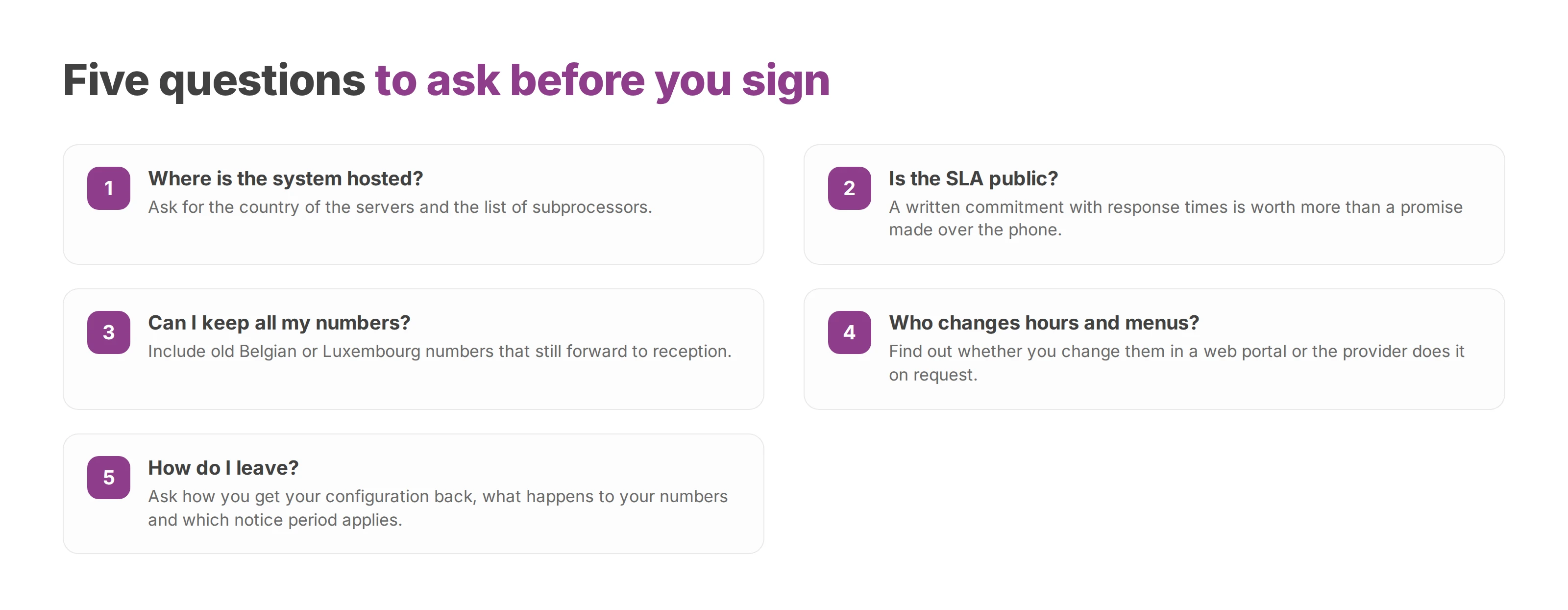
Where is the system hosted? Ask for the country of the servers and the list of subprocessors.
Is the SLA public? A written commitment with response times is worth more than a promise made over the phone.
Can I keep all my Belgian or Luxembourg numbers, including old ones that still forward to reception? Our guide to porting a business phone number explains the process.
Who changes the opening hours and the voice menu? You, in a web portal, or the provider, on request?
How do I leave if the service no longer suits me? Ask how you get your configuration back, what happens to your numbers and which notice period applies.
Our business phone system checklist goes further, with ten questions to put to every provider.
A PABX (private automatic branch exchange) is the traditional system, installed on your premises and connected to traditional phone lines. IP telephony carries calls over the internet. A business phone system can therefore be a PABX on site, an IP system on site, or a service a provider hosts in the cloud.
On Voxbi Managed you choose between per-minute billing and the unlimited-calls option at a fixed price per user. Voxbi Free includes €0.70 of call credit a month. Beyond that, calls are billed per minute.
Yes, with Voxbi Managed. Our team arranges the port with your current operator, and your numbers stay the same. Voxbi Free doesn't take an existing number.
Test your greeting before you decide: start the free trial, with 2 local test numbers in Belgium or Luxembourg. Would you rather our team set everything up? See Voxbi Managed on the pricing page or write to hello@voxbi.com.

Send a fax without a machine or an analogue line. Five steps, three ways to send, and the records to keep in case anyone disputes the fax later.
A practical guide to the call centre dashboard: the KPIs worth a place on screen, how to read the queue, live versus historical views, and the numbers that suit service firms, clinics and hotels.
A how-to for AI phone answering on your business number: start with after-hours and overflow calls, hand callers to a person, then run a short pilot.
Start a free trial, or work with a certified Voxbi partner.