Voicemail transcription converts a recorded voice message into readable text automatically. Spoke Phone, a vendor blog, publishes figures for France. It reports more than 4.9 million voicemail messages exchanged every day and 20% of calls diverted to voicemail, which it presents as close to 980,000 messages generated daily. At that volume, voicemail becomes an operational subject.
The cost sits in the delay. Reception, sales, support, bookings and administration all wait while somebody finds time to listen to a message, retypes the content and forwards it by email or an internal ticket. If you run IT for a mid-sized company, integrate telephony for clients or resell it, you're also answering a second question about where the audio, the text and the metadata are stored.
Voicemail transcription changes that workflow. Your teams read, sort, search and route the information instead of listening to every message end to end. The European version of the requirement goes further than ergonomics. A useful transcription is readable in the tools people already use, integrable with the phone platform, and hosted under a GDPR-compatible arrangement that treats data sovereignty as a first-order requirement.
What voicemail transcription is
Voicemail transcription is the automatic conversion of a voicemail recording into text, delivered where the person who needs it already works: the email client, the phone platform's web interface, a ticket or a customer record. The audio stays available. The text becomes the object people read, forward, file, search and act on.
Four questions decide whether the feature earns its place:
Fast reading. Can your team understand the message without replaying the audio every time?
Routing. Does the text land in the right queue, group or tool?
Traceability. Does the content stay consultable for follow-up or an internal audit?
Compliance. Do you know where the audio, the text and the metadata are stored?
For a small or mid-sized company the subject is productivity. For an integrator it's architecture as well. The value comes from the deployment around the recognition engine as much as from the engine itself.
How voicemail transcription technology works
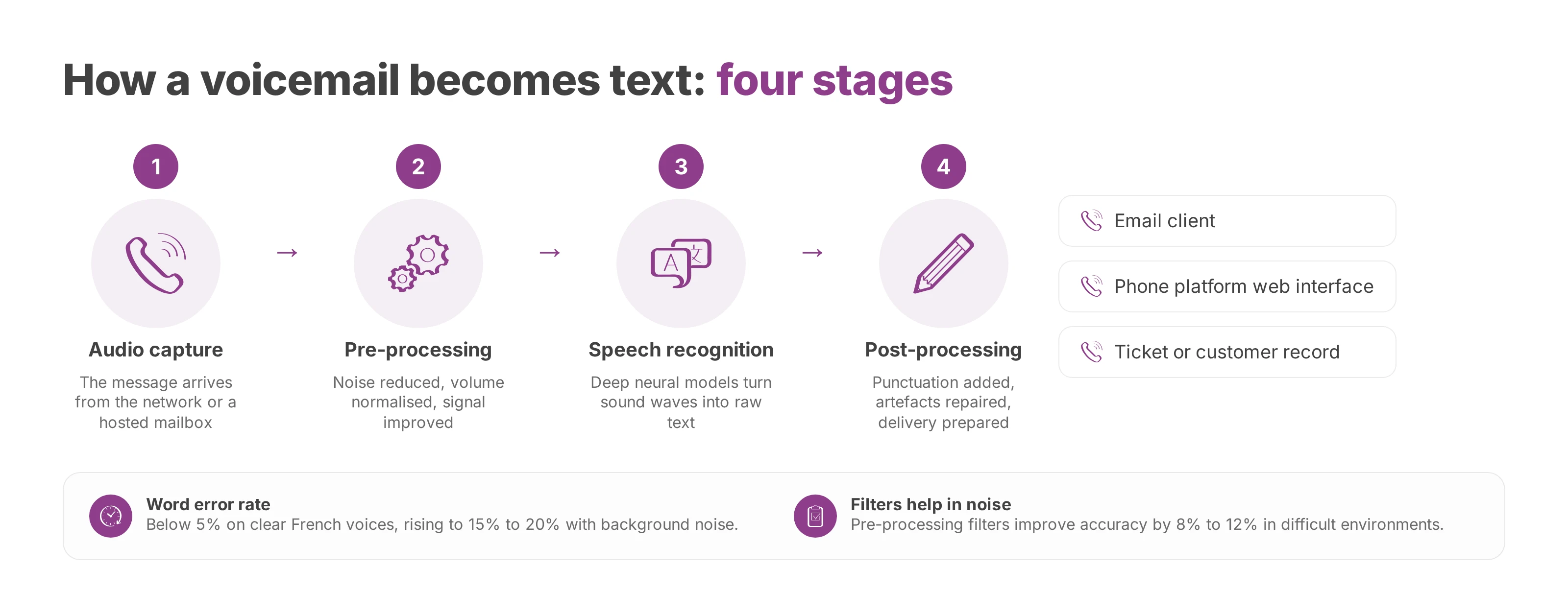
Automatic transcription runs as a sequence of processing steps. On the user side, a message arrives and text appears. Behind that, four stages each carry their own failure modes.
From audio signal to usable text
Audio capture comes first. The message arrives from the public telephone network, a hosted mailbox or a cloud PBX platform, and the file gets prepared before anything analyses it. For the network layer underneath, our explainer on the public switched telephone network covers where that audio originates.
Pre-processing follows. The system reduces noise, normalises volume and improves the signal where it can. This phase decides much of the final text quality, and it's the one most often skipped in a product demo.
Automatic speech recognition is the third stage. Current engines use deep neural models trained on language corpora. They analyse the sound waves, convert them into linguistic units and produce raw text.
Post-processing closes the sequence. It adds punctuation, repairs artefacts and prepares delivery into the telephony platform or a business application. This is also the point where a system pushes the transcription into a customer record or a reception queue, which is ordinary computer telephony integration work.
What degrades or improves accuracy
The technical indicator is word error rate, or WER. Lower is better, and it's the number to ask a supplier about. The French original reports that modern speech recognition for French reaches a word error rate below 5% on clear voices, rising to 15% to 20% with background noise, and that pre-processing filters improve accuracy by 8% to 12% in difficult environments. Those figures are attributed to an unnamed reference corpus, so read them as an order of magnitude.
Several factors move the result:
Treat a transcription as an aid to action. When the information is sensitive, keep access to the original audio.
The technology performs when the audio path, the engine choice and the integration are designed together.
Operational benefits for your business
The value of a transcription service shows up in daily operations. A team adopts the feature to process incoming information faster.
Gains visible in daily operations
Audio imposes linear listening. Text gets read, skimmed, forwarded and searched. That difference changes the working rhythm on the switchboard, at reception, in support and in a sales team.
The gains concentrate in five places:
Faster handling. Someone identifies the subject of a message immediately.
Better prioritisation. An urgent request separates from an administrative callback.
Simpler hand-off. The text goes to the right team without a second listen.
Usable archive. A written record supports follow-up, especially next to call history and call recording.
Accessibility. Some people would rather read a message quickly than play it in an open-plan office, a hall or on the move.
How text changes missed-call handling
In a well-integrated cloud PBX, transcription improves how you steer call traffic. Operations managers see what's arriving in the mailboxes, what's had no follow-up and what needs redistributing.
Text also makes voicemail compatible with modern working methods. Assignment, comments, export, keyword search and attachment to a customer file all become direct actions. For an integrator, that changes the internal argument for the project. The question becomes how to cut the time lost around missed calls while keeping a usable record.
Risks and constraints to control
A transcription deployment needs scoping before anyone switches it on. A loose one accumulates comprehension errors, compliance exposure and unrealistic user expectations.
Technical limits to accept
Human verification stays in the loop. Accuracy varies with accent, background noise, speech rate, network quality and the vocabulary in use.
AI transcription reaches 80% to 95% overall accuracy, with 99% on phone numbers and only 70% to 85% on names, according to figures published by GetNextPhone, a vendor blog. That split matters in practice. A booking reference, a patient name, a company name or a foreign surname has to be re-readable against the original recording.
In sensitive contexts, several guardrails are worth writing into the procedure:
Critical messages. Keep an audio listen available for sensitive requests.
Sector vocabulary. Test the service with the real words your teams use, not only with clean demo audio.
Language and accents. Check the behaviour on the language as it's actually spoken in your service area.
Internal procedure. Define who validates what before anyone acts on a key detail.
Legal and architecture requirements
A voicemail recording usually carries an identity, a number and a reason for calling, sometimes health information or a contractual commitment. The transcription adds a second layer of data to protect.
For a European buyer, the questions to put to a supplier are precise:
Data sovereignty covers more than a server location. Processing, backups, logs and integration paths belong in the same review.
Stay precise about the regulation too. A service can be designed to support GDPR work and to prepare a company for European rules on artificial intelligence. Treating compliance with the European Union AI Act as automatically acquired would be imprudent without an analysis of the supplier, the use case and the processing path.
Voicemail transcription use cases by sector
Sector reality shows the relevance better than a datasheet does. A clinic, a hotel and a multi-site organisation share the technical base and diverge fast on operational criteria.
Healthcare
In a healthcare organisation, many messages carry no clinical urgency and still demand reliable traceability. Callback requests, appointment changes, logistics coordination and administrative questions still arrive through the mailbox.
Hosting is the non-negotiable point. The French original reports that 74% of French healthcare companies require recordings and transcriptions to be hosted in the European Union. Its citation for that figure points to a Level365 support article on enabling voicemail transcription rather than to a regulator's publication. Either way, data sovereignty sits at the centre of the technology choice here.
Transcription earns its place in this setting when the route is explicit. The message stays visible, goes to the right department and remains under controlled retention rules.
Hospitality
A hotel voicemail can hold a booking request, a late arrival time, a specific need or an instruction for the front desk. Service quality drops the moment the team finds the message too late.
Transcription changes the sequence. Reception reads the request, then assigns it to the booking, to housekeeping or to the department concerned. Recorded greetings do complementary work here, because a clear structure for your business voice message improves what the caller leaves on the mailbox in the first place.
Multi-site organisations
Across several sites, the message lands at one location and the action belongs to another. An integrated transcription makes that routing readable. Three uses carry most of the benefit:
Centralisation. Voicemail messages group into one shared view.
Distribution. The text is redirected to the competent local team.
Follow-up. Managers keep a written record of what's handled and what's still waiting.
The benefit includes time saved and goes further than that. A message stops sitting in one individual mailbox with no visibility for the rest of the organisation.
Integrating transcription into a European cloud PBX
A successful integration connects the mailbox, the transcription, the users, the access rights, the logs and the business applications into one coherent architecture.
Integration points that matter
Two models dominate in a cloud PBX environment. Transcription is native to the platform, or it arrives through an application programming interface or a connector. Both work, and they imply different governance.
A sound integration handles five things at minimum:
Triggering. Which event starts the transcription when a new message lands?
Storage. Where do the audio, the text and the associated metadata reside?
Rights. Who can read the transcription, play the original audio or export the data?
Business routing. Does the message create a task, a notification, a ticket or a customer-record action?
Supervision. Can IT audit the processing and diagnose a failed job?
Technical teams replacing a legacy on-premise exchange usually make the European cloud PBX the convergence point. It centralises telephony, exposes integration interfaces and removes scattered workarounds. That logic is visible in cloud PBX platforms designed for Europe.
The role of European hosting
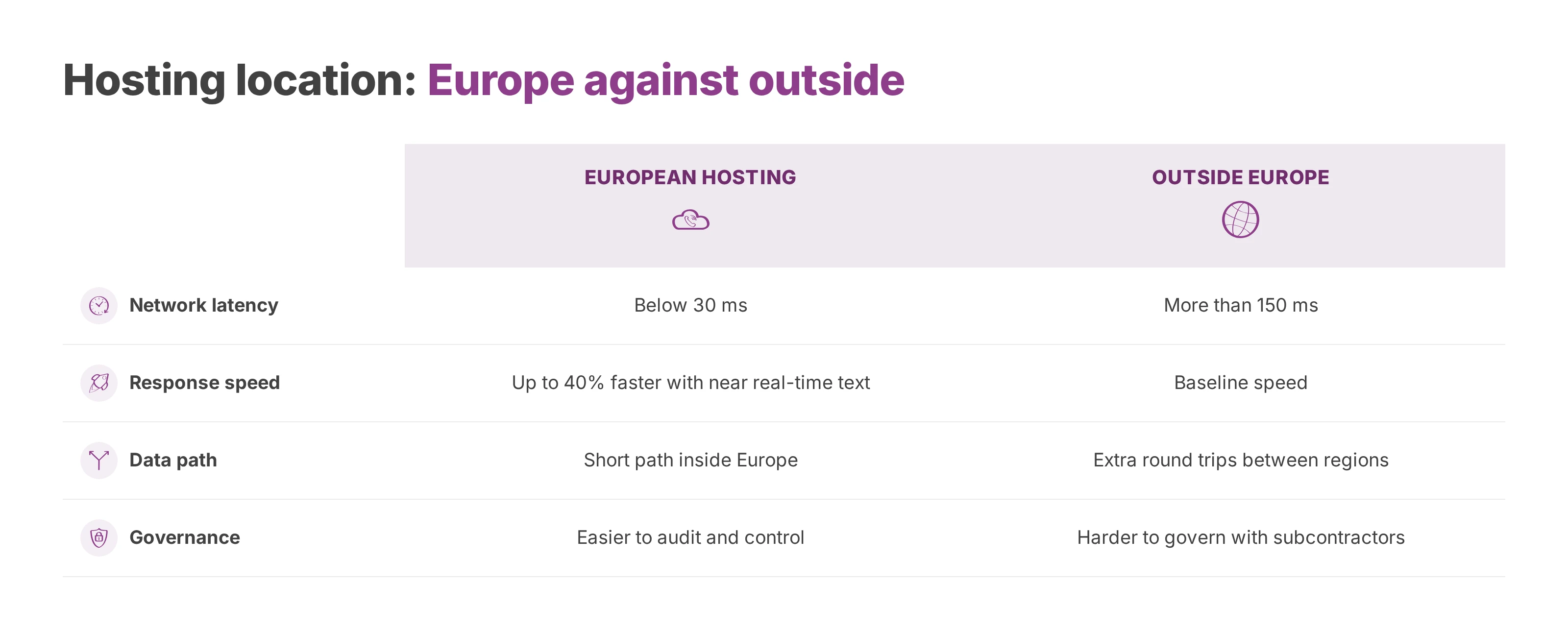
Hosting location affects compliance and performance together. The French original reports that cloud services hosted in European data centres guarantee network latency below 30 ms, against more than 150 ms for services outside the European Union, and that this can improve customer service response speed by 40% when teams work with near real-time transcriptions. Both claims come from the same unnamed reference corpus.
The practical effect is about keeping the path short. When a transcription feeds a reception queue, a booking desk, a clinic or a customer support team, every extra round trip between regions and subcontractors slows the operation and makes it harder to govern.
A solid deployment usually follows this order:
Map the data paths between audio, transcription and target applications.
Validate European hosting for content and for metadata.
Set the access rules by role, site or team.
Test real scenarios with accents, noise and long messages.
Document the governance for operations, audit and support.
The right technical choice is rarely the most spectacular one. It reduces operational friction while keeping control of the processing.
Choosing your voicemail transcription solution
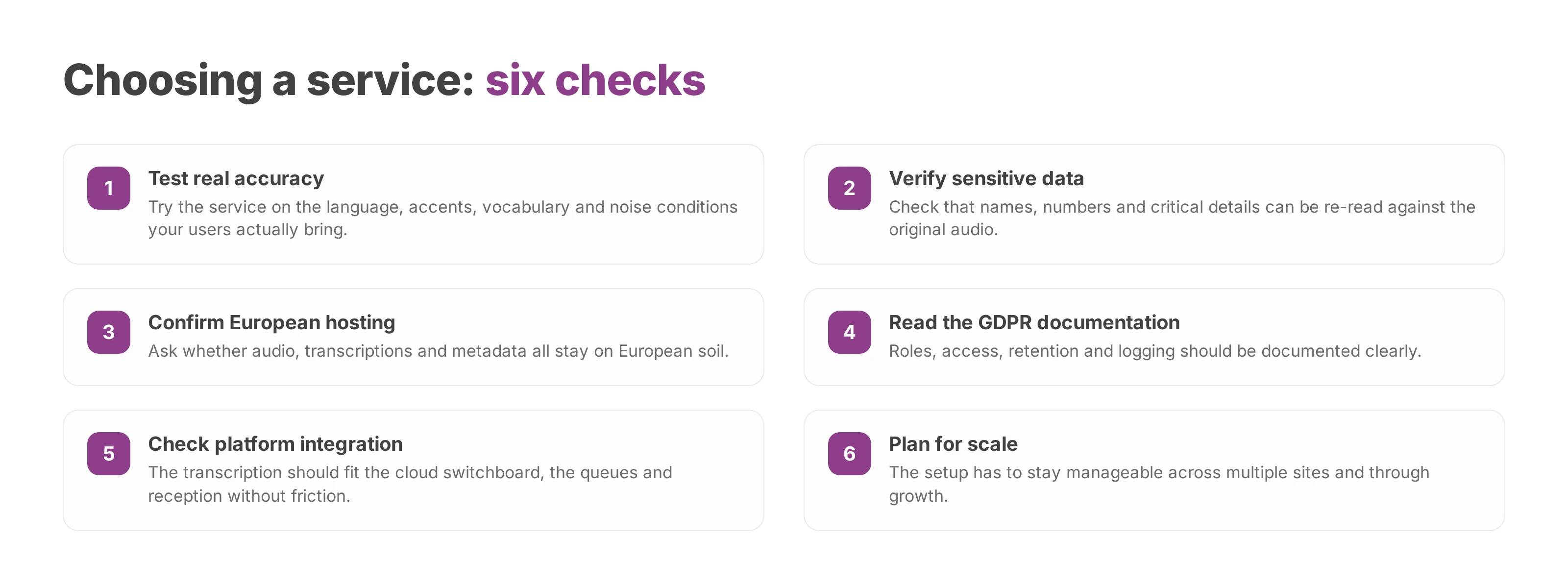
The right choice balances transcription quality, telephony integration, security and data governance in one decision. For an IT director, an integrator or a reseller, the most useful evaluation grid stays short.
Decision checklist
Real accuracy. Is the service tested on the language your users actually speak, with their accents, their vocabulary and their noise conditions?
Sensitive-data verification. Can names, numbers and critical details be re-read easily, with access to the original audio?
European hosting. Does the supplier guarantee that audio, transcriptions and metadata stay on European soil?
GDPR documentation. Are roles, access, retention and logging documented clearly?
Platform integration. Does the transcription fit the cloud switchboard, the queues, reception and internal workflows without friction?
Usability. Can your teams read, forward, search and process messages without adding more tools?
Scalability. Does the setup stay manageable across multiple sites or through growth?
When those criteria hold, voicemail stops being a blind spot. It becomes structured, traceable information that the whole company can work with.
Voxbi runs a European cloud PBX for companies that want to modernise telephony without moving their data outside the European Union. In Voxbi Cockpit you configure the mailboxes, the queues and the greetings behind all of this, and Mixvoip supplies the numbers underneath. Send your transcription requirements to hello@voxbi.com and ask which options apply to your setup.