
Inbound vs outbound calls: the difference and how to manage both
An inbound call reaches your organisation and an outbound call leaves it. Here's how to route, measure and govern each one, and keep your numbers when you migrate.
Oct 24, 2026
How a hotel phone system routes reservation, room and maintenance calls, connects to your PMS, and helps you stay secure and meet the GDPR across one site or many.

A hotel phone system carries reservations, room requests, wake-up calls and maintenance alerts, so it sits close to the centre of how a property runs. This guide is for hotel owners, and for the IT teams behind hotel groups, who are choosing a system in 2026.
It is Friday evening in high season. Reception is checking guests in, two rooms have asked for a late checkout, and the phone keeps ringing. One caller wants to change a booking. Another asks for a pickup from the station. Maintenance is waiting for someone to pass on a fault report. If the switchboard sends those calls to the wrong desk, the hotel loses time, and it can lose bookings and expose guest data as well.
A hotel phone system is the private branch exchange (PBX) that connects guest rooms, the front desk and back-of-house teams to each other and to outside callers. It routes each call by department, time of day and priority. Give each room phone an extension that matches its room number, so a call from room 214 shows up at reception as 214.
With a cloud PBX, the switching happens in a data centre, while the hotel keeps its desk phones, DECT handsets and staff apps on site. You manage the whole set-up from a web console.
Tourist accommodation in the European Union recorded 3.1 billion nights in 2025, up from 3.0 billion in 2024, according to Eurostat. That count covers all tourist accommodation, not only hotels. Hotels themselves range from family-run inns to international groups, and a phone system has to work for all of them.
Hotel teams rarely work in one place. Reception takes bookings, housekeeping reports room status, maintenance handles urgent faults, and a manager may oversee several sites. An old PBX in a back room often can't route calls by department, schedule or priority.
Rule of thumb: a reservation call should reach someone who can sell or change a stay, even when reception is busy with arrivals.
The phone still brings in bookings. In a Harris Interactive survey of 2,000 French adults, run in 2013 for Booking.com and Euros Agency, 39% said they book by calling the hotel directly, and 83% used online channels to look up a place to stay. So the voice line sits next to the website and the booking platforms. A caller with an unusual request gets an answer, and the hotel gets a chance to turn that enquiry into a booking.
Older equipment adds pressure of its own. If your hotel still runs analogue lines, check the lines, the equipment and your fallback scenarios before you move. Our explainer on the public switched telephone network covers which equipment still depends on it.
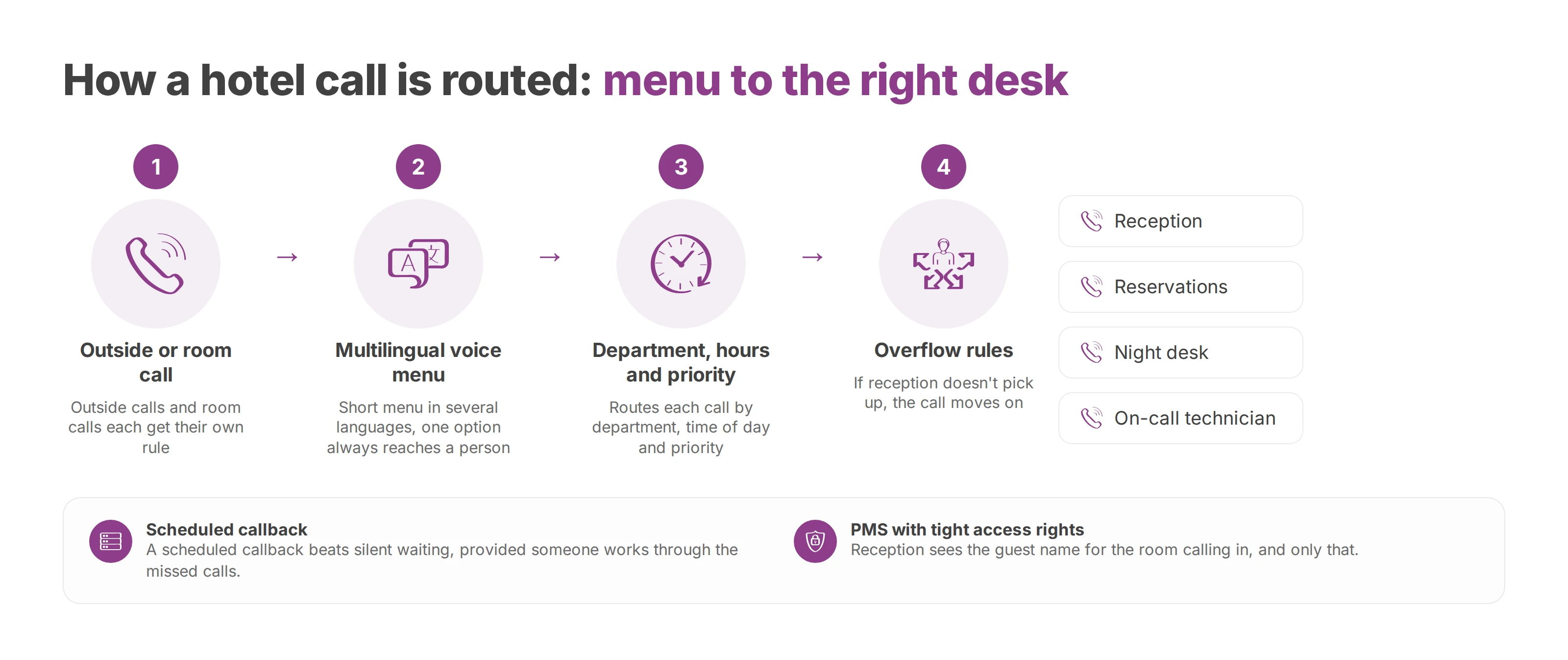
Your switchboard answers for several teams at once. Reception, reservations, the restaurant, room service, housekeeping and maintenance keep different hours and priorities. The system should tell an outside call from a room call and apply the right rule to each.
An interactive voice response (IVR) menu in several languages can send callers to reservations, reception or the night desk. Keep it short: a long menu moves the frustration around without solving anything. Recorded messages can handle the routine questions about breakfast times, directions and parking, as long as one option always reaches a person. The menu design principles are the same as for any cloud IVR.
Set overflow rules for every queue. When reception doesn't pick up, the call can move to the reservations team, an on-call number or a dedicated queue. A scheduled callback beats silent waiting, provided someone works through the missed calls afterwards.
Staff should be able to schedule, confirm and monitor wake-up calls. Make sure someone can see whether each call went through and step in when one fails. Our page on wake-up calls shows how the feature works. Housekeeping and maintenance calls follow their own groups and schedules. A fault reported at night then reaches the on-call technician.
The property management system (PMS) gives the phone useful context. Room numbers map to internal extensions, and room status can drive some call workflows. Set access rights so that each user sees only the data their job requires. Reception should see the guest name for the room calling in, with no reason to browse call history for the whole property.
A good integration doesn't show reception more data. It shows the right data at the right moment.
A traditional PBX can still suit a small property whose needs rarely change. It gets slow once a group adds a site, changes its hours or reworks its queues, because each change means a technician on site. A cloud PBX makes those changes from one interface.
A cloud PBX takes the phone service off the hardware in your back office. You still have to look after your network (bandwidth, quality of service and a backup connection). The routing rules live in one place, though, and every site picks them up.
For a group with several properties, consistency comes first. Admins set users, groups, queues, opening hours and calendars from one console. Changing the night on-call number should take a minute and no site visit.
Plan for group-wide policies and local quirks from the start. A city hotel's reception keeps different hours from a seasonal resort's. Give each site manager control of their own property within set limits, and let central IT keep the overview.
Hotel staff move between reception, the guest floors and the service areas. A softphone in the browser or on Windows, iOS or Android works well next to the desk phones. Treat it as an extra channel, never the only one: battery life, Wi-Fi coverage and staff habits all decide whether a mobile app rings when it should. Regional managers, back-office staff and on-call technicians get the most out of it.
A good migration starts from the call flows, not from a feature list. Map who answers each type of call, at which hours and with what priority. The cloud platform then applies those rules.
Fix the organisation before you move: a confusing voice menu stays confusing in the cloud, and a PMS integration with loose permissions adds risk. When you compare cloud PBX providers, ask how each one handles day-to-day admin, security and getting your data out if you leave.
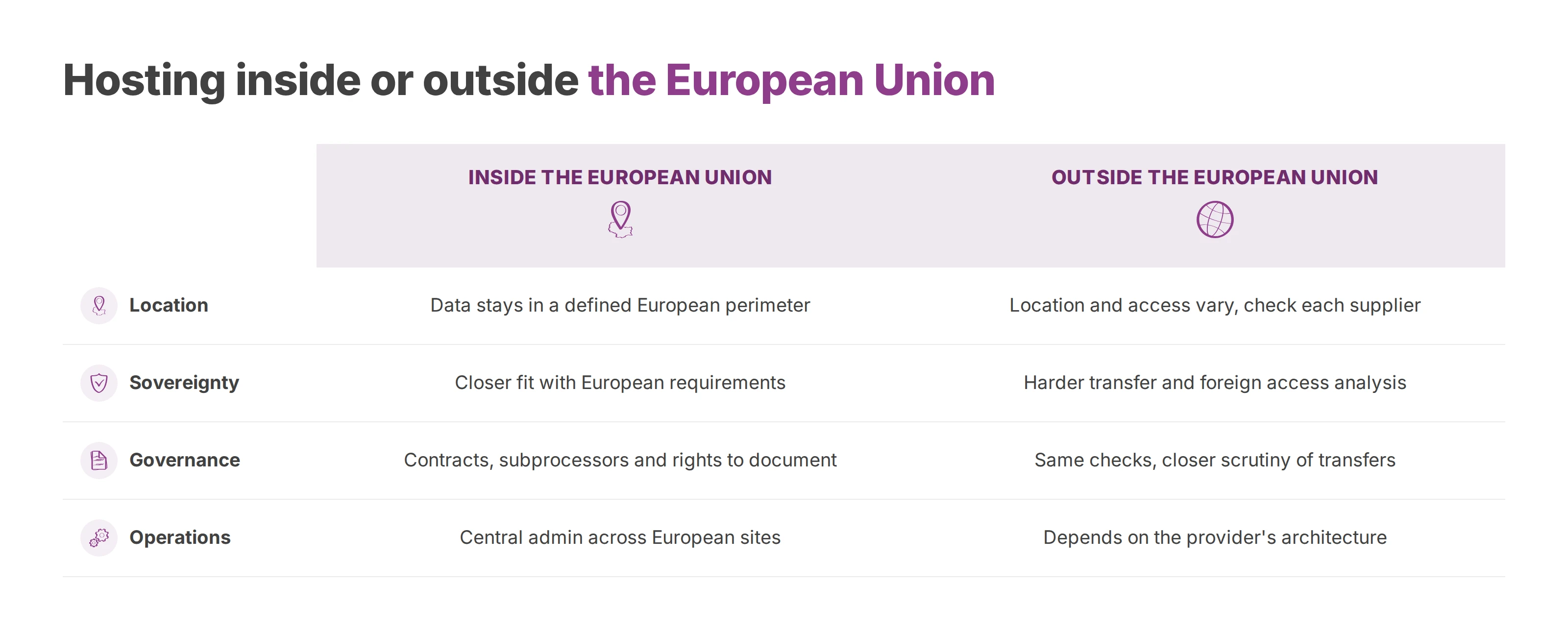
A telephony platform processes call metadata, logs and user accounts, and it may also hold recordings and details tied to a guest's stay. Where the servers sit matters, and so do the subprocessors, admin access, data transfers and retention periods.
Hosting in the European Union leaves your compliance team fewer questions about data transfers to answer. You still have to document the lawful basis, what guests are told and the security measures for each use of the data.
| Criterion | Inside the European Union | Outside the European Union |
|---|---|---|
| Location | Data stays within a defined European perimeter | Location and access vary by supplier, so check each one |
| Sovereignty | Closer fit with European requirements, depending on the processing | Harder analysis of transfers and foreign access requests |
| Governance | Contracts, subprocessors and rights to document | The same checks, with closer scrutiny of transfers |
| Operations | Central admin across European sites | Depends on the provider's architecture and commitments |
A clean port starts with an inventory of published numbers, grouped lines and the details your current operator holds. Build in a validation window for inbound calls, outbound calls, transfers and emergency numbers. Porting rules and deadlines differ from country to country. Our guide to porting a business phone number walks through the sequence.
Keeping data in Europe only pays off if guests can still reach the hotel and staff keep their access throughout the switch.
Your switchboard is part of your attack surface. Treat admin accounts, reception phones, mobile apps, PMS integrations and recordings as parts of your IT system. Hosting in the European Union helps, but compliance still comes from how you configure and run the system.
The sector is exposed. Among small and medium-sized French businesses in accommodation and food service, 34% have already had a cybersecurity incident, yet only 27% use multi-factor authentication, according to the France Num 2025 barometer. That gap matters on a phone system. One compromised admin account can rewrite a voice menu, divert a queue, read call logs or switch on recording.
| Control | What to verify |
|---|---|
| Multi-factor authentication | Enabled for admins and every privileged account |
| Roles | Admin, supervision, reception and report access kept separate |
| Encryption | SIP over TLS and secured WebRTC wherever those channels are used |
| Logs | Limited access, a record of who opened what, a set retention period |
| Recordings | Purpose, notice, lawful basis and deletion procedure on file |
| Leavers | Fast revocation for seasonal staff and contractors |
Take stock of your call data. Logs can hold numbers, times, destinations and staff details, and recordings add voice content that may be sensitive. Your policy should say what is kept, why, for how long and who can open it. Our article on call recording and the GDPR covers notice and retention in detail.
AI can help qualify requests, route calls or answer repetitive questions. For each use, decide what data goes to the service, whether it trains models, where it is processed and how guests are told.
To prepare for the EU AI Act, your IT team should ask the supplier for its documentation, review the subprocessors and fold the controls into your existing governance. Weigh any automated feature against the data it exposes: a lighter load at reception can come with a wider risk.
You measure the return on a hotel phone system in protected bookings, calls answered at peak times, less time on repetitive tasks and cleaner handovers between departments.
Guest habits back this up, in figures compiled by Bowo. In Oracle Hospitality's 2022 data, 65% of French travellers and 73% of international travellers want to use their phone for parts of their stay, such as check-in, checkout, payments and orders. And 53% of hotel guests are annoyed by time lost at check-in or checkout (Coach Omnium, 2018). So keep the room phone when you add an app: offer guests several routes, with voice as the fallback.
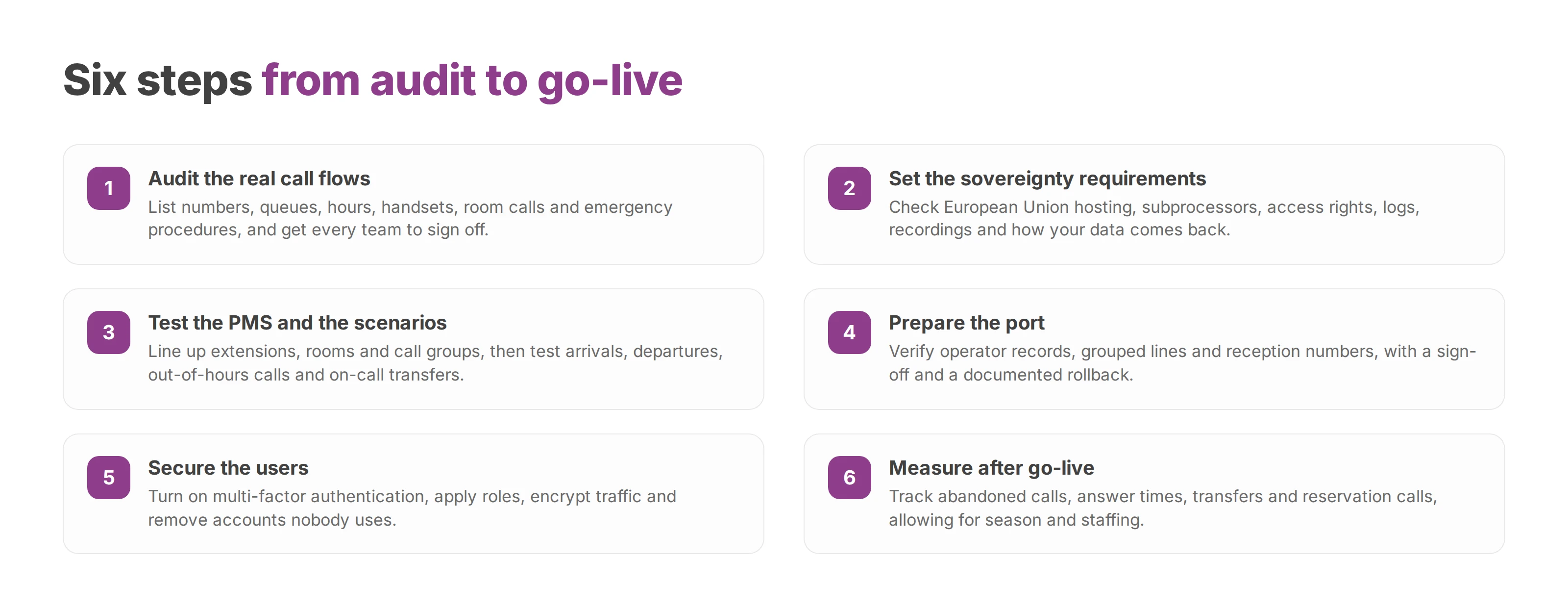
Audit the real call flows. List the published numbers, queues, hours, handsets, room calls and emergency procedures. Reception, housekeeping, maintenance and reservations should each sign off on the map.
Set the sovereignty requirements. Check European Union hosting, subprocessors, access rights, logs, recordings and backups. Make sure the contract says how your data comes back to you when you leave.
Test the PMS and the scenarios. Check that extensions, rooms, call groups and statuses line up. Include arrivals, departures, out-of-hours calls and transfers to the on-call number in your tests.
Prepare the port. Verify the operator records, grouped lines and reception numbers. Plan a sign-off before cut-over and a documented rollback.
Secure the users. Turn on multi-factor authentication, apply roles, encrypt traffic and remove accounts nobody uses. Train staff on suspicious calls and the recording rules.
Measure after go-live. Track abandoned calls, answer times, transfers, callback requests, reservation calls and service incidents. Compare them with earlier periods, and remember that some of the change will come from the season or staffing, not the platform.
Put costs and observed results side by side. Costs cover subscriptions, the handsets you keep, PMS integration, porting, training and support. Benefits can come from recovering more reservation calls, shorter handling times and simpler admin across sites. A group should also count the value of standard rules and fewer local call-outs.
Voxbi is a cloud PBX built and hosted in the European Union, so your calls and data stay within European Union borders. On Voxbi Managed, our team sets the system up and runs it, and you get phone support and an uptime guarantee.
Wake-up calls and emergency routing are Voxbi Managed features, on the Business and Enterprise plans. Business costs €11.20 per user a month with calls billed per minute, and a shared phone with no fixed user, such as the reception desk phone, costs €5.70 a month on Business.
Voxbi One is the self-service line. Its Voxbi Channel plan charges per concurrent call instead of per user, which suits a property with more phones than people: €14.50 per channel a month, with a minimum of 3 channels. On Voxbi One a phone number costs €2.00 a month, available in Germany, France and Switzerland. Voxbi Managed covers more countries today. Talk to us for the price of a number there. All prices exclude VAT. To map your call flows and plan the move, write to hello@voxbi.com or see the pricing page.
An inbound call reaches your organisation and an outbound call leaves it. Here's how to route, measure and govern each one, and keep your numbers when you migrate.
What the GDPR asks of a business that records calls. It covers the lawful basis, notice before recording starts, fixed retention, tight access and the national rules to check.

Click to call turns a tap on a phone number into a routed call. See how it works from the click to the SIP INVITE, where it helps and what GDPR asks.
Start a free trial, or work with a certified Voxbi partner.