
Suspected spam: what the label means for your calls
Suspected spam means a filter has scored a number as probably unwanted. How that score is built, what it costs outbound calling, and how to clear a false positive.

Suspected spam means a filtering system has scored a phone number or a message as probably unwanted. The warning reports a probability. It's built from user reports, calling patterns and behavioural signals, each of which carries a margin of error, so a legitimate business number can pick up the same label.
If you run telephony for a contact centre, a healthcare provider or a public-sector team, the expensive half of this problem points outward. Your agents call patients, residents and customers, answer rates slip, and some handsets show a warning before anyone picks up. Reachability decays for weeks before anything looks like an outage in monitoring.
What suspected spam means
A handset or a carrier shows suspected spam when the calling number has lost standing in a reputation system. The score behind that display builds from three kinds of input: how often recipients have marked the number, how its calling pattern compares with known nuisance campaigns, and how carriers and filtering apps have consolidated those reports.
The score moves gradually, so the display arrives late. By the time a warning appears on a screen, the number has usually been drifting downward for a while. The call itself still connects, and the person holding the phone declines it.
Why legitimate business numbers get flagged
A clinic confirming appointments, a council chasing an open file and a contact centre returning a quote request all produce the same shape of traffic. One presentation number places repeated outbound calls to people who haven't asked to be called that day. Filters read volume, cadence and recipient reaction, and from the outside that traffic resembles a canvassing campaign.
Impersonation makes it worse. When somebody spoofs your number for their own campaign, the reports land against your reputation, and you'll see the warning without having placed a single call.
The layer to inspect first is the number's reputation score. In a cloud PBX, the levers sit in routing, in number presentation and in outbound policy. A shared DDI number that serves several teams spreads one damaged reputation across all of them, and campaigns handed to an outsourced contact centre do the same whenever nobody has set the dialling rules.
Nuisance calling, voice spam and SMS spam
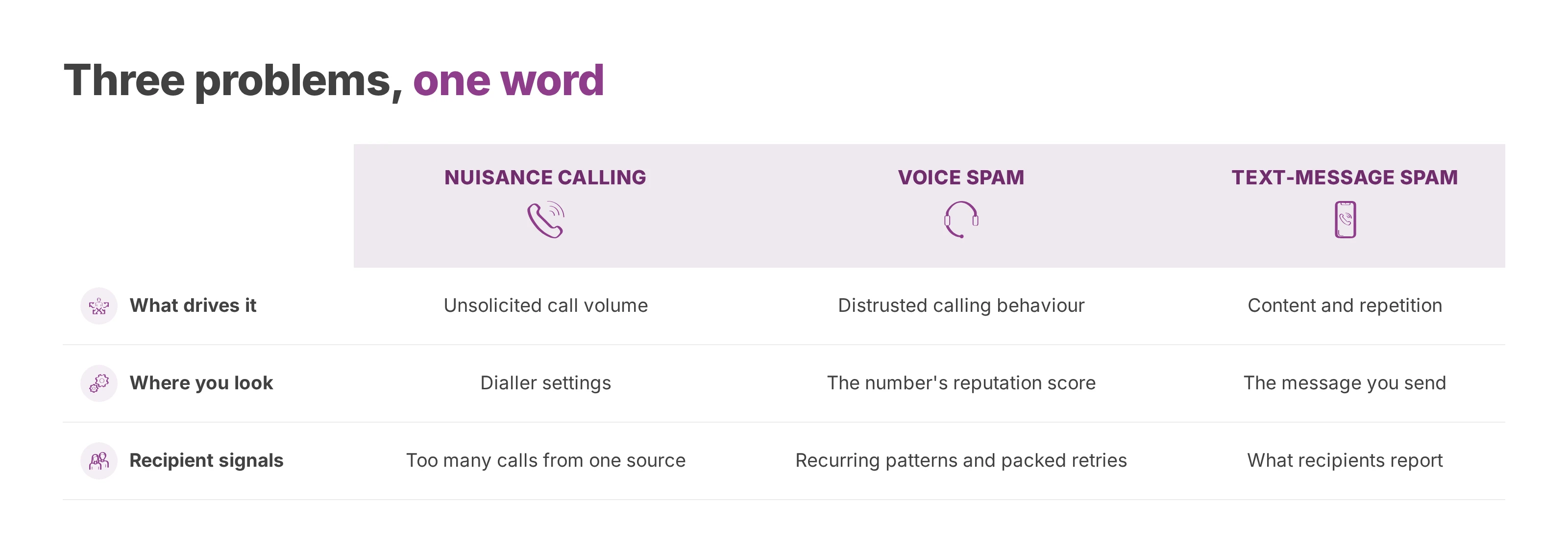
Three different problems hide under one word. Nuisance calling is a volume problem: too many unsolicited commercial calls from one source. Voice spam attaches to numbers whose calling behaviour matches patterns the filters already distrust. Text-message spam turns mostly on content, on repetition and on what recipients report. The technical definition covers unsolicited bulk communication sent for advertising and sometimes for fraud, as Proofpoint's spam reference sets out.
The split decides where you look. A cadence problem shows in dialler settings. A content problem shows in the message you send. A reputation problem shows in the score attached to the number, and it survives changes to both of the others.
How carriers and handsets detect spam calls
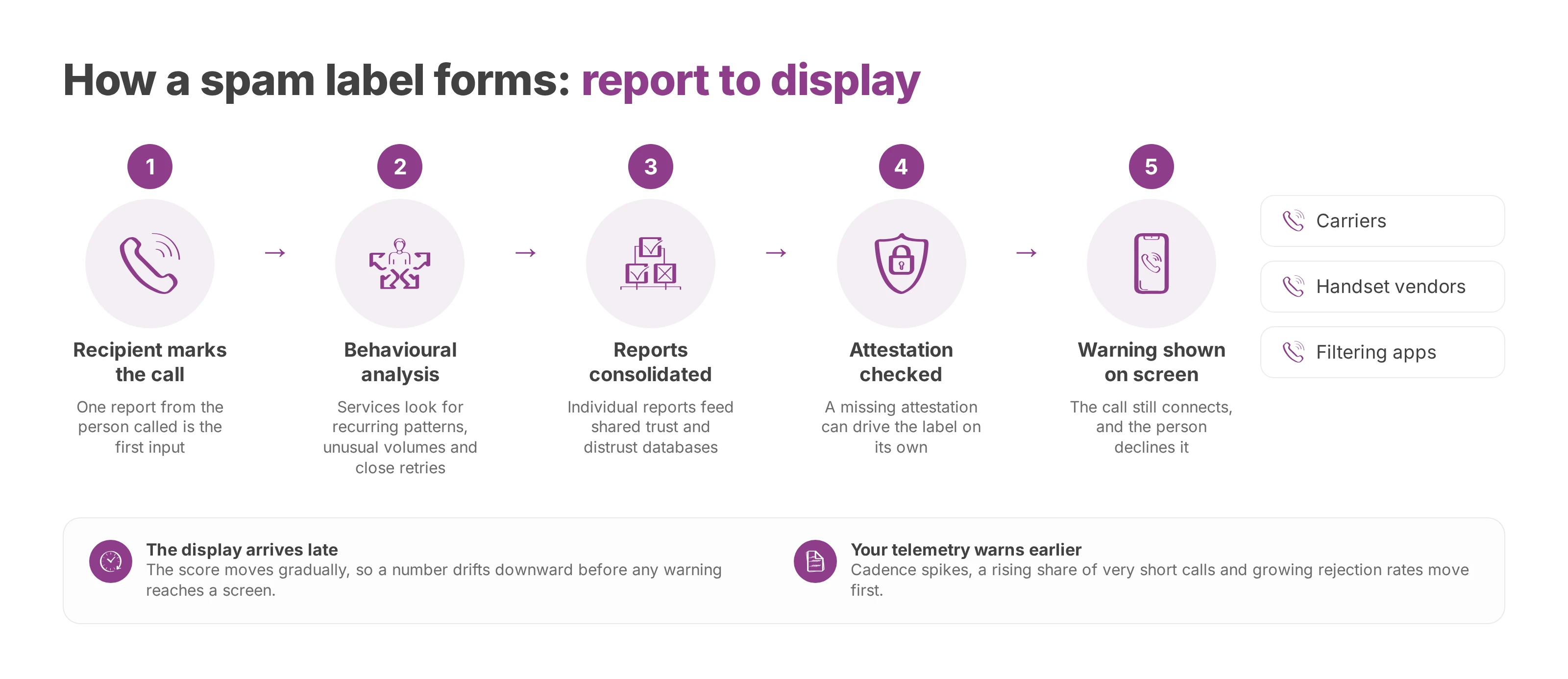
A recipient marks a call as unwanted, and that report is the first input. Behavioural analysis is the second: services look for recurring patterns, unusual volumes and retries packed too closely together. Consolidation is the third step. Individual reports stop being isolated and feed shared trust and distrust databases that carriers, handset vendors and filtering apps read.
Caller authentication feeds the same score in English-speaking markets, and it weighs heavily there. Where a carrier can't attest that the calling party has the right to present the number, that missing attestation drives the label on its own. Standards such as STIR/SHAKEN exist to carry the attestation across networks.
Public reporting schemes pour into the same pool. France runs the 33700 shortcode for abusive text messages, while English-speaking markets spread reporting across regulators, carriers and handset apps instead of one shared number. Either way, an end-user report doesn't stay with the user who made it.
Your own outbound telemetry gives the earlier warning. Cadence spikes, a rising share of very short calls and growing rejection rates all move before any label reaches a screen.
What the label costs your daily operations
Answer rates fall first, and the drop is easy to misread as list quality. Recipients who do see the warning hang up within a second. The team then spends its hours on second and third attempts, on list checks and on explaining the warning to people who call back to ask about it.
Contact centres feel it in connect rate. Healthcare providers lose the confirmation and follow-up calls that hold a schedule together. Public-sector teams find that residents stop recognising them, especially when several departments call from different lines at different hours.
Multisite organisations carry the largest exposure, because many uses share one telephone identity. The number's standing then behaves like an operating asset: it decides whether first contact happens at all. The indicators worth a dashboard are reachability per number, end-user feedback, rejection rate, and any internal line that starts showing a warning.
Fixing false positives and restoring number reputation
Diagnosis starts with the source of the marking. A handset app, a carrier filter and a shared reputation service can each produce the same on-screen warning from different data, and each has its own correction route. Teams that skip this step rewrite call scripts while the score stays exactly where it was.
Then examine how the number gets used. Repeated waves, stale lists and frequent retries produce the profile of an unsolicited campaign whatever the intent behind them.
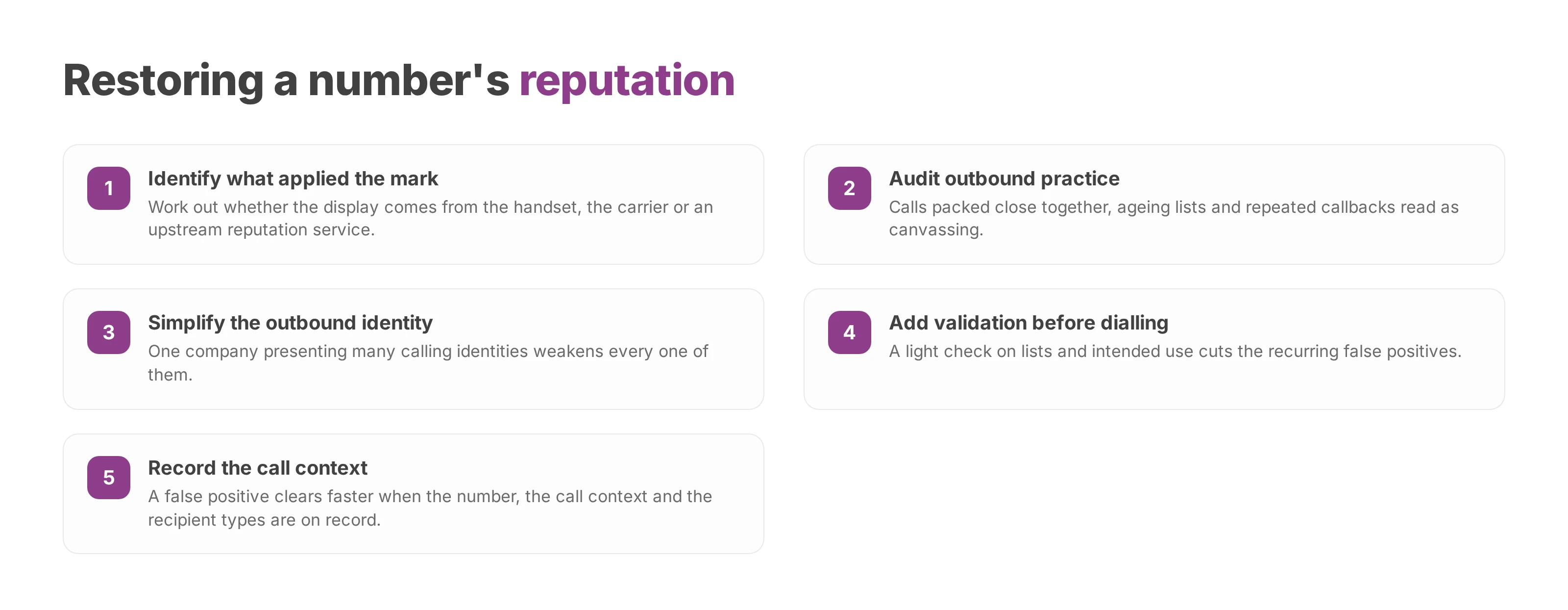
Identify what applied the mark. Work out whether the display comes from the handset, the carrier or an upstream reputation service.
Audit outbound practice. Calls packed close together, ageing lists and repeated callbacks read as canvassing.
Simplify the outbound identity. One company presenting many calling identities weakens every one of them.
Add validation before dialling. A light check on lists and intended use cuts the recurring false positives.
Field rule. A predictable, documented outbound policy that respects the person receiving the call is the strongest defence against a suspected spam label.
A false positive clears faster when the number, the call context and the recipient types are on record. Without those records the diagnosis stays guesswork, and a carrier review has nothing to act on.
Some marks lift after a carrier review or a configuration fix. Others point at the design, such as campaigns spread across providers with no shared rule. Consolidating the outbound model removes the cause.
Prevention for European businesses
Prevention rests on outbound hygiene. Contact lists stay current, campaigns respect consent, and dialling avoids the bursts that look like canvassing. Across a cloud estate that means one written rule set for every site. Caller authentication adds a first line of defence where it's available, and it works alongside the hygiene rather than replacing it.
European businesses gain from hosting, data and call logs handled under one coherent set of GDPR obligations. Voxbi runs as a European cloud PBX, and Mixvoip supplies the numbers and the carrier relationship. Sovereignty shows up in the architecture, the data centres and the access governance.
Artificial intelligence helps analyse calling patterns and assist agents, and it remains a feature of the platform. Obligations under the EU AI Act depend on the deployment and the use, so each rollout needs its own assessment.
Documenting the outbound design
Integrators get the most value from writing three things down at design time. Which numbers reach which audience. Which queues, departments and services share a presentation number. What process corrects a suspected spam mark once it appears.
Cloud telephony centralises those rules, records the events and narrows the drift between sites. In healthcare, public-sector and multi-branch estates that visibility is worth more than extra lines. Making one number legible to the systems that score it beats holding five that nobody can account for.
Number reputation as an operational asset
Harder blocking helps with inbound spam and stops there. Durable protection covers communication quality, a consistent outbound identity and transparent use, because those are the inputs the scoring systems actually read.
Recipients need to recognise the number, understand the reason for the call and sense a person rather than a machine at scale. Legitimate calls that fail those tests lose their effect at the first filter, and no script recovers it.
Working with European technology partners lets you align telephony, compliance, data governance and daily operations under one set of rules. Filters keep getting more sensitive, so teams that standardise their numbers hold on to the voice channel while teams that improvise lose it.
Voxbi gives European businesses a European cloud PBX with centralised rules and traceable call events, which is the base an IT team needs to govern its numbers. If your outbound calls are collecting warnings, map which numbers reach which audience and write down what each one is for. Reach us at hello@voxbi.com.