
Best cloud PBX for Odoo users in 2026
Which cloud PBX providers actually integrate with Odoo, how each one connects, what the integration costs and where call recordings are stored.
Sep 14, 2026
The ten cloud PBX providers worth shortlisting in Europe in 2026, compared on price, hosting country, support and what the entry plan includes.

We build Voxbi, a cloud phone system, at Mixvoip in Luxembourg. Customers ask us the same question every week: who else should we be looking at, and what does this really cost? So we did the work properly and wrote it down, competitors included.
Every price in this article was read from the provider's own website or price list on 9 September 2026. Where a provider publishes no price, we say so rather than guess.
How we chose, and the obvious conflict of interest
We are one of the ten. There is no way around that, so instead we made the bias easy to check. We used the same template for every provider, we list what our own entry plan leaves out, and we publish a section at the end naming every fact we could not verify, ours included.
Selection rule. Headquartered in Europe, including the UK and Switzerland. Selling a cloud phone system to businesses as a product, not as a one-off integration project. Enough public information to write a profile. That excludes US platforms such as RingCentral, 8x8, Zoom Phone and Dialpad. They are good products. They are not European companies.
The order is not a ranking. The ten sit in two groups, alphabetical inside each. A league table published by one of the ten would not be worth your time.
If you are trying to work out whether you are late to this, here is the short version.
Nobody can tell you what share of European businesses use a cloud phone system. We looked hard. Eurostat runs the survey everyone quotes, and it splits cloud services into ten categories: email, office software, file storage, security, accounting, database hosting, ERP, computing platforms, CRM and development platforms. Telephony is not one of them. So any article claiming "68% of European businesses have moved to cloud telephony" is quoting a paid analyst report, a marketing team, or nothing at all. We are not going to add another invented number to that pile.
What the official data does tell you is useful anyway.
Table 1. Enterprises buying paid cloud services in the EU, 2025
| Company size | Share buying paid cloud services |
| 10 to 49 staff | 49.3% |
| 50 to 249 staff | 66.8% |
| 250 staff and above | 84.7% |
| All firms with 10 or more staff | 52.7% |
Source: Eurostat, isoc_cicce_use, 2025 data published February 2026. Cloud services in general, not telephony.
Three practical readings of that.
You are probably not late, and you are probably not early either. Just over half of European firms with ten or more staff buy paid cloud services of some kind. Telephony tends to be one of the last things to move, because the old phone system still works and nobody wants to touch it.
Size predicts this more than country does. A large company is 35 points more likely to buy cloud than a small one. If you are a small firm still on an old box, you are in the majority, not the minority.
There are a lot of firms in your position. Eurostat counts 33.5 million enterprises in the EU, and 33.2 million of them, 99%, have fewer than 50 staff.
Table 2. Paid cloud services by country, firms with 10 or more staff, 2025
| Country | 10 to 49 | 50 to 249 | 250+ | All 10+ |
| Netherlands | 64.5% | 82.5% | 90.8% | 68.5% |
| Belgium | 57.1% | 77.7% | 93.5% | 61.6% |
| Germany | 50.7% | 65.2% | 85.6% | 53.9% |
| EU27 average | 49.3% | 66.8% | 84.7% | 52.7% |
| Luxembourg | 44.7% | 57.3% | 71.0% | 47.7% |
| France | 35.8% | 62.7% | 84.7% | 40.4% |
One more figure worth knowing before you shortlist. Frost & Sullivan estimates Europe had about 49.1 million business cloud telephony seats in 2024, heading for 78.5 million by 2030, and puts the top five providers at just 35% of the installed base. That is an analyst estimate rather than an official statistic, and we flag it as one. But the fragmentation is real, and it is why a shortlist of ten is a genuine shortlist. There is no European default vendor the way there is in email or office software.
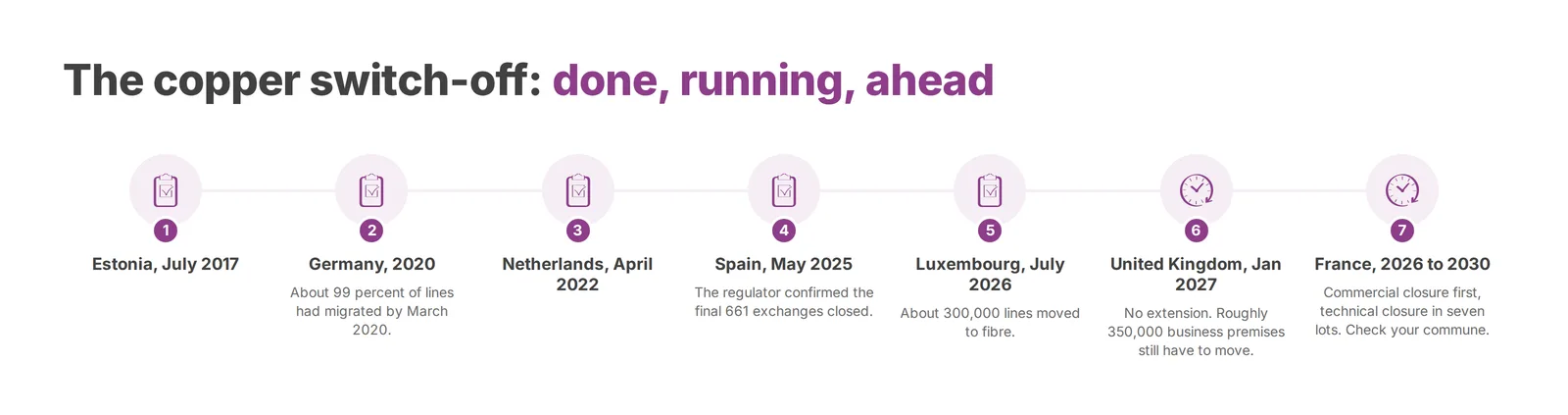
If this decision has a date attached, it is not fashion. The old copper network is being turned off country by country, and when the line into your building stops working, a phone system that depends on it stops working too.
Table 3. PSTN and copper switch-off by country
| Country | Status | Date | Source |
| Estonia | Done | July 2017 | Telia |
| Germany | Done, 99% migrated by March 2020 | 2020 | Deutsche Telekom |
| Netherlands | Done, ISDN stopped | 1 April 2022 | KPN |
| Norway | Done, last call 19 December 2022 | End 2022 | Telenor |
| Spain | Done, final 661 exchanges closed | 27 May 2025 | CNMC, the regulator |
| Luxembourg | Done, about 300,000 lines moved to fibre | 3 July 2026 | POST Luxembourg |
| Switzerland | All-IP migration under way | From 2018 | Swisscom |
| Belgium | Running, area by area, no single national date | Feb 2026 to Jun 2028 | Proximus |
| United Kingdom | Deadline ahead. About 350,000 business premises still on PSTN | 31 January 2027 | Openreach |
| France | Deadline ahead. Seven lots, commercial closure first | 31 Jan 2026 to 2030 | ARCEP, the regulator |
Two of these need a word of explanation.
The UK has the hardest deadline and the least time left. Openreach confirmed in July 2026 that there will be no extension. About 1.5 million lines still have to move, roughly 350,000 of them business premises, and legacy line pricing is rising sharply before the cut.
France has the longest runway and the most confusing one. Commercial closure reached about three quarters of communes on 31 January 2026, but technical closure runs in seven lots until around November 2030. A French business can be told the copper network is closing and also find its own exchange has years left. Check your commune, not the national headline.
We found no reliable national date for Italy, Sweden, Denmark or Finland, so we left them out rather than repeat dates that circulate without a source.
Here are three ways to run business telephony, priced from published tariffs, ex VAT, for 10, 25, 50 and 100 people in Luxembourg, France, Belgium and Germany. One table per company size, so you can go straight to yours.
A. Mobiles only. Everyone gets a business mobile and there is no phone system at all.
B. On-premise PBX. A box in the comms room, desk phones, SIP channels, a maintenance contract and someone to look after it.
C. Cloud PBX. A subscription and a company number, with the maintenance built into the price.
What is measured, and what is assumed. Read this before using the numbers.
Published, verifiable: business mobile tariffs from POST Luxembourg, Bouygues, Proximus and Telekom. Hardware at list price: Yeastar P550 at €1,049 up to 50 users, P560 at €1,499 above, entry desk phones at €104 each. SIP channels at €4.00. Equipment spread over the life the German tax authority assigns it, ten years for a phone system and eight for handsets. Cloud prices from voxbi.com. Staff time costed at the Eurostat 2025 hourly labour cost, which already includes employer social contributions: Luxembourg €56.80, Belgium €48.20 (2024 figure), Germany €45.00, France €44.30.
Assumed, because nothing credible is published: the on-premise maintenance contract at 15% of hardware value per year, and the monthly IT time, at 2, 4, 7 and 12 hours for on-premise against 0.5, 1, 2 and 3 hours for cloud at the four sizes. We searched for a real study of both and found only vendor marketing with no method. Change these two numbers and the answer changes, so they are shown on their own line in every table.
Not counted anywhere: call minutes on the on-premise and per-minute cloud rows. Those are marked "calls extra" and they push the on-premise column up further than shown.
Table 4. Monthly cost for 10 people, ex VAT
| Cost line | Luxembourg | France | Belgium | Germany |
| A. Mobiles only, calls included | €222.20 | €220.00 | €230.00 | €181.30 |
| B. Equipment and SIP lines | €31.58 | €31.58 | €31.58 | €31.58 |
| B. Maintenance contract | €26.11 | €26.11 | €26.11 | €26.11 |
| B. IT time | €113.60 | €88.60 | €96.40 | €90.00 |
| B. On-premise total, calls extra | €171.29 | €146.29 | €154.09 | €147.69 |
| C. Subscription and one number | €55.30 | €55.30 | €55.30 | €55.30 |
| C. Maintenance | in the price | in the price | in the price | in the price |
| C. IT time | €28.40 | €22.15 | €24.10 | €22.50 |
| C. Cloud total, calls extra | €83.70 | €77.45 | €79.40 | €77.80 |
| C. Cloud total, unlimited calls | €150.90 | €144.65 | €146.60 | €145.00 |
| Saved per year against mobiles | €856 | €904 | €1,001 | €436 |
| Saved per year against on-premise | €1,051 | €826 | €896 | €839 |
Table 5. Monthly cost for 25 people, ex VAT
| Cost line | Luxembourg | France | Belgium | Germany |
| A. Mobiles only, calls included | €555.50 | €550.00 | €575.00 | €453.25 |
| B. Equipment and SIP lines | €63.83 | €63.83 | €63.83 | €63.83 |
| B. Maintenance contract | €45.61 | €45.61 | €45.61 | €45.61 |
| B. IT time | €227.20 | €177.20 | €192.80 | €180.00 |
| B. On-premise total, calls extra | €336.64 | €286.64 | €302.24 | €289.44 |
| C. Subscription and one number | €133.30 | €133.30 | €133.30 | €133.30 |
| C. Maintenance | in the price | in the price | in the price | in the price |
| C. IT time | €56.80 | €44.30 | €48.20 | €45.00 |
| C. Cloud total, calls extra | €190.10 | €177.60 | €181.50 | €178.30 |
| C. Cloud total, unlimited calls | €353.30 | €340.80 | €344.70 | €341.50 |
| Saved per year against mobiles | €2,426 | €2,510 | €2,764 | €1,341 |
| Saved per year against on-premise | €1,758 | €1,308 | €1,449 | €1,334 |
Table 6. Monthly cost for 50 people, ex VAT
| Cost line | Luxembourg | France | Belgium | Germany |
| A. Mobiles only, calls included | €1,111.00 | €1,100.00 | €1,150.00 | €906.50 |
| B. Equipment and SIP lines | €114.91 | €114.91 | €114.91 | €114.91 |
| B. Maintenance contract | €78.11 | €78.11 | €78.11 | €78.11 |
| B. IT time | €397.60 | €310.10 | €337.40 | €315.00 |
| B. On-premise total, calls extra | €590.62 | €503.12 | €530.42 | €508.02 |
| C. Subscription and one number | €263.30 | €263.30 | €263.30 | €263.30 |
| C. Maintenance | in the price | in the price | in the price | in the price |
| C. IT time | €113.60 | €88.60 | €96.40 | €90.00 |
| C. Cloud total, calls extra | €376.90 | €351.90 | €359.70 | €353.30 |
| C. Cloud total, unlimited calls | €700.10 | €675.10 | €682.90 | €676.50 |
| Saved per year against mobiles | €4,931 | €5,099 | €5,605 | €2,760 |
| Saved per year against on-premise | €2,565 | €1,815 | €2,049 | €1,857 |
Table 7. Monthly cost for 100 people, ex VAT
| Cost line | Luxembourg | France | Belgium | Germany |
| A. Mobiles only, calls included | €2,222.00 | €2,200.00 | €2,300.00 | €1,813.00 |
| B. Equipment and SIP lines | €220.82 | €220.82 | €220.82 | €220.82 |
| B. Maintenance contract | €148.74 | €148.74 | €148.74 | €148.74 |
| B. IT time | €681.60 | €531.60 | €578.40 | €540.00 |
| B. On-premise total, calls extra | €1,051.16 | €901.16 | €947.96 | €909.56 |
| C. Subscription and one number | €523.30 | €523.30 | €523.30 | €523.30 |
| C. Maintenance | in the price | in the price | in the price | in the price |
| C. IT time | €170.40 | €132.90 | €144.60 | €135.00 |
| C. Cloud total, calls extra | €693.70 | €656.20 | €667.90 | €658.30 |
| C. Cloud total, unlimited calls | €1,336.90 | €1,299.40 | €1,311.10 | €1,301.50 |
| Saved per year against mobiles | €10,621 | €10,807 | €11,867 | €6,138 |
| Saved per year against on-premise | €4,290 | €2,940 | €3,361 | €3,015 |
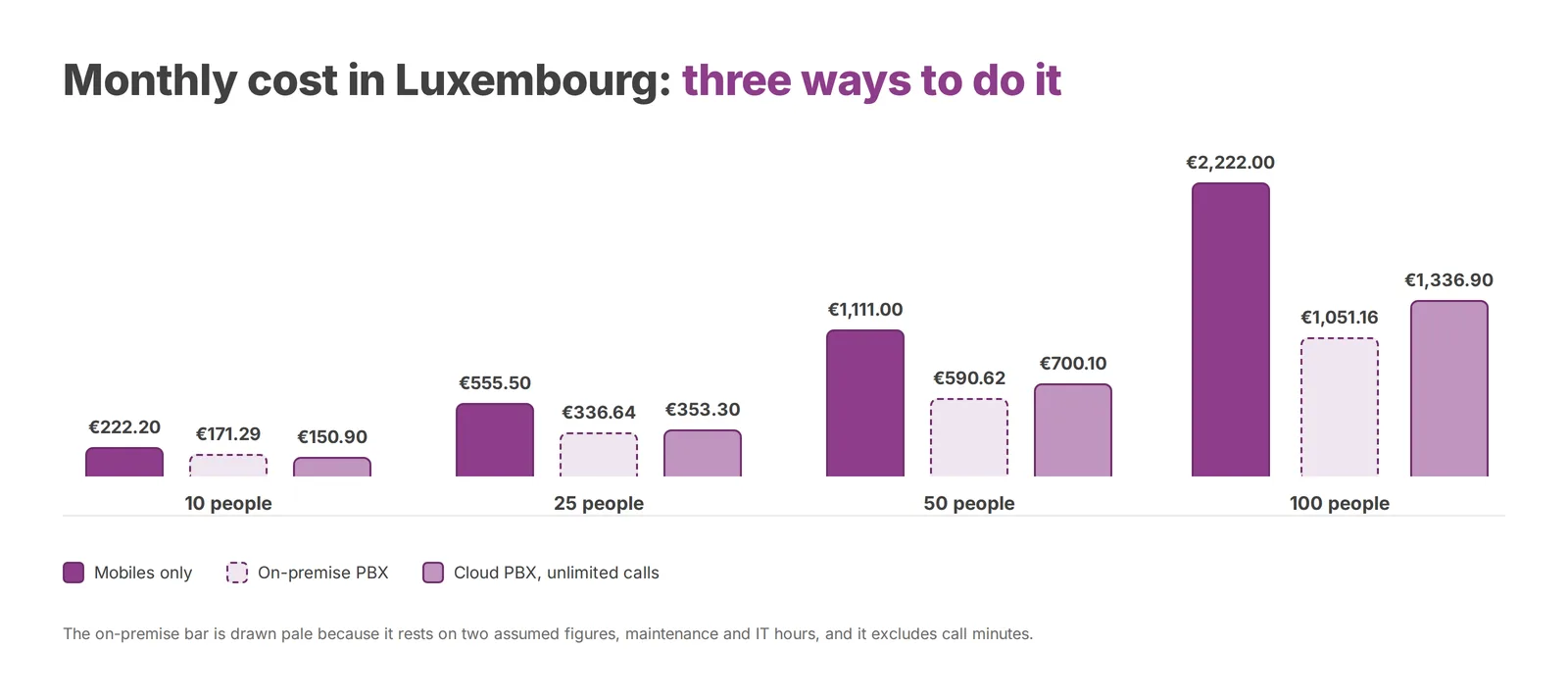
Mobiles are the expensive way to run a phone system. The saving against a cloud PBX with unlimited calls runs from about 32% in Germany to 49% in Belgium. Germany is lowest because German operators discount hard from the second SIM card, so the real per-card cost across a team is well below the headline tariff. And a pile of mobiles still gives you no main company number, no opening-hours greeting, no menu, no queue, and no way to pick up a colleague's ringing line. One fair caveat in the other direction: a mobile plan also buys mobile data, and a cloud PBX does not. Most companies will keep some mobiles either way.
The hardware is not what makes an on-premise system expensive. Look at the equipment line. Spread over its tax life, a phone system for 50 people costs about €115 a month. If the comparison stopped there, the box on the wall would win, and we would rather say that plainly than pretend otherwise.
What makes it expensive is the maintenance contract and the hours. Those two lines are 80% or more of the on-premise total at every size. That is also where the honest uncertainty sits, which is why we put both on their own line rather than burying them in a total. If your maintenance contract is cheaper than 15% a year, or your system genuinely needs almost no attention, run the numbers again with your own figures. Everything you need is in the tables.
The gap grows with headcount. At ten people, moving off an on-premise system saves roughly €800 to €1,050 a year. At a hundred, it is €2,900 to €4,300. The subscription grows with your team, but the maintenance and the hours grow faster.
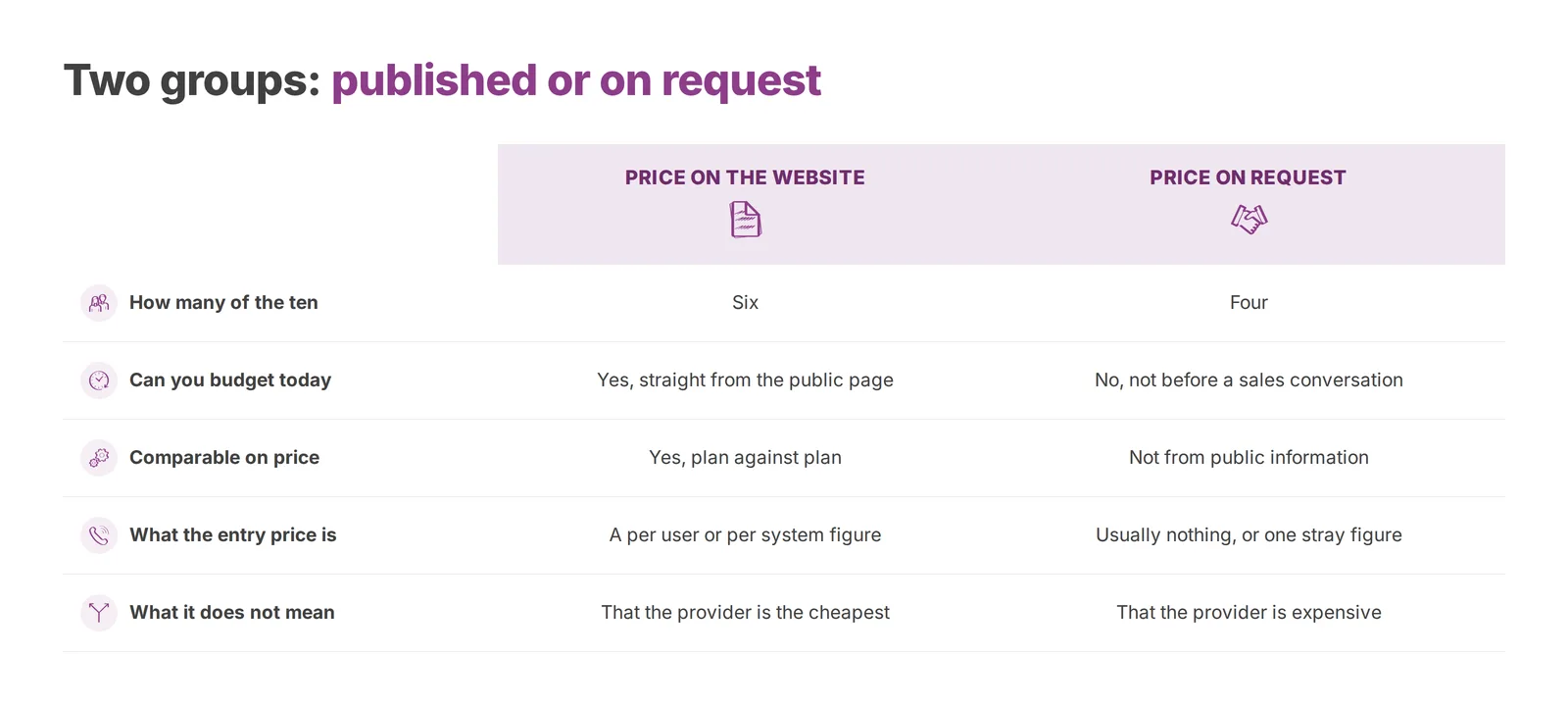
Two groups. Group A publishes its prices, so you can build a budget today without speaking to anyone. Group B sells through partners and quotes on request. That is not a criticism, but it does mean you cannot compare it on price until you are already in a sales conversation. Inside each group the order is alphabetical.
How to read the hosting and compliance line in each card
"European company" and "European hosting" are not the same claim. Wildix is an Estonian company that hosts on AWS in whichever region you pick. 3CX is Cypriot and will happily run in Ohio. If data location is your reason for buying European, ask about the data centre, not the head office.
A claimed certification is not a certificate. Of these ten, only Gamma lets you download one. Enreach publishes one that has expired. Telavox scopes its certificate to part of the organisation. We claim ISO 27001 and do not publish ours either, which is a fair point against us. Ask every vendor, including us, for the certificate, the scope statement and the expiry date.
If you are a regulated financial entity, DORA changes the conversation. Telephony can fall inside your ICT third-party risk perimeter, which turns exit rights, subcontractor lists and audit rights into contract questions rather than technical ones. NIS2 has a similar effect for in-scope sectors, and a provider that will not name its data centre is hard to put in a supplier register.
1. 3CX · Nicosia, Cyprus · 3cx.com
3CX Ltd, founded 2005 by Nick Galea and still founder-owned. HQ at 4 Markou Drakou, Engomi, 2409 Nicosia, with offices in Germany, the USA, Dubai and Australia. Publishes more than 350,000 customers in 190 countries and 12 million daily users.
The model is unlike anything else here. 3CX licenses a phone system by the number of calls happening at the same time, per system per year, with no per-user fee at all. It also does not sell phone numbers. You bring your own SIP trunk.
Entry plan, verified 9 September 2026
Free tier: up to 10 users, 4 simultaneous calls, self-hosted only.
Cheapest paid: Basic, 8 simultaneous calls, up to 40 users, €285 a year for the whole system. Pro €380, AI €550. Hosting by 3CX adds €285 a year at that size. Ex VAT, billed annually.
Included in Basic: call routing, auto attendant, ring groups, call parking, basic reporting, web and mobile apps, live chat.
Not in Basic: call queues, call recording, Microsoft Teams, CRM integrations and API, hot desking, failover, transcription.
**Hosting and compliance:** your choice, and that is the catch. 3CX names Google Cloud, Azure, AWS, DigitalOcean and Vultr across EU and US regions, and OVH as EU only. **Data can leave the EU** depending on what you pick. No support hours, no SLA and no security certification are published anywhere on [3cx.com](http://3cx.com).

**Our disclosure:** we sell certified SIP trunks into 3CX installations, so 3CX is a partner of ours as well as an alternative to us.
2. NFON · Munich, Germany · nfon.com
NFON AG, founded 2007, listed on the Frankfurt Prime Standard as NFN. HQ at Zielstattstraße 36, 81379 München. One of very few pure-play European cloud telephony companies whose accounts you can actually read.
Scale, from its own 2025 results: revenue €89.1m, 647,384 installed seats, blended ARPU €10.01, more than 400 staff and over 54,000 customers across 15 European countries. Local numbers directly available in 13 countries including Germany, France, Belgium, the Netherlands, Spain and the UK.
Entry plan, verified 9 September 2026
Cloud Telefonie Business Standard, €6.80 a month, plus €25 one-off activation. A modular licence module starts at €4.80. Ex VAT, German market.
Calls are not included. Landline 0.9 cents a minute, mobile 9.9 cents. Flat rates are paid add-ons at €3.90 landline only or €8.90 landline and mobile.
Numbers are not included: 10 local numbers cost €19.00 one-off.
Not in the entry plan: softphone (+€4.90), call recording (needs an add-on), HD video and AI summaries, CRM Connect (+€1.80), Microsoft Teams (a separate product).
Caution: NFON's price page says prices are "pro Anlage", per system, while the activation column says "pro Nebenstelle", per extension. The page contradicts itself. Get the unit confirmed before you budget.
**Hosting and compliance:** geo-redundant data centres inside the EU, and NFON states the data **never leaves the EU**. Published SLA of 99.9% on the NFON network and 98% on the web interfaces. Support Monday to Friday 08:00 to 18:00, with 7x24 cover for high-priority faults. ISO 27001 and ISO 9001 are claimed in NFON's knowledge base, but we could not find a live page offering the certificates for download.
3. peoplefone · Zurich, Switzerland · peoplefone.com
peoplefone AG, founded 2005 as a Zurich start-up. HQ at Albisstrasse 107, CH-8038 Zürich. Ownership is not disclosed anywhere on its own site.
Reach: own subsidiaries in seven countries, Switzerland, Germany, Austria, France, Lithuania, Poland and Slovakia, plus certified VoIP provider status in Belgium, Italy, Luxembourg, Spain and the Netherlands. International numbers from more than 60 countries. Publishes 300,000+ business users and 120+ staff.
Entry plan, verified 9 September 2026
vPBX BASIC, CHF 15 a month on a 24-month contract for 1 to 5 users, or CHF 20 on 12 months. For 6 to 10 users it is CHF 25 and CHF 30.
Included: unlimited hunt groups, 1 IVR menu, 1 call queue, 1 time-based routing, 1 manual routing, up to 10 users.
Not in BASIC: softphones, visual call flow editor, analytics. Microsoft Teams, CRM, SMS and call recording are separate add-ons on every tier.
Calls are billed separately. A Swiss flat rate is CHF 39 a month including VAT, or CHF 44 for Switzerland and the EU.
Caution: the price table carries no "per user" label and no VAT note, and the English version of the page drops the table entirely. Confirm the billing unit first.
**Hosting and compliance:** **Switzerland only**, stated plainly, with no storage of call or customer data abroad. For an EU buyer that is a country outside the EU covered by an adequacy decision, which is a deliberate design choice rather than a problem, but it is a choice you should make knowingly. Support Monday to Friday 08:00 to 18:00, first line through the certified installation partner, and **24/7 support is a paid add-on at CHF 160 a month**. No uptime figure published, and no information security certification. The page titled "Zertifizierungen" is about interoperable hardware, not security.
4. Ringover · Montrouge, France · ringover.com
SAS BJT PARTNERS, trading as Ringover, founded 2005 and still controlled by its three founders, with minority backing from BPI France and Orange Ventures. HQ at Immeuble High Line, 8 rue François Ory, 92120 Montrouge, plus London, Barcelona and Atlanta. Publishes more than 14,000 customers, with numbers in 65+ destinations including Luxembourg.
Entry plan, verified 9 September 2026
TALK, €20 per user per month ex VAT on a 12-month commitment, or €29 month to month. Minimum 3 users.
Included: one number per company, unlimited national calls, customisable greeting and opening hours, basic voice menu, call recording with AI transcription and summaries, an AI receptionist, voicemail, and email and phone support.
Not in TALK: numbers in the other 64 countries, international calling, SMS, the 100+ CRM and helpdesk integrations, API, webhooks and SDK, smart routing, power dialer, advanced statistics. There is no SLA on TALK or on the mid tier.
Watch the badge. TALK is marked "Web only": mobile and web apps only, no desktop app.
**Hosting and compliance:** Ringover's GDPR page states every data centre holding service data is **in France**, with no transfer outside the EU or EEA. Its security page separately claims "17 data centers across the globe (including 6 in the US)". Those two statements do not agree, we report both, and we would ask Ringover which one governs call data and recordings. Claims 99.95% reliability; support hours are not published. Ringover publishes **no security certification of its own**. The ISO 27001 it cites belongs to its hosting providers.
5. Telavox · Malmö, Sweden · telavox.com
Telavox AB, org. nr 556600-7786, founded in Malmö around 2002 and still founder-led. HQ at Ångfärjekajen 8, SE-211 19 Malmö, with offices in Stockholm, Aarhus, Helsinki, Oslo, Barcelona and Saintes.
Scale: publishes 1,000,000+ active users and revenue "+180 million EUR", though not the year. Operates in Sweden, Denmark, Finland, Norway, the UK, France and Belgium, and supplies numbers in those plus the Netherlands, each with local registration requirements.
Entry plan, verified 9 September 2026
Fixed Premium, 249 SEK per user per month. We quote Swedish krona because that is what Telavox publishes. The UK page renders the same krona figures with a pound sign, which is a bug, so ignore it.
Included: calls via fixed line and softphone, admin portal, PBX routing features, free internal calls worldwide, apps for mobile, desktop and Teams, and 500 minutes of AI Assist.
Not in Fixed Premium: call recording, CRM integrations, custom integrations and API, the Microsoft Teams integration, ticketing, advanced statistics and "all PBX functionality". Those sit in Fixed Max, priced on request.
Caution: the price page states no VAT basis, no minimum term, and does not say whether a number is included.
**Hosting and compliance:** the most specific disclosure of the ten, and it deserves credit. Telavox names its actual hosting suppliers, **Kraftringen, Equinix Sweden and Digital Realty Sweden**, so Swedish data centres, with traffic records on Google Cloud EMEA and all standard storage inside the EU or EEA. Support Monday to Friday 07:00 to 18:00 by phone and email with a 24-hour response commitment, and a trust centre claim of **99.98% uptime**. ISO 27001, but scoped to the "product and R&D organization" rather than the whole group, and no certificate is published.
6. Voxbi, that is us · Steinsel, Luxembourg · voxbi.com
Operated by Mixvoip SA, RCS B138372, HQ at Rue des Prés 70, 7333 Steinsel. We are registered as an electronic communications operator with ILR in Luxembourg, IBPT in Belgium, the Bundesnetzagentur in Germany and ARCEP in France, through local entities in each country. We run our own network rather than reselling someone else's.
Two ways to buy. Voxbi One is self-service and you run it yourself. Voxbi Managed is run by our team, and it is the only line with phone support and an SLA.
Entry plan, verified 9 September 2026
Voxbi Free, €0, up to 3 users, with 2 phone numbers included, 2 calls at a time, €0.70 of monthly call credit and emergency calling. Activation needs a card and an ID check.
Cheapest paid seat: Voxbi Starter, €1.20 per user per month, unlimited users, one call at a time per user, porting in.
Numbers cost €1.60 a month each on Voxbi One and are not included in any paid plan.
Not on any Voxbi One plan: phone support, or an SLA with downtime credit. Both are Managed only. Microsoft Teams costs +€50 a month. Odoo, Microsoft 365 and API access start at Voxbi Plus, €2.90 a user.
Managed entry: Voxbi Essential, €5.20 per user per month with calls per minute, or €11.60 with unlimited calls. The company number is €3.30 or €6.50 depending on which you pick.
**Hosting and compliance:** built and hosted in the European Union, with calls and data staying inside EU borders. Voxbi One is **email support only**; Managed adds phone support and an SLA with downtime credit at four service levels. We claim ISO 27001 on the Mixvoip accreditations page along with the "Cybersecurity Made in Europe" label, but **we do not publish the certificate number or its validity dates**, which is exactly the gap we flag for NFON and Telavox above.

**Where our published information is thin:** [voxbi.com](https://www.voxbi.com) lists self-service number availability in Germany, France, the Netherlands, Spain, Italy and Portugal. If you need a number somewhere else, including Luxembourg or Belgium, ask us rather than assume.
7. Dstny · Zaventem, Belgium · dstny.com
Dstny BE NV, enterprise number 0442.894.476, HQ at Belgicastraat 17, 1930 Zaventem. Founded 2008 as Destiny by Samuel and Daan De Wever, now owned by the private equity fund Apax Partners, since rebranded Seven2.
Scale, self-published: 20,000+ customers, 3 million+ business users, 1,000 staff across seven countries and €250 million annual turnover. Operates in Belgium, the Netherlands, France, Germany, Sweden, Denmark and the UK.
Entry plan, verified 9 September 2026
No public pricing published. There is no pricing page on the Belgian or the group site, and every route ends in a request for advice.
The one euro figure Dstny publishes anywhere is "from €10 a month per concurrent call" on its Business Communications page. That applies to fixed telephony and is priced per channel, not per user, with no VAT basis or contract term stated beside it.
Contract length is the thing to watch. Dstny's general conditions default to an initial period of 36 months where the order form does not state one, then renew annually with three months' notice.
**Hosting and compliance:** described only as "secure, European infrastructure". **No country or data centre is named**, and the general conditions allow personal data to be processed outside the EEA where the destination is judged adequate. No published support hours and no SLA percentage; the conditions refer to "the applicable SLA" without giving an availability figure. ISO 9001, 27001 and 27701 were announced by **Dstny Sweden**, and whether that scope covers the Belgian entity is not stated. No certificate is published.
8. Enreach · Almere, Netherlands · enreach.com
Enreach Holding B.V., formed in 2018 by combining Voiceworks, Swyx and Centile behind Waterland Private Equity, and grown by more than fifteen acquisitions since. Headquarters given as Verlengde Duinvalleiweg 102, 1361 BR Almere, which we took from its own privacy statements because Enreach publishes no imprint page. The German operation, carrying the Swyx brand, sits at Robert-Bosch-Straße 1, 44803 Bochum.
Scale: 900+ staff and 2.6 million+ users, active in Austria, Denmark, France, Germany, Italy, Latvia, the Netherlands, Spain, Sweden, Switzerland and the UK. If you have seen Swyx in a German office, this is who owns it now.
Entry plan, verified 9 September 2026
No public pricing published. Enreach sells entirely through partners. The Swyx Flex page describes a monthly subscription with "no high one-time costs" but publishes no figure.
German distributors list Swyx Flex per-user rental licences in their own catalogues. Those are distributor prices, not Enreach's, so we have not reproduced them.
**Hosting and compliance:** the Enreach Contact privacy statement says all data sits on servers within the **EEA**, while the general privacy statement adds that Enreach may transfer personal data outside the EEA under standard contractual clauses. EEA by default, with a written reservation. Nothing on support hours or SLA is published at group level, so those terms sit with your reselling partner and are worth pinning down in writing. ISO 9001 and ISO 27001 are claimed, but the certificate Enreach publishes, DNV number C752281, **ran from 15 March 2023 to 14 March 2026 and has expired**. Ask for the current one.
9. Gamma Communications · Manchester and Newbury, UK · gammagroup.co
Gamma Communications plc, company number 08943488, registered office Arbeta, 11 Northampton Road, Manchester M40 5BP, principal place of business Kings House, Kings Road West, Newbury RG14 5BY. Listed on the London Stock Exchange main market since May 2025 and in the FTSE 250 since June 2025, ticker GAMA.
By seat count this is the largest company in the list. 2025 revenue £645.8m, up 11%, adjusted EBITDA £141.7m, over 2,000 staff and 1,798,000 cloud seats: 1,087,000 in the UK and 711,000 in Europe, of which 594,000 in Germany. It owns STARFACE and Placetel in Germany and the former VozTelecom in Spain, and also operates in the Netherlands and Ireland.
Entry plan, verified 9 September 2026
No public pricing published on gammagroup.co. There is no pricing page.
The only first-party price Gamma publishes anywhere is on the UK government's G-Cloud 14 framework, where Gamma Network Solutions lists the Horizon platform at £5.50 a licence. That is public-sector framework pricing and is not a market rate. The listing does describe the service: inclusive UK local, national and mobile calls, call queuing, auto attendant, voicemail to email, conferencing and a 30-day trial.
Minimum term and minimum seats for commercial Horizon are not published.
**Hosting and compliance: the best disclosure of the ten, and we say that as a competitor.** Hosting in the **United Kingdom** per Gamma's own G-Cloud service definition, which for an EU buyer means relying on the UK adequacy decision. A **24/7** support desk with a published phone number. SLA from the G-Cloud listing: core service 99.95%, interface 99.9%, user subscriptions 99.5%, severity response targets from 30 minutes. ISO/IEC 27001:2022, ISO 22301:2019, ISO 9001, ISO 14001, BS 10008 and Cyber Essentials Plus, **with the certificates downloadable** from its accreditations page.
10. Wildix · Tallinn, Estonia · wildix.com
Wildix OÜ, Estonian registry code 12915667, HQ at Laeva tn. 2, 10111 Tallinn, with the operations office in Trento, Italy. Founded 2005 by brothers Dimitri and Steve Osler, who still lead it. The Baltic fund Livonia Partners announced a strategic investment in December 2023, with the stake size undisclosed.
Scale: the site publishes 1.2 million users and 45,000 businesses, while the Livonia announcement cited nearly 2 million users across 135 countries and 280+ staff. Sold entirely through partners. Numbers come via its own CLASSOUND service, which claims local numbers in 100+ countries without publishing the list.
Entry plan, verified 9 September 2026
No public pricing published. The page headed "Pricing" lists four licence tiers with their features and contains no currency figure anywhere.
The cheapest user licence is UC-Essential: 4 concurrent calls and 10 devices per user, web, mobile and desktop apps, chat and internal web meetings. PBX-Basic sits below it but is for unattended phones, not people.
Not in UC-Essential: customer-facing web meetings and WebRTC links, AI transcription and summaries, business integrations such as HubSpot, Salesforce and Zoho, and two-way SMS. Contact-centre reporting needs the top tier.
Billing monthly, yearly or over five years. Minimum users and minimum term are not published.
**Hosting and compliance:** AWS, with a dedicated single-tenant instance per customer and a **region chosen by the customer**. There is **no EU-only guarantee**, so where your data sits is a question for your partner rather than a property of the product. No published support hours, and end-user support comes from the partner. Wildix publishes availability figures of 99.99% for its services and 99.999% for CLASSOUND. SOC 2 Type 1 and Type 2 are available through the trust centre after signing an NDA. Read the ISO wording carefully: the ISO 27001 and ISO 22301 Wildix refers to are held by **the data centres**, not by Wildix.
We would rather you picked the right system than picked ours. So here is the short version of when we are a good answer.
Talk to us if
You want an operator, not a reseller. We run our own network and hold operator registrations with the regulator in Luxembourg, Belgium, Germany and France. When something breaks, the fix is ours to make.
You want your data to stay in the EU. Voxbi is built and hosted in the European Union, and calls and data stay inside EU borders. No region picker, no reservations in the small print.
You want the lowest possible seat price and you are happy to run it yourself. Voxbi Starter at €1.20 a user is the cheapest paid seat in this article by a wide margin, and Voxbi Free is a working system for three people with two numbers included, not a time-limited trial.
You use Odoo. Call logging into the contact record and live caller lookup are built in from Voxbi Plus.
You would rather pay for the calls you make. Most plans here bundle a flat rate whether you use it or not. We publish both, per-minute and unlimited, so you can pick the cheaper one for your actual traffic.
You need phone support and an uptime guarantee. That is Voxbi Managed, from €5.20 a user. It is not on the self-service plans, and we would rather tell you that now than at the point you need help.
This is where budgets break. Every point below comes from the ten providers above.
1. The number is usually not included. We charge €1.60 a month per number on self-service and €3.30 or more on Managed. NFON charges €19 one-off for ten numbers. Ringover includes exactly one number for the whole company on its entry plan, not one per person. If you have priced a 25-person system on seat cost alone, you have not priced it.
2. One number per company is not one number per person. Ringover TALK gives one per company, and one per user only from the mid tier. Our paid plans include none at all. Decide early whether your people need direct dial, because it moves the total more than the seat price does.
3. Minimum seats and minimum channels. Ringover requires three users. Our own Channel plan requires three channels, so €43.50 a month before anyone speaks. peoplefone prices in bands of one to five and six to ten, so a sixth hire raises the bill by two thirds. Look at the step, not just the rate.
4. Contract length, and what leaving costs. Dstny's general conditions default to 36 months when the order form is silent. Ringover's entry price needs a 12-month commitment, and month to month costs 45% more. peoplefone's best price needs 24 months. 3CX is annual. Read the exit clause, not just the term.
5. The upgrade trigger. Look at what is missing from the cheapest tier, because that is what you will pay for in month four. Across these ten, the things most often held back are call recording, CRM integration, API access and Microsoft Teams. On 3CX Basic even call queues are missing. On our own entry plan it is phone support and the SLA.
6. Support is sometimes a separate product. peoplefone charges CHF 160 a month for 24/7 cover. Gamma includes 24/7 in the service. We give no phone support at all on self-service. Those are three genuinely different offers, whatever the headline price says.
7. Calls. NFON, peoplefone, 3CX and our own standard plans all bill calls per minute on top of the seat. Ringover and Telavox include national calling. A plan that looks expensive per seat can be the cheaper one once your real minutes are in the model.
Ask these of any provider, us included.
What is the total monthly cost for exactly our headcount, including every phone number, with VAT shown separately?
Is a phone number included, and is it one per company or one per person?
What is the minimum contract term, and what does it cost to leave in month seven?
Which country are the servers in, and can call recordings leave the EU under any circumstances?
Can you send me the ISO 27001 certificate, its scope statement and its expiry date?
What availability figure is in the contract, and what is the credit if you miss it?
What are the support hours, is phone support included at this price, and what is the response time for a total outage?
Which of the features we have just discussed are not in this plan?
If we leave, how do we take our numbers, our recordings and our call history with us?
Our copper line is being switched off. What exactly do we need on site on the day, and who pays for it?
We are publishing this in full, because a comparison is only as good as its worst-sourced line.
The most-quoted statistic in this industry does not exist. There is no official EU figure for cloud PBX adoption. We have not published one, and nobody else should without naming a paid report.
The split between on-premise and hosted extensions in Europe. MZA Ltd measures it and the figure is behind a paywall. We will not infer it from general cloud adoption.
The number of business fixed lines in the EU. Not published by Eurostat, BEREC or any regulator we checked. The only hard figure anywhere is the UK's roughly 350,000 business premises still on PSTN.
Annual maintenance as a share of PBX hardware value. Every search result was vendor marketing with no method. We used 15% a year as a stated assumption and put it on its own line so you can replace it.
Hours a month spent administering a phone system. No credible European study exists. Our figures are assumptions, shown separately in every table for the same reason.
NFON's price unit, per system or per extension. Its own page says both.
Ringover's hosting, France only or 17 global data centres. Its own pages say both.
peoplefone's billing unit and VAT basis. Not on the price table, and the English page drops the table.
Telavox's VAT basis, minimum term, and whether a number is included. None are on the price page.
Whether Dstny's ISO certificates cover the Belgian entity. They were announced by the Swedish one.
Enreach's current ISO 27001. The published certificate expired in March 2026.
Switch-off dates for Italy, Sweden, Denmark and Finland. Dates circulate. Sources do not.
Our own ISO 27001 certificate number and validity. Claimed on the Mixvoip accreditations page, not published. We are fixing that.
Of the ten here, the cheapest paid seat is our own Voxbi Starter at €1.20 per user per month, and Voxbi Free is €0 for up to three users. But seat price is a poor way to choose, because numbers, calls and support are priced separately and vary enormously between providers. 3CX is cheapest in a completely different way: €285 a year for an entire 8-call system, with no per-user fee at all.
On our figures, yes, but not because of the hardware. Spread over its tax life, a phone system for 50 people costs about €115 a month, which is cheap. The cost is in the maintenance contract and the staff hours. Once both are counted, a cloud system saves roughly €800 to €1,050 a year at ten people and €2,900 to €4,300 at a hundred. If your maintenance is cheaper than 15% a year, or your system needs almost no attention, rerun the tables with your own numbers.
Yes, clearly. On published business mobile tariffs, ten people on mobiles cost €181 to €230 a month depending on the country, against €150.90 or less for a cloud PBX with unlimited calls and the IT time included. The saving is 32% to 49%, and mobiles still give you no company number, no menu and no queue.
It depends on the country, and in several it has already happened. Germany finished in 2020, the Netherlands in 2022, Spain in May 2025 and Luxembourg in July 2026. The United Kingdom has a hard deadline of 31 January 2027. France runs in lots until around 2030. Belgium is going area by area between 2026 and 2028.
Of the ten, NFON and Voxbi both state that data never leaves the EU, and Telavox names Swedish data centres with EU or EEA storage. Ringover says France only on one page and contradicts it on another. Gamma hosts in the UK and peoplefone in Switzerland, both outside the EU but covered by adequacy decisions. 3CX and Wildix let you choose the region, including regions outside the EU. Dstny names no country at all.
Usually not straight away. Every provider here offers computer and mobile apps, and most support common SIP desk phones you may already own. If you do buy, entry models list around €104 and mid-range between €238 and €279, and a phone is normally written off over eight years.
Yes. Number portability is a legal right across the EU, and every provider here supports porting in. Entry plans differ though: our own Voxbi Free does not allow porting in, while the paid plans do. Ask who pays for the port and how long it takes.
A cloud PBX replaces the phone system: numbers, extensions, menus, queues, voicemail. UCaaS, unified communications as a service, wraps that together with chat, video meetings and presence. Most providers here now sell the second and call it the first.
PBX: private branch exchange, the system that routes calls inside a company and connects it to the public network.
Cloud PBX or hosted PBX: the same job, run by a provider, reached over the internet and paid monthly.
UCaaS: unified communications as a service. A cloud PBX plus chat, video and presence.
SIP trunk: the connection carrying calls between a phone system and the public network, replacing ISDN lines.
Channel or concurrent call: one call happening at one time. Systems priced per channel, such as 3CX and Voxbi Channel, charge for these instead of for people.
Extension: an internal number for one person or device.
DID or DDI: direct inward dialling, a public number that rings one person directly.
IVR: the recorded menu that says "press 1 for sales".
PSTN and ISDN: the old public and digital telephone networks now being switched off.
Porting: moving an existing number from one provider to another.
E112: the European emergency calling requirement, including passing your location. Worth checking on any plan used away from the office.
Every provider fact here was read from that provider's own website, price list, terms or investor material on 9 September 2026. Where a page renders prices only in a browser, we opened it in a browser rather than reporting an empty result. Where a provider publishes no price, we wrote that instead of quoting a reseller.
Market and regulatory figures come from primary sources: Eurostat for cloud adoption, enterprise counts and labour cost; ARCEP, CNMC and the Bundesnetzagentur for network and switch-off data; Openreach, Proximus, POST Luxembourg, KPN, Telenor and Swisscom for operator announcements; Destatis for sector labour cost; the German federal finance ministry's depreciation tables for equipment life. The single analyst estimate we use, for European UCaaS seats, is attributed to Frost & Sullivan and labelled as an estimate.
Prices change. If you are reading this well after September 2026, check the figure before relying on it. If we have got something wrong, tell us and we will correct it.
Which cloud PBX providers actually integrate with Odoo, how each one connects, what the integration costs and where call recordings are stored.
Entry prices compared with numbers, calls and support added back in, because the headline seat price is never the total. Ten providers priced.
A 90-day cloud PBX migration guide for European companies. Diagnose the ground, train by user profile, deploy in waves with written go/no-go criteria, and measure adoption once the system is live.
Talk to us or to a certified Voxbi partner.